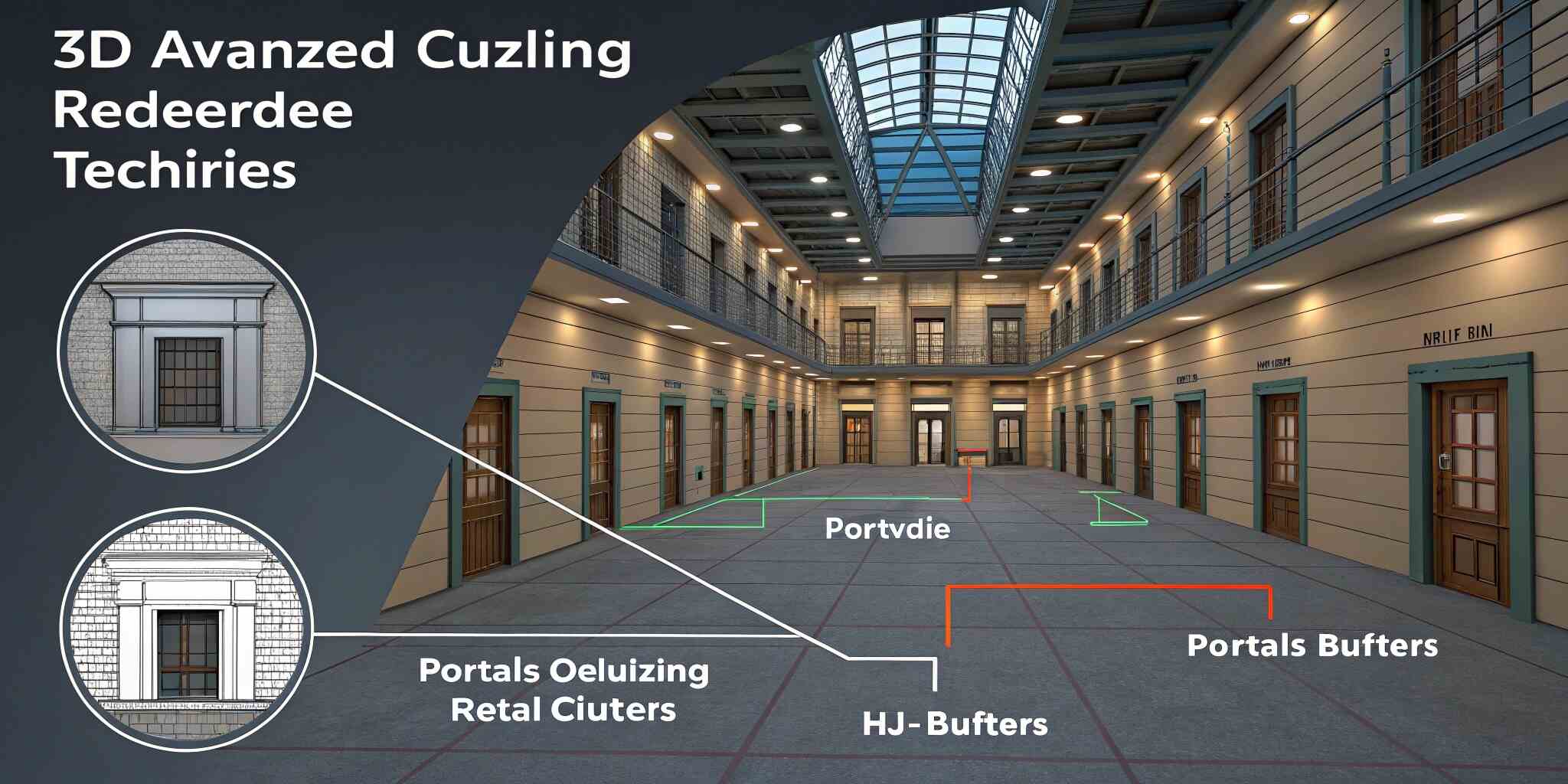
As modern games push toward larger worlds, denser geometry, and higher visual fidelity, rendering performance becomes a critical bottleneck. Simply drawing everything in the camera’s frustum is no longer viable. To maintain high frame rates, game engines rely heavily on advanced occlusion culling techniques that determine which objects are actually visible to the player. Among the most effective methods are portal culling, hierarchical Z-buffers (Hi-Z), and clustered rendering. When combined, these techniques dramatically reduce GPU workload while preserving visual accuracy.
Occlusion culling focuses on skipping geometry that is fully hidden behind other objects. Traditional frustum culling only removes objects outside the camera view, but occlusion culling removes objects that are inside the view yet blocked by walls, terrain, or structures. This distinction is crucial in dense environments such as cities, interiors, or large procedural worlds where most objects are technically in view but not visible.
Portal-based occlusion culling is one of the oldest and most reliable techniques, particularly effective for indoor or segmented environments. In this approach, the world is divided into connected regions such as rooms, corridors, or zones. Visibility is restricted through portals, which are predefined openings like doors, windows, or archways. If a portal is not visible, everything beyond it can be safely culled. Portal systems are computationally inexpensive and highly deterministic, making them ideal for structured levels. However, they require careful level design and preprocessing, which limits their flexibility in highly dynamic or open environments.
For more general-purpose visibility determination, modern engines rely on Hierarchical Z-Buffers, commonly referred to as Hi-Z buffers. A Hi-Z buffer stores depth information at multiple resolutions, allowing the GPU to quickly test whether an object is occluded by already-rendered geometry. Instead of performing expensive per-pixel depth tests, the engine can compare an object’s bounding volume against a coarse depth representation. If the object lies entirely behind the depth buffer, it is culled before any detailed rendering occurs.
Hi-Z culling is especially powerful because it operates fully on the GPU and scales well with scene complexity. It is well-suited for outdoor scenes, procedural worlds, and highly dynamic environments where manual culling structures are impractical. However, Hi-Z culling is most effective when combined with depth pre-passes, which ensure that the depth buffer accurately represents the scene early in the frame.
Clustered rendering complements occlusion culling by optimizing how visible objects are processed once visibility is determined. In clustered rendering, the view frustum is divided into three-dimensional clusters rather than simple screen tiles. Objects and lights are assigned to these clusters, allowing the engine to process only the data relevant to each region of space. This approach significantly reduces overdraw, minimizes shading cost, and improves memory locality on the GPU.
When combined with occlusion culling, clustered rendering ensures that only visible geometry is shaded, lit, and post-processed. This is particularly important in scenes with many dynamic lights, particle effects, or volumetric elements. By limiting work to visible clusters, engines avoid wasting GPU cycles on geometry that would ultimately be discarded.
The real power of advanced occlusion culling emerges when these techniques are layered together. Portal culling provides coarse, low-cost visibility pruning in structured environments. Hi-Z buffers handle fine-grained occlusion in dynamic and open spaces. Clustered rendering ensures that the remaining visible geometry is processed efficiently. Together, they form a multi-stage visibility pipeline that scales gracefully from small interiors to massive open worlds.
From a performance perspective, the benefits are substantial. Reducing overdraw lowers fragment shader execution, which is often the most expensive part of the rendering pipeline. Memory bandwidth usage decreases, GPU cache efficiency improves, and CPU-to-GPU submission overhead is reduced. These gains translate directly into higher frame rates, more stable performance, and the ability to push higher visual fidelity.
Looking forward, occlusion culling continues to evolve alongside GPU-driven rendering techniques such as mesh shaders and indirect draw calls. Visibility determination is increasingly handled entirely on the GPU, reducing CPU bottlenecks and enabling massive scene complexity. As worlds grow larger and more detailed, advanced occlusion culling will remain a cornerstone of real-time rendering performance.
In conclusion, advanced occlusion culling using portals, Hi-Z buffers, and clustered rendering is not a luxury but a necessity for modern game engines. These techniques allow developers to render only what truly matters, making ambitious visual experiences possible without sacrificing performance.