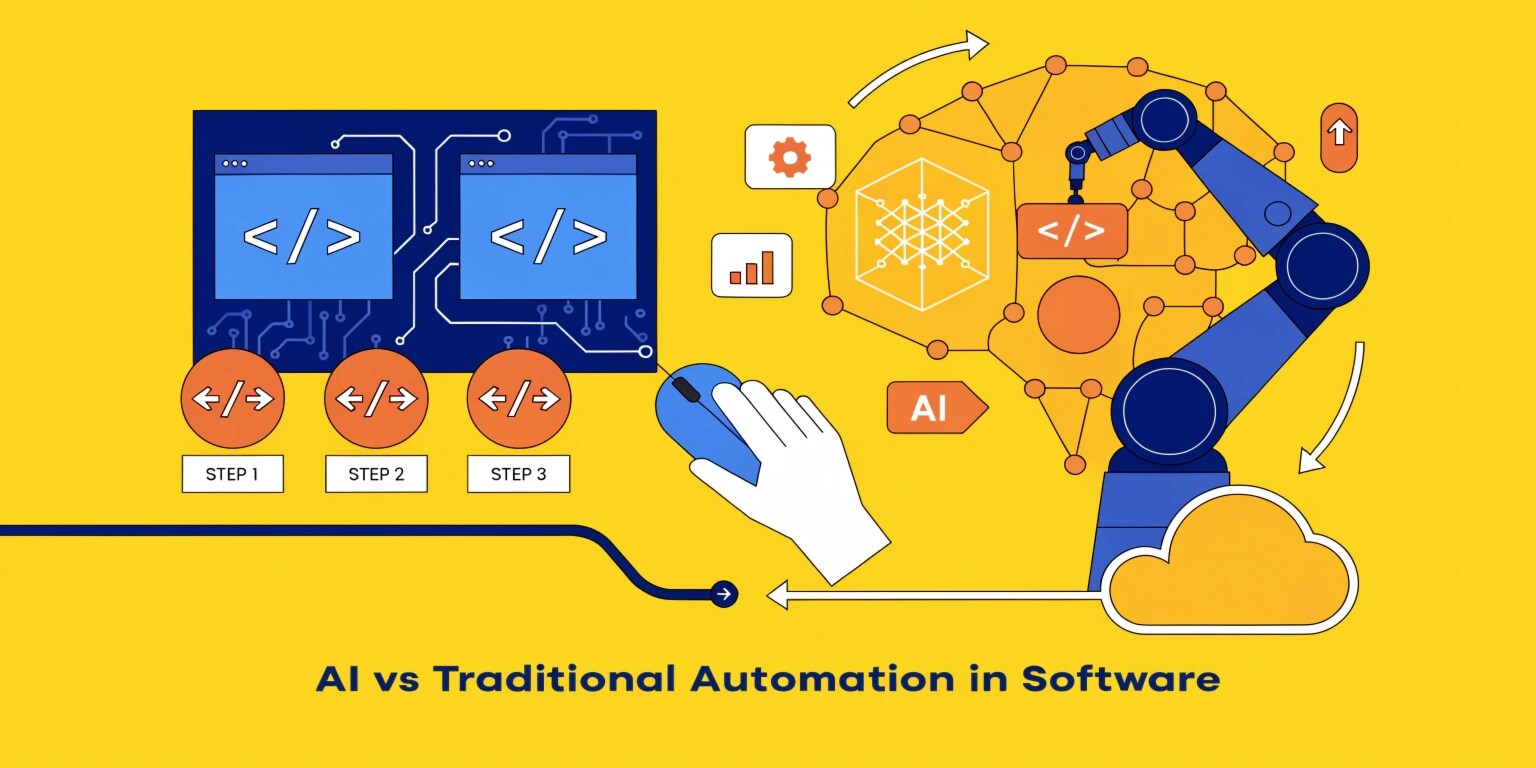
Automation has become one of the most important drivers of digital transformation across industries. Businesses increasingly rely on software automation to improve efficiency, reduce operational costs, minimize human errors, and accelerate workflows.
For many years, traditional automation systems dominated enterprise operations by executing predefined tasks through fixed rules and programmed workflows. However, the rapid advancement of artificial intelligence is introducing a new generation of intelligent automation systems capable of learning, adapting, and making decisions dynamically.
Today, organizations face an important technological question:
Should they rely on traditional automation or adopt AI-powered automation systems?
Understanding the differences between AI automation and traditional automation is critical for businesses, developers, and technology leaders building future-ready software systems.
While both approaches aim to improve operational efficiency, they differ significantly in:
- Intelligence
- Flexibility
- Scalability
- Decision-making capabilities
- Adaptability
- Data processing abilities
As AI technologies continue evolving, intelligent automation is becoming increasingly central to enterprise software development and digital business strategies.
What is Traditional Automation?
Traditional automation refers to software systems that execute tasks based on predefined rules and structured workflows.
These systems follow:
- Fixed instructions
- Conditional logic
- Programmed actions
- Repetitive workflows
Traditional automation works best for:
- Predictable tasks
- Structured data
- Repetitive operations
- Stable environments
Examples include:
- Payroll processing
- Form submissions
- Database synchronization
- Workflow approvals
- Invoice generation
- Scheduled backups
Traditional automation systems are highly reliable when processes remain consistent and rule-based.
What is AI-Powered Automation?
AI-powered automation combines automation with artificial intelligence technologies such as:
- Machine learning
- Natural language processing
- Predictive analytics
- Computer vision
- Generative AI
Unlike rule-based systems, AI automation can:
- Learn from data
- Adapt to changing conditions
- Recognize patterns
- Make predictions
- Handle unstructured information
- Improve performance over time
AI systems can automate more complex tasks involving:
- Decision-making
- Human language understanding
- Image recognition
- Customer interactions
- Predictive analysis
This creates more flexible and intelligent software environments.
Key Difference: Rules vs Learning
The biggest difference between traditional automation and AI automation is how decisions are made.
Traditional Automation
Uses:
- Static rules
- Hardcoded logic
- Fixed workflows
Behavior remains predictable unless manually updated.
AI Automation
Uses:
- Learning algorithms
- Data-driven models
- Adaptive intelligence
Behavior evolves based on new data and experiences.
AI systems can improve automatically without requiring complete manual reprogramming.
Structured vs Unstructured Data
Traditional automation performs best with structured data such as:
- Tables
- Forms
- Databases
- Spreadsheets
AI systems can process both structured and unstructured data, including:
- Emails
- Images
- Audio
- Videos
- Natural language text
- Customer conversations
This makes AI automation far more versatile in modern digital environments.
Adaptability and Flexibility
Traditional automation struggles when workflows change frequently.
Any process modification often requires:
- Reprogramming
- Workflow redesign
- Manual configuration updates
AI-powered systems adapt more dynamically.
For example:
- AI chatbots can understand new customer questions
- Fraud detection systems can identify evolving attack patterns
- Recommendation engines continuously improve personalization
This adaptability is one of AI automation’s biggest advantages.
Decision-Making Capabilities
Traditional automation follows predefined decision trees.
It cannot:
- Interpret ambiguity
- Analyze complex context
- Handle unpredictable scenarios effectively
AI automation enables intelligent decision-making through:
- Pattern recognition
- Predictive modeling
- Context analysis
- Probabilistic reasoning
For example:
- AI systems can predict customer churn
- Recommend products
- Detect anomalies
- Optimize workflows automatically
This creates smarter and more autonomous software systems.
Role in Customer Experience
AI-powered automation is significantly improving customer interactions.
Traditional customer support automation often relies on:
- Scripted responses
- Fixed workflows
- Basic FAQs
AI-powered systems provide:
- Conversational interactions
- Context-aware responses
- Personalized recommendations
- Sentiment analysis
Companies such as OpenAI and Microsoft are helping organizations integrate AI copilots and conversational systems into enterprise applications.
AI-driven customer experiences are becoming increasingly natural and intelligent.
Scalability Differences
Traditional automation scales efficiently for repetitive tasks but becomes limited when:
- Data complexity increases
- Business conditions change
- Dynamic decisions are required
AI automation scales more effectively in:
- Complex environments
- Large datasets
- Adaptive workflows
- Real-time decision systems
AI systems improve with larger data volumes and continuous learning.
Cost and Implementation Complexity
Traditional automation is generally:
- Easier to implement
- Less expensive initially
- Faster for simple workflows
However, maintaining complex rule-based systems at scale can become difficult.
AI automation often requires:
- Large datasets
- Model training
- Advanced infrastructure
- AI expertise
- Ongoing optimization
Initial implementation costs may be higher, but long-term efficiency gains can be substantial.
AI and Robotic Process Automation (RPA)
Robotic Process Automation (RPA) is a popular form of traditional automation.
RPA bots typically:
- Mimic human actions
- Follow structured workflows
- Automate repetitive business tasks
Modern intelligent automation increasingly combines:
- RPA
- AI models
- Machine learning
- Predictive analytics
This hybrid approach creates more advanced automation systems capable of handling complex workflows.
Use Cases of Traditional Automation
Traditional automation remains highly effective for:
- Payroll systems
- Invoice processing
- Data entry
- Inventory tracking
- System monitoring
- Scheduled workflows
These tasks benefit from predictable execution and structured processes.
Use Cases of AI Automation
AI automation excels in:
- Fraud detection
- Predictive maintenance
- Recommendation systems
- AI chatbots
- Image recognition
- Intelligent search
- Healthcare diagnostics
- Cybersecurity analysis
These applications require adaptability and contextual understanding.
Challenges of AI Automation
Despite its advantages, AI automation introduces several challenges.
Data Dependency
AI systems require large amounts of quality data.
Bias Risks
Poor training data may create biased outcomes.
Explainability Problems
AI decisions may be difficult to interpret.
Infrastructure Requirements
AI systems often require powerful computing resources.
Ethical Concerns
Privacy and responsible AI governance remain major considerations.
Organizations must balance innovation with accountability.
Future of Intelligent Automation
The future of software automation will likely combine:
- Traditional rule-based systems
- AI-driven intelligence
- Autonomous decision-making
- Real-time analytics
- Adaptive workflows
Businesses increasingly adopt hybrid automation strategies to maximize efficiency and flexibility.
Future intelligent applications may include:
- Self-optimizing workflows
- AI copilots
- Autonomous business operations
- Predictive enterprise systems
AI will continue transforming how software systems operate and evolve.
Choosing the Right Automation Approach
The best automation strategy depends on:
- Business goals
- Process complexity
- Data availability
- Scalability needs
- Budget constraints
Traditional automation remains valuable for stable and repetitive processes.
AI automation is more suitable for:
- Dynamic environments
- Complex decision-making
- Personalized experiences
- Predictive systems
Many organizations benefit most from combining both approaches strategically.
Conclusion
AI-powered automation and traditional automation both play critical roles in modern software systems. While traditional automation remains highly effective for repetitive and rule-based tasks, AI automation introduces adaptability, intelligence, and advanced decision-making capabilities.
As digital transformation accelerates, businesses increasingly require automation systems that can learn, predict, and optimize operations dynamically. Intelligent automation powered by AI is rapidly becoming the next evolution of enterprise software.
Organizations that successfully integrate both traditional and AI-driven automation strategies will gain significant advantages in efficiency, scalability, innovation, and customer experience in the future digital economy.