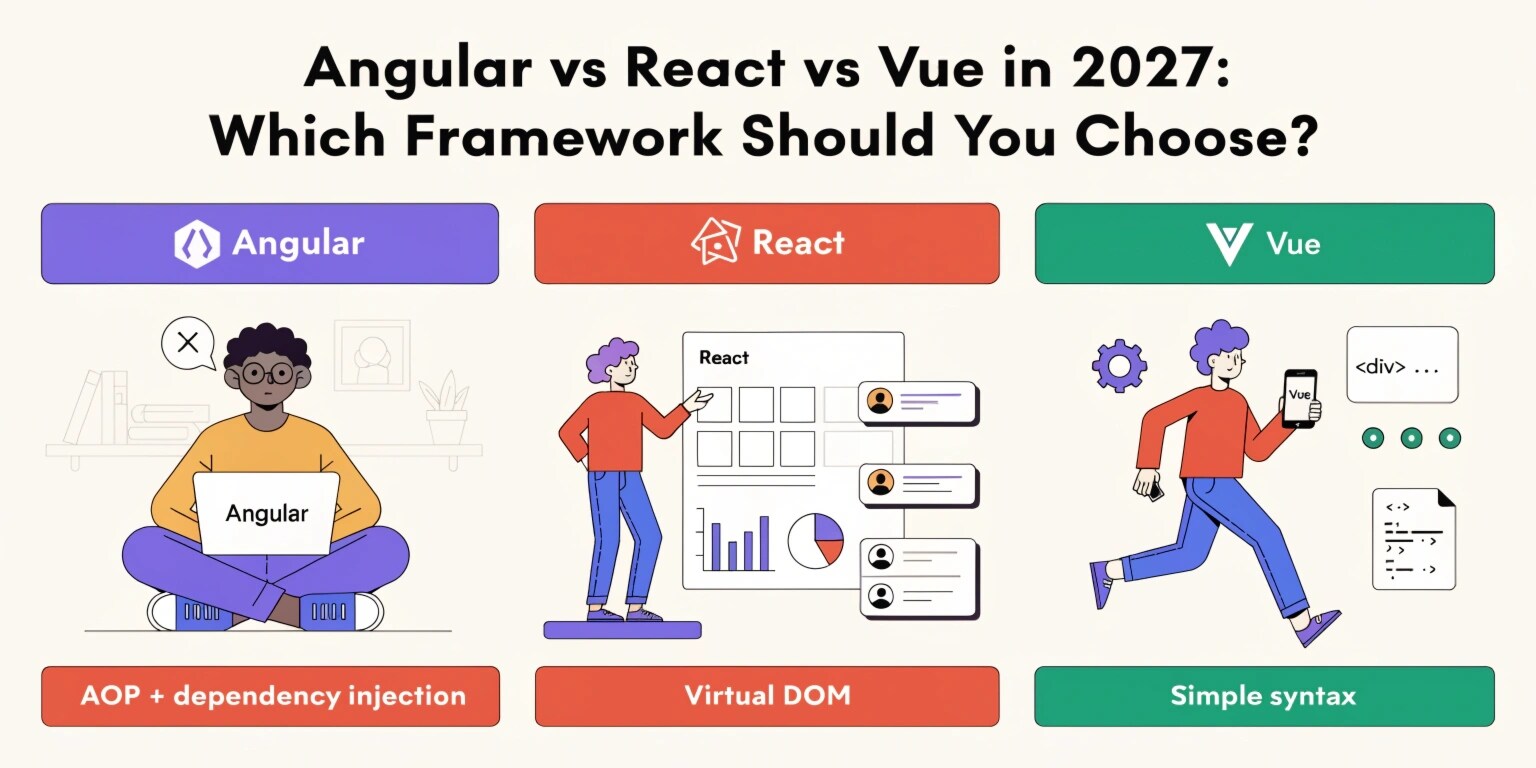
Frontend development has evolved dramatically over the past decade. Modern web applications require exceptional performance, scalability, maintainability, and user experience. To meet these demands, developers increasingly rely on powerful JavaScript frameworks and libraries that simplify application development while supporting complex business requirements.
Among the leading technologies in this space are Angular, React, and Vue. Each has built a strong ecosystem, extensive community support, and a proven track record of powering successful applications across industries.
As we move through 2027, businesses and developers continue to ask the same question: Which framework should you choose? The answer depends on project requirements, team expertise, scalability needs, and long-term goals.
Understanding the Three Technologies
Angular
Angular is a comprehensive frontend framework maintained by Google.
It provides a complete solution for application development, including:
- Component architecture
- Dependency injection
- Routing
- State management
- Form handling
- Testing tools
Angular follows a highly structured approach, making it particularly popular among enterprise organizations.
React
React, developed by Meta, is technically a JavaScript library rather than a full framework.
Its strengths include:
- Component-based architecture
- Virtual DOM
- High flexibility
- Extensive ecosystem
- Strong community support
React allows developers to choose additional libraries based on project requirements.
Vue
Vue combines simplicity with powerful capabilities.
Developed as a progressive framework, Vue offers:
- Easy learning curve
- Lightweight architecture
- Flexible integration
- Strong performance
- Developer-friendly syntax
Vue has gained significant adoption among startups and mid-sized businesses.
Performance Comparison
Performance remains a critical factor in frontend development.
React
React's Virtual DOM efficiently updates only the necessary portions of a user interface.
Benefits include:
- Fast rendering
- Responsive interfaces
- Efficient state updates
React performs exceptionally well in dynamic applications.
Vue
Vue also uses a Virtual DOM and highly optimized rendering mechanisms.
Its lightweight nature often results in:
- Faster startup times
- Lower memory usage
- Smooth user experiences
Angular
Angular delivers strong performance but includes a larger framework footprint.
Recent improvements have significantly enhanced:
- Rendering speed
- Build performance
- Application optimization
However, Angular applications may require more careful optimization for very large projects.
Performance Winner
For most scenarios:
- React and Vue offer slightly better frontend performance.
- Angular excels in large enterprise applications where structure matters more than minimal overhead.
Learning Curve
Vue
Vue is generally considered the easiest framework to learn.
Developers appreciate:
- Clear documentation
- Familiar HTML structure
- Intuitive syntax
New developers can become productive quickly.
React
React has a moderate learning curve.
Developers must understand:
- JSX
- State management
- Hooks
- Component architecture
While straightforward initially, advanced React patterns can become complex.
Angular
Angular has the steepest learning curve.
Developers must learn:
- TypeScript
- Dependency Injection
- RxJS
- Angular architecture
However, this complexity often benefits large-scale projects.
Learning Curve Winner
Vue remains the easiest framework for beginners and small teams.
Scalability and Enterprise Development
Angular
Angular was designed for enterprise-grade applications.
Advantages include:
- Strong architecture
- Consistent coding standards
- Built-in solutions
- Long-term maintainability
Large organizations often prefer Angular for mission-critical systems.
React
React scales effectively through its flexible ecosystem.
Large applications can leverage:
- Redux
- Zustand
- Next.js
- React Query
Many global enterprises rely on React.
Vue
Vue has improved significantly in scalability.
Modern Vue applications can support:
- Enterprise dashboards
- SaaS platforms
- Large business applications
However, Angular and React still dominate the largest enterprise environments.
Scalability Winner
Angular and React lead in enterprise-scale development.
Ecosystem and Community Support
React
React boasts one of the largest developer communities worldwide.
Benefits include:
- Extensive learning resources
- Large talent pool
- Thousands of libraries
- Strong corporate backing
Angular
Angular has mature documentation and enterprise-focused support.
Google's continued investment strengthens its ecosystem.
Vue
Vue's ecosystem continues growing rapidly.
Developers benefit from:
- Excellent documentation
- Active community
- Modern tooling
Although smaller than React's ecosystem, Vue remains highly competitive.
Community Winner
React leads in community size and third-party ecosystem.
Development Speed
Vue
Vue enables rapid development due to its simplicity.
Teams can build applications quickly with minimal setup.
React
React offers excellent development speed, especially when combined with frameworks like Next.js.
Angular
Angular's initial setup can be more complex, but its built-in tools reduce the need for external dependencies.
Development Speed Winner
Vue often provides the fastest path from concept to deployment.
AI Integration and Future Readiness
Artificial Intelligence is influencing every aspect of software development.
Modern applications increasingly require:
- AI-powered search
- Chatbots
- Recommendation engines
- Predictive analytics
- Personalized experiences
All three technologies integrate effectively with AI services.
However:
React
React currently dominates AI-driven web applications due to:
- Extensive AI tooling
- Strong Next.js ecosystem
- Widespread adoption among AI startups
Vue
Vue offers excellent flexibility for integrating AI features.
Angular
Angular remains strong for enterprise AI applications requiring structured architectures.
AI Readiness Winner
React currently has a slight advantage in AI-focused ecosystems.
Use Cases
Choose Angular If:
- Building enterprise applications
- Managing large development teams
- Requiring long-term maintainability
- Developing complex business systems
Choose React If:
- Building scalable web applications
- Creating dynamic user interfaces
- Integrating AI-powered features
- Seeking maximum ecosystem flexibility
Choose Vue If:
- Developing MVPs and startups
- Prioritizing developer productivity
- Building lightweight applications
- Requiring a quick learning curve
Future Trends in 2027
Several trends are shaping frontend development:
- AI-assisted coding
- Server-side rendering
- Edge computing
- Progressive Web Apps (PWAs)
- Real-time collaboration features
- WebAssembly integration
Angular, React, and Vue are all evolving to support these innovations.
React continues benefiting from strong ecosystem momentum, Angular remains a favorite in enterprise environments, and Vue keeps attracting developers through simplicity and flexibility.
Which Framework Should You Choose in 2027?
There is no universal winner.
Your decision should depend on:
- Team expertise
- Project complexity
- Performance requirements
- Long-term maintenance goals
- Budget and timeline
For enterprise applications, Angular remains a strong choice.
For maximum flexibility and ecosystem support, React continues to lead.
For simplicity and rapid development, Vue remains highly attractive.
Conclusion
Angular, React, and Vue each offer unique advantages in 2027. Angular excels in enterprise architecture and maintainability, React dominates through flexibility and ecosystem strength, while Vue provides an outstanding balance of simplicity and performance.
Rather than focusing solely on popularity, businesses should evaluate project requirements, team capabilities, and long-term objectives when selecting a framework. By choosing the right technology for the right use case, organizations can build scalable, high-performing web applications that remain competitive in an increasingly digital world.