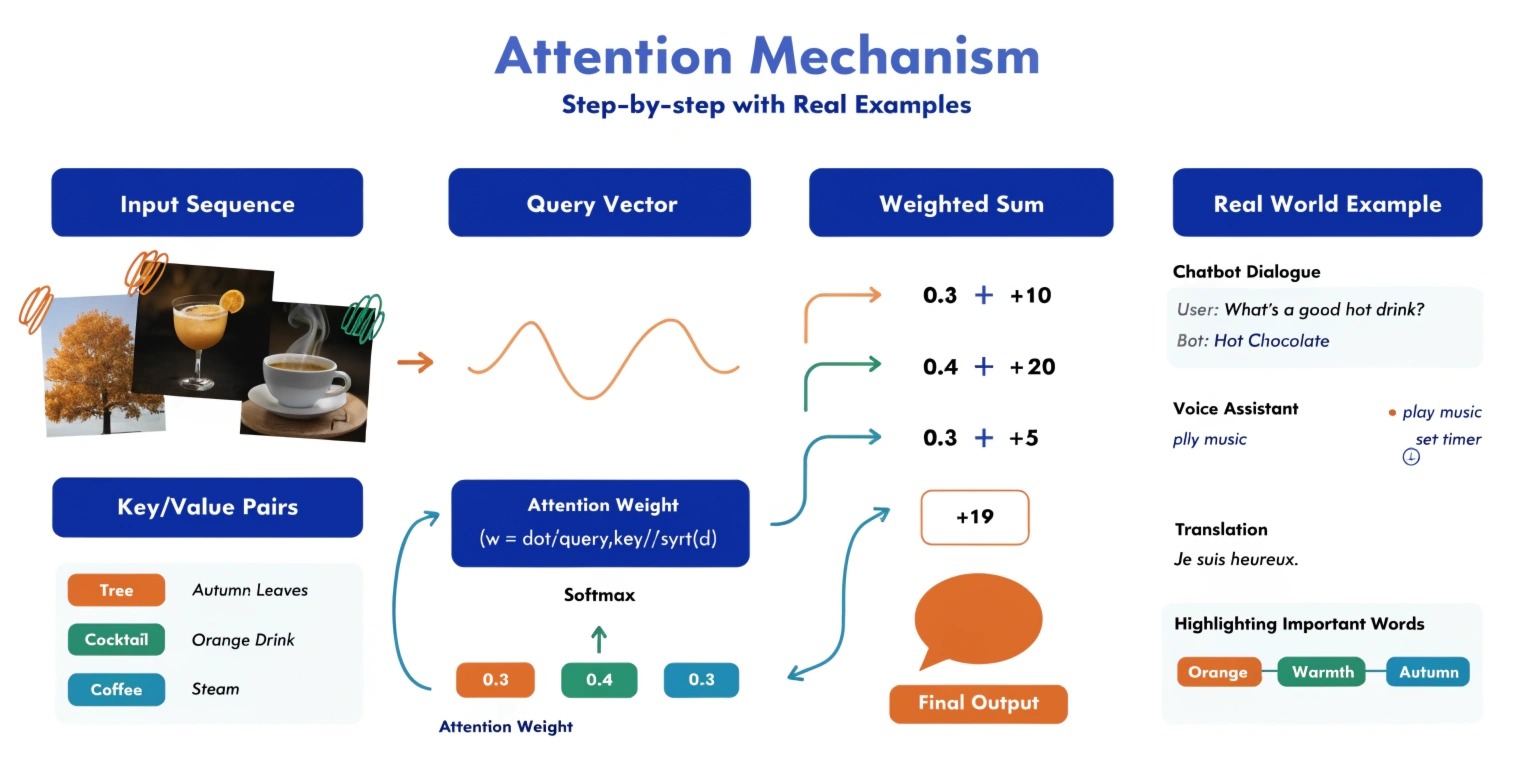
Artificial Intelligence models today can translate languages, summarize documents, and answer complex questions. One key innovation that made this possible is the attention mechanism.
Attention allows neural networks to focus on the most important parts of input data instead of treating everything equally. This idea is especially powerful in Natural Language Processing (NLP) and forms the foundation of modern transformer models.
In this article, we will break down the attention mechanism step-by-step with simple examples.
Why Attention Mechanism Was Needed
Earlier neural networks like Recurrent Neural Networks (RNNs) processed sentences word by word. When sentences became long, the model struggled to remember earlier information.
For example:
Sentence:
"The book that I borrowed from the library yesterday was extremely interesting."
When predicting the meaning of "interesting", the model must remember "book" from earlier in the sentence. Traditional models often lost this connection.
The attention mechanism solves this by allowing the model to look back at every word and decide which ones matter most.
Core Idea of Attention
Attention works using three main components:
- Query (Q)
- Key (K)
- Value (V)
These components help the model determine which words should influence the current prediction.
Think of it like searching in a database:
- Query → what we are looking for
- Keys → available information
- Values → actual content returned
Step 1: Input Sentence Representation
Consider the sentence:
"The cat sat on the mat."
Each word is converted into a vector representation using embeddings.
Example:
WordVectorThe[0.2, 0.8, 0.1]Cat[0.7, 0.3, 0.9]Sat[0.6, 0.1, 0.4]
These vectors capture semantic meaning.
Step 2: Creating Query, Key, and Value
Each word embedding is transformed into three vectors:
- Query vector
- Key vector
- Value vector
This is done using simple matrix multiplication with learned weights.
For example:
Word: Cat
Query = Wq × embedding
Key = Wk × embedding
Value = Wv × embedding
This allows the model to compare relationships between words.
Step 3: Calculating Attention Scores
Next, we compute how relevant each word is to another word.
Formula:
Attention Score = Query × Keyᵀ
This produces a similarity score.
Example when focusing on the word "sat":
WordScoreThe0.1Cat0.8Sat0.7On0.3Mat0.2
Here the model sees that "cat" is highly related to "sat".
Step 4: Applying Softmax
Scores are converted into probabilities using the Softmax function.
Example:
WordProbabilityThe0.05Cat0.40Sat0.35On0.12Mat0.08
Now the model knows where to focus attention.
Step 5: Weighted Sum of Values
Finally, the model multiplies these probabilities with the value vectors.
Formula:
Output = Σ (Attention Weight × Value)
This produces a new representation that emphasizes important words.
In this example, "cat" and "sat" will strongly influence the output.
Real-World Example: Machine Translation
Imagine translating this sentence from English to French:
"The animal didn't cross the street because it was too tired."
The word "it" refers to "animal".
The attention mechanism helps the model identify that "it" should focus on "animal", not "street".
This greatly improves translation accuracy.
Self-Attention: A Powerful Extension
Modern AI models use self-attention, where every word attends to every other word in the sentence.
Advantages include:
- Understanding context better
- Parallel computation
- Handling long sentences efficiently
Self-attention is the core component of Transformer architectures used in advanced AI systems.
Where Attention Mechanism Is Used
Attention is used in many AI applications:
Natural Language Processing
- Machine translation
- Chatbots
- Text summarization
- Question answering
Computer Vision
- Image captioning
- Object detection
Speech Recognition
- Voice assistants
- Audio transcription
Benefits of Attention Mechanism
- Captures long-range dependencies
- Improves model interpretability
- Enables parallel training
- Scales well for large datasets
These benefits made attention one of the most influential ideas in modern deep learning.
Conclusion
The attention mechanism revolutionized deep learning by allowing models to focus on the most relevant parts of input data.
By computing relationships between words using queries, keys, and values, attention enables models to understand context much better than earlier architectures.
This idea laid the foundation for modern transformer models that power today's most advanced AI systems.
Understanding attention is essential for anyone exploring AI, machine learning, or natural language processing.