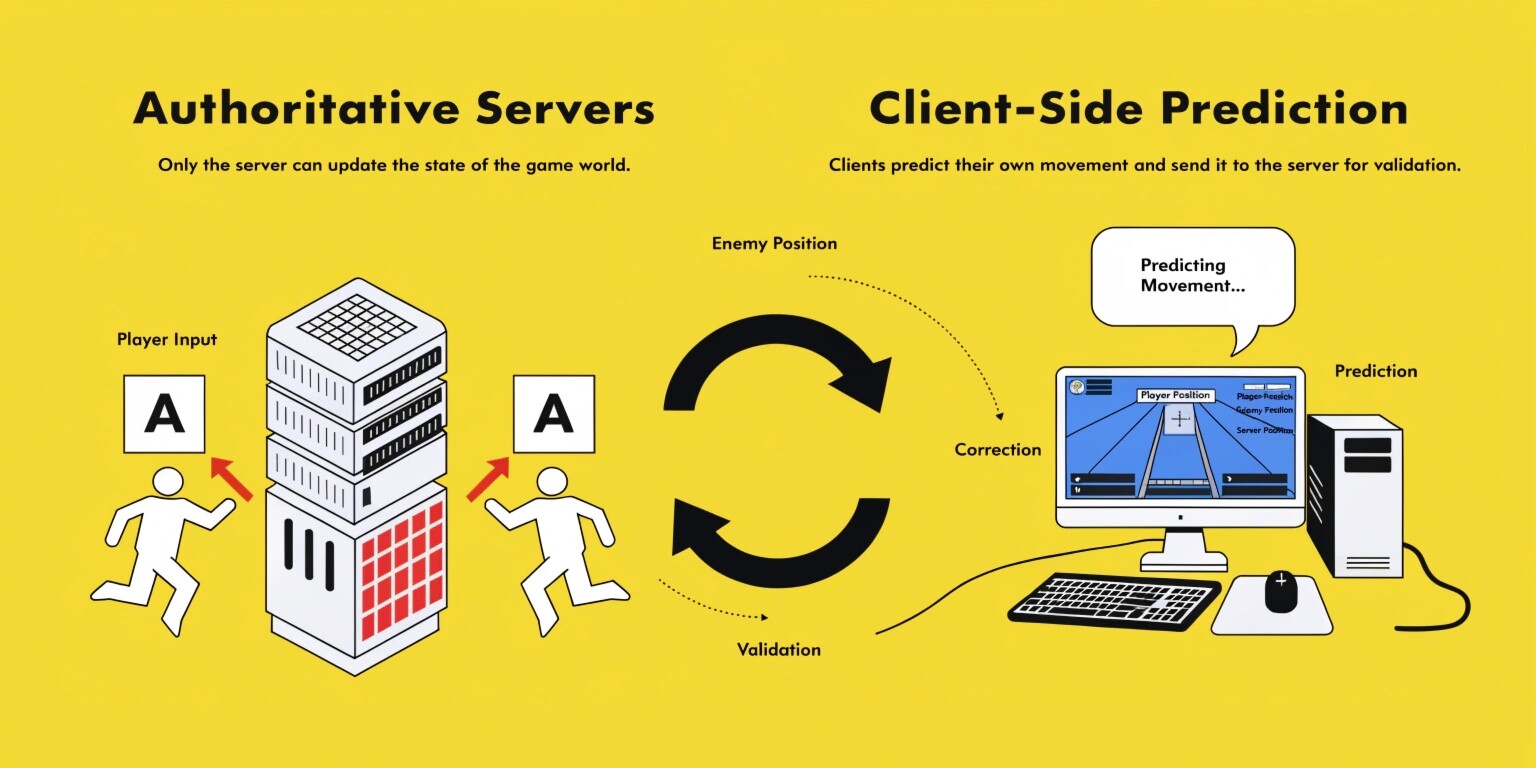
Multiplayer games have evolved dramatically over the past decade, with players expecting smooth gameplay, accurate hit detection, and minimal latency regardless of their location. Behind every successful online game is a networking architecture that balances responsiveness, fairness, and security. Two of the most important concepts in modern multiplayer networking are authoritative servers and client-side prediction.
At first glance, these approaches may seem to compete with one another, but in reality they solve different problems. Client-side prediction improves responsiveness by allowing players to see the results of their actions immediately, while authoritative servers ensure that the game state remains secure and synchronized for everyone. Most modern multiplayer games—including competitive first-person shooters, battle royale titles, and online action games—combine both techniques to deliver a high-quality experience.
What Is an Authoritative Server?
An authoritative server is the central authority responsible for maintaining the official game state. Every important action, such as movement, combat, inventory updates, and score calculations, is validated by the server before being accepted.
The typical process is:
- A player sends an action request to the server.
- The server validates the action.
- The server updates the official game state.
- The updated information is distributed to all connected players.
Because the server makes all final decisions, clients cannot easily manipulate gameplay.
Advantages
- Strong protection against cheating
- Consistent game state across all players
- Reliable hit validation
- Easier synchronization
- Improved competitive fairness
Limitations
- Additional server infrastructure costs
- Increased network traffic
- Higher latency without prediction techniques
- Greater operational complexity
What Is Client-Side Prediction?
Waiting for server confirmation before displaying every player action would make controls feel sluggish. Client-side prediction solves this problem by allowing the player's device to immediately simulate local actions while the server processes the request in the background.
For example, when a player presses the movement key:
- The character moves instantly on the local screen.
- The movement command is sent to the server.
- The server validates the action.
- Any differences between the predicted and actual positions are corrected through reconciliation.
This approach creates a highly responsive gameplay experience while preserving server authority.
Advantages
- Immediate player feedback
- Smooth controls
- Reduced perceived latency
- Better overall user experience
Limitations
- Prediction errors require correction
- Complex synchronization logic
- Potential visual artifacts if corrections are large
- More challenging implementation
Server Reconciliation
Prediction is not always perfect. Network delays or collisions may cause the server's result to differ from the client's predicted state.
Server reconciliation resolves these discrepancies by:
- Comparing the client's predicted position with the server's authoritative position
- Replaying unacknowledged player inputs
- Smoothly correcting movement without noticeable teleportation
This process allows players to enjoy responsive controls while maintaining an accurate shared game state.
Comparing the Two Approaches
FeatureAuthoritative ServerClient-Side PredictionDecision MakerServerClient (temporary)Cheat ResistanceExcellentLimited without server validationResponsivenessModerateExcellentLatency PerceptionHigherLowerFairnessHighDepends on reconciliationComplexityModerateHigh
Rather than choosing one over the other, successful multiplayer games combine both models.
Why Modern Games Use Both
Competitive multiplayer games typically follow this workflow:
- Players move instantly using client-side prediction.
- Inputs are transmitted to the server.
- The authoritative server validates all actions.
- Server reconciliation corrects any prediction errors.
- Lag compensation ensures fair hit registration.
This hybrid approach provides:
- Responsive gameplay
- Accurate synchronization
- Reduced cheating
- Fair competition
- Smooth movement
Security Considerations
Authoritative servers significantly reduce the risk of cheating because clients never have full control over the game state.
Servers should validate:
- Player movement
- Damage calculations
- Inventory changes
- Physics interactions
- Resource collection
- Ability cooldowns
- Match scores
Never trusting client-provided data is a fundamental principle of secure multiplayer game development.
Performance Considerations
A server-authoritative architecture requires efficient resource management.
Developers should optimize:
- Tick rate
- Packet sizes
- Update frequency
- Compression techniques
- Interest management
- Delta synchronization
- Load balancing
These optimizations reduce bandwidth usage while maintaining a responsive experience.
Best Practices
When building multiplayer games:
- Keep the server authoritative for all critical gameplay logic.
- Use client-side prediction only for local responsiveness.
- Implement server reconciliation to correct prediction errors smoothly.
- Apply lag compensation for accurate hit detection.
- Minimize bandwidth through state compression.
- Validate all client requests before applying changes.
- Test gameplay under different latency conditions.
- Continuously monitor server performance and player synchronization.
Following these practices results in a secure, scalable, and enjoyable multiplayer experience.
Future Trends
Advancements in networking technology continue to improve multiplayer game performance.
Emerging trends include:
- AI-assisted network optimization
- Adaptive tick-rate systems
- Edge computing for reduced latency
- Cloud-hosted authoritative servers
- Machine learning-based lag prediction
- Rollback networking improvements
- Distributed server architectures
- 5G-enabled mobile multiplayer
These innovations will further reduce latency while supporting increasingly complex online worlds.
Conclusion
Authoritative servers and client-side prediction are complementary technologies that address different aspects of multiplayer networking. While authoritative servers ensure security, fairness, and synchronization, client-side prediction provides the instant responsiveness players expect from modern games. Combined with server reconciliation and lag compensation, these techniques create multiplayer experiences that are both smooth and trustworthy.
For developers building competitive online games, understanding how these systems interact is essential. By carefully balancing responsiveness with server authority, teams can deliver multiplayer titles that feel fast, fair, and resilient under real-world network conditions