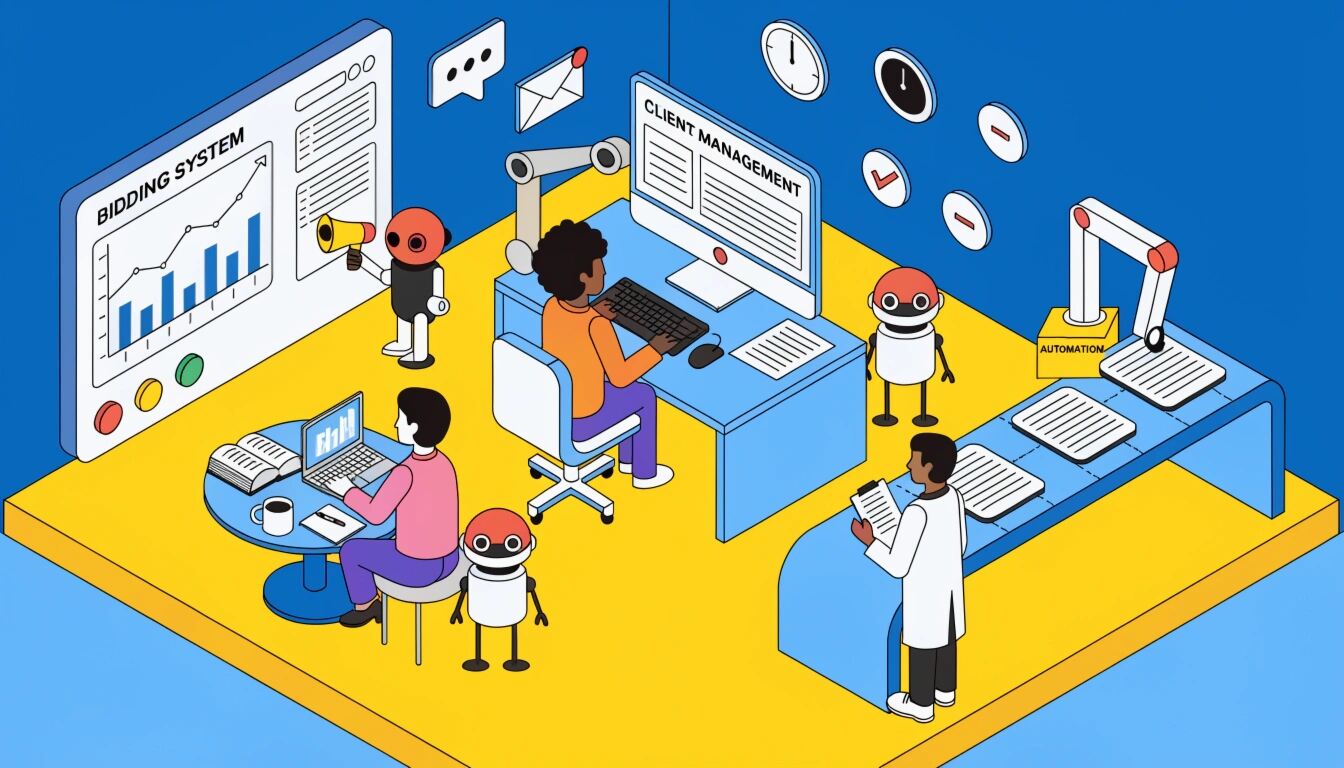
In today’s competitive digital market, IT service companies must manage multiple responsibilities simultaneously, including lead generation, proposal creation, client communication, project coordination, and customer retention. As businesses grow, handling these processes manually becomes increasingly difficult and inefficient.
This is why automation in bidding and client management is becoming a critical strategy for modern IT businesses.
Automation helps companies streamline repetitive tasks, improve response times, reduce operational errors, and focus more on building client relationships rather than handling administrative work. Whether it is a software development agency, digital marketing company, SaaS provider, or freelance IT business, automation tools can significantly improve productivity and business scalability.
Organizations that effectively automate bidding and client management processes often gain a major competitive advantage in sales efficiency and customer satisfaction.
What is Automation in Bidding?
Bidding automation refers to using software tools and AI-powered systems to simplify and optimize proposal submission and lead response processes.
This includes:
- Automated proposal generation
- Smart pricing suggestions
- Lead qualification
- Proposal templates
- Follow-up scheduling
- AI-powered response recommendations
Businesses working on platforms like Upwork and Freelancer often use automation tools to improve bidding efficiency and manage multiple client opportunities simultaneously.
Instead of manually creating every proposal from scratch, automation systems help teams respond faster and more consistently.
What is Client Management Automation?
Client management automation focuses on streamlining customer interactions and relationship management throughout the project lifecycle.
Automation can support:
- Lead tracking
- Client onboarding
- Email communication
- Meeting scheduling
- Invoice management
- Task assignment
- Project updates
- Customer support workflows
Modern CRM systems help businesses maintain organized and scalable client communication processes.
Why Automation is Becoming Essential
As competition grows in the IT services industry, clients increasingly expect:
- Faster response times
- Professional communication
- Transparent workflows
- Real-time updates
- Personalized experiences
Manual processes often create:
- Delayed responses
- Missed follow-ups
- Communication gaps
- Administrative overload
Automation helps solve these operational inefficiencies while improving overall customer experience.
Benefits of Automation in Bidding
1. Faster Proposal Submission
In freelance platforms and B2B sales environments, speed matters significantly.
Automation tools can:
- Generate proposal drafts instantly
- Insert reusable project details
- Suggest relevant case studies
- Personalize client responses quickly
Faster responses increase the likelihood of client engagement.
2. Improved Proposal Consistency
Automation ensures that proposals maintain:
- Professional formatting
- Consistent branding
- Standard pricing structures
- Clear service descriptions
This improves brand credibility and communication quality.
3. Lead Qualification Efficiency
AI-powered systems can analyze incoming leads based on:
- Budget
- Industry
- Project scope
- Timeline
- Technical requirements
This helps sales teams prioritize high-quality opportunities rather than pursuing every inquiry equally.
4. Reduced Manual Workload
Automation minimizes repetitive tasks such as:
- Data entry
- Email follow-ups
- Scheduling reminders
- Proposal formatting
This allows teams to focus on strategy and relationship building.
Benefits of Client Management Automation
Better Customer Communication
Automated communication systems can:
- Send onboarding emails
- Share project updates
- Schedule follow-up reminders
- Deliver support responses
Clients appreciate timely and organized communication.
Improved Project Tracking
Automation platforms integrate with project management systems to provide:
- Task updates
- Deadline monitoring
- Workflow visibility
- Progress tracking
This improves transparency and collaboration between teams and clients.
Stronger Client Retention
Consistent communication and organized workflows improve customer satisfaction, leading to:
- Higher retention rates
- Repeat business
- Long-term partnerships
- Better referrals
Client management automation supports relationship continuity.
Popular Tools for Bidding and Client Management
Many IT companies use CRM and automation platforms such as:
- HubSpot
- Salesforce
- Zoho
- Monday.com
These platforms help automate:
- Sales pipelines
- Lead nurturing
- Customer communication
- Reporting dashboards
- Workflow management
Automation platforms are increasingly integrating AI-powered features to improve productivity further.
AI and Automation in Modern Client Management
Artificial intelligence is transforming how businesses manage clients and bidding strategies.
AI-powered systems can:
- Predict lead conversion probability
- Recommend personalized proposals
- Analyze customer behavior
- Automate meeting summaries
- Generate project reports
- Detect customer dissatisfaction signals
AI-driven automation improves both efficiency and decision-making accuracy.
Automation in Freelancer Platforms
Freelancers and agencies increasingly use automation for:
- Proposal templates
- Portfolio recommendations
- Automated client follow-ups
- Interview scheduling
- Lead tracking dashboards
However, businesses must balance automation with personalization.
Over-automated responses may appear generic and reduce client trust.
The most effective strategy combines:
- Automation efficiency
- Human relationship building
- Customized communication
Challenges of Automation
Although automation offers major advantages, it also introduces certain risks.
Loss of Personalization
Excessive automation can make communication feel robotic.
Clients still value authentic interactions and personalized attention.
Incorrect Automation Workflows
Poorly configured systems may:
- Send irrelevant messages
- Trigger incorrect follow-ups
- Create duplicate communications
Automation requires proper monitoring and optimization.
Data Privacy Concerns
CRM and automation systems handle sensitive client information.
Businesses must implement:
- Secure authentication
- Access control
- Data encryption
- Privacy compliance measures
Security becomes especially important for enterprise clients.
Best Practices for Successful Automation
Start with Repetitive Tasks
Automate routine workflows first, such as:
- Follow-up emails
- Meeting scheduling
- Proposal formatting
Keep Human Oversight
Automation should support human teams rather than replace relationship management entirely.
Personalize Communication
Use automation intelligently while maintaining customized messaging for important clients.
Integrate Systems Properly
CRM, project management, communication, and billing systems should work together seamlessly.
Continuously Optimize Workflows
Automation systems require ongoing improvements based on:
- Performance metrics
- Conversion data
- Customer feedback
Future of Automation in IT Services
The future of bidding and client management will likely include:
- AI-generated proposals
- Predictive sales analytics
- Autonomous workflow management
- Voice-based CRM systems
- Intelligent customer success platforms
- Real-time personalization engines
As AI capabilities continue evolving, automation will become increasingly proactive and intelligent.
Businesses that adopt modern automation strategies early will gain significant advantages in scalability, efficiency, and customer experience.
Conclusion
Automation in bidding and client management is transforming how IT service companies operate and grow. By reducing repetitive tasks, improving communication efficiency, and streamlining workflows, automation enables businesses to scale more effectively while maintaining strong client relationships.
However, successful automation requires balance. Technology should enhance human interaction rather than eliminate it entirely. Companies that combine intelligent automation with personalized customer experiences will be better positioned to succeed in the increasingly competitive digital services market.