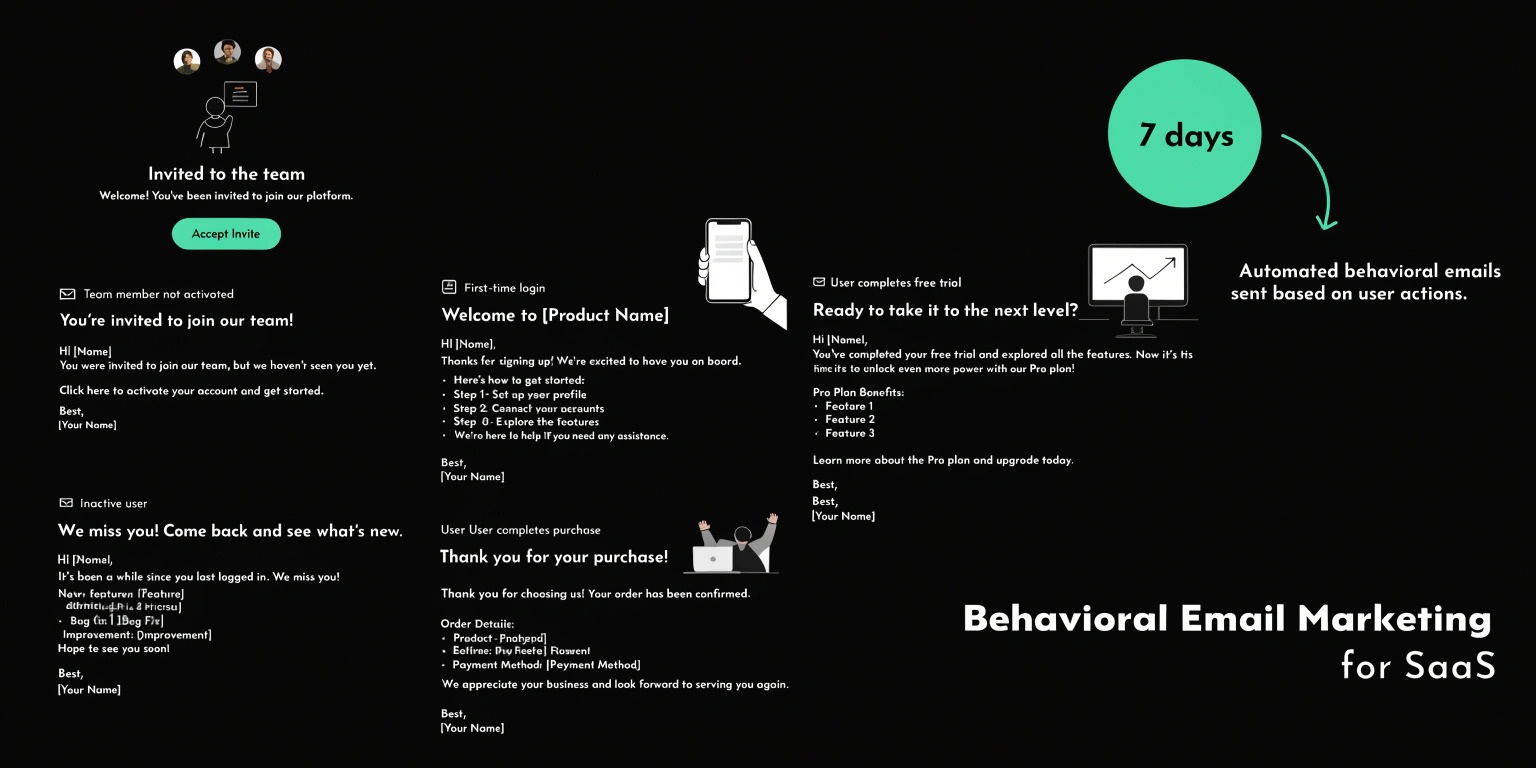
SaaS businesses operate in an environment where customer behavior can change rapidly. Users may sign up for a free trial, explore several features, stop using the product, invite teammates, upgrade their plans, or become inactive. Sending the same email to every user ignores these important behavioral signals.
Behavioral email marketing solves this problem by using user actions and engagement data to deliver timely, personalized emails.
Instead of asking, "What email should we send today?" SaaS marketers can ask, "What did this user do, and what message would be most useful right now?"
This shift from generic campaigns to behavior-driven communication can significantly improve engagement, conversions, and retention.
What Is Behavioral Email Marketing?
Behavioral email marketing involves sending emails based on specific actions, events, or patterns demonstrated by users.
Examples include:
- Signing up for an account
- Starting a free trial
- Completing onboarding
- Using a specific feature
- Inviting a team member
- Abandoning an important workflow
- Becoming inactive
- Reaching a usage limit
- Upgrading a subscription
- Cancelling an account
These behaviors trigger relevant email campaigns automatically.
The result is a more personalized customer experience.
Why Behavioral Email Marketing Matters for SaaS
Traditional email marketing usually relies on broad audience segments. Behavioral marketing adds another layer by considering what users actually do inside the product.
Benefits include:
- Higher email engagement
- Better trial conversions
- Faster product adoption
- Improved feature discovery
- Reduced churn
- Increased retention
- More expansion opportunities
- Better customer experience
For SaaS companies operating on recurring revenue models, these improvements can directly influence customer lifetime value.
Use Product Behavior as a Marketing Signal
SaaS applications generate valuable behavioral data.
For example, suppose a user repeatedly visits a reporting feature but has not activated it. This behavior indicates potential interest.
A targeted email could explain how to use the feature, provide a short tutorial, or showcase a relevant use case.
Similarly, if a customer suddenly stops using the platform, the company can trigger a re-engagement campaign.
The product itself becomes a source of marketing intelligence.
Behavioral Emails During Onboarding
Onboarding is one of the most important stages of the SaaS customer lifecycle.
Instead of sending a fixed sequence to every user, companies can create behavior-based onboarding.
For example:
User signs up: Send a welcome email.
User does not complete setup: Send an activation reminder.
User completes setup: Introduce the next important feature.
User uses a core feature: Recommend an advanced workflow.
User invites teammates: Explain collaboration features.
This approach makes onboarding more relevant and reduces information overload.
Trial Conversion Campaigns
Free trials provide an excellent opportunity for behavioral marketing.
Not every trial user has the same level of buying intent.
A highly engaged user who has used multiple features should receive different messaging from someone who logged in once and disappeared.
Possible triggers include:
- Number of logins
- Feature usage
- Sessions completed
- Team members invited
- Reports generated
- Integrations connected
Highly engaged users can receive conversion-focused messaging, while inactive users may need educational or support-oriented emails.
Feature Adoption Emails
A SaaS company may offer dozens of features, but customers often use only a small portion of the product.
Behavioral campaigns can identify underused features and introduce them at the right time.
For example:
"You're already using our project management tools. Here's how automated reporting can save your team hours every week."
This is more effective than randomly promoting features because the recommendation is connected to the user's existing behavior.
Re-Engagement Campaigns
User inactivity is an important warning signal.
A SaaS company can define inactivity based on its product's normal usage patterns.
For example:
- No login for seven days
- No activity for fourteen days
- Reduced weekly usage
- Declining feature adoption
A re-engagement campaign could provide helpful resources, product updates, or assistance.
The goal should not always be to sell. Sometimes the best approach is simply asking whether the customer needs help.
Churn Prevention
Behavioral data can also support proactive churn prevention.
Potential warning signals include:
- Declining login frequency
- Reduced feature usage
- Unresolved support issues
- Fewer active users
- Lower engagement with important workflows
- Repeated failed actions
When several signals appear together, the system can trigger a customer-success email.
For example:
"We noticed your team's activity has decreased recently. Would you like help getting more value from the platform?"
This proactive approach gives companies an opportunity to address problems before cancellation occurs.
Upselling and Cross-Selling
Behavioral marketing can identify customers who may be ready for additional products or higher-tier plans.
Potential signals include:
- Reaching usage limits
- Using advanced features
- Adding multiple team members
- Repeatedly accessing premium functionality
- Increased account activity
Instead of sending generic upgrade promotions, SaaS companies can connect the recommendation to a specific customer need.
For example, a customer approaching a usage limit may receive information about a plan with higher capacity.
Personalization Beyond First Names
Effective behavioral personalization goes beyond adding a customer's name.
Emails can reference:
- Recently used features
- Account activity
- Previous interactions
- Industry-specific use cases
- Product milestones
- Subscription status
For example:
"Your team has created 50 projects this month. Here's how automation can help you manage them more efficiently."
This type of personalization demonstrates that the company understands how the customer uses its product.
Combining Behavioral Data With Segmentation
Behavioral data becomes even more powerful when combined with traditional customer attributes.
Segments might consider:
- Industry
- Company size
- Subscription plan
- Location
- User role
- Product usage
- Engagement level
A SaaS company could therefore create a campaign specifically for highly engaged operations managers at mid-sized companies who are approaching their plan limits.
This level of targeting can dramatically improve message relevance.
Measuring Behavioral Email Performance
SaaS companies should track metrics beyond basic open rates.
Important measurements include:
- Click-through rate
- Trial-to-paid conversion
- Activation rate
- Feature adoption
- Product engagement
- Retention rate
- Churn rate
- Expansion revenue
- Customer lifetime value
The most important metric depends on the campaign objective.
An onboarding campaign should focus on activation, while a retention campaign should focus on engagement and churn reduction.
Common Mistakes to Avoid
Behavioral email marketing can become ineffective when businesses over-automate.
Common mistakes include:
- Sending too many emails
- Creating irrelevant triggers
- Tracking excessive user behavior
- Ignoring customer preferences
- Using overly aggressive personalization
- Failing to test campaigns
- Sending promotional messages when users need support
Automation should enhance the customer experience rather than make communication feel intrusive.
The Future of Behavioral Email Marketing
Artificial intelligence is making behavioral marketing increasingly sophisticated.
AI systems can analyze large amounts of product data to identify patterns, predict customer intent, recommend content, and estimate churn probability.
Future SaaS email campaigns may dynamically determine:
- Which users should receive an email
- What message they should see
- Which feature should be recommended
- When the email should be delivered
- Which offer is most relevant
This creates a more adaptive and intelligent customer lifecycle.
Conclusion
Behavioral email marketing allows SaaS companies to move beyond generic email campaigns and communicate based on what customers actually do. By analyzing product usage, onboarding progress, feature adoption, engagement patterns, and subscription behavior, businesses can create highly relevant campaigns throughout the customer lifecycle.
From trial conversion and onboarding to retention, churn prevention, and upselling, behavioral emails can support nearly every stage of SaaS growth. When implemented thoughtfully, they provide value at the right moment while helping businesses increase engagement, strengthen customer relationships, and maximize recurring revenue.