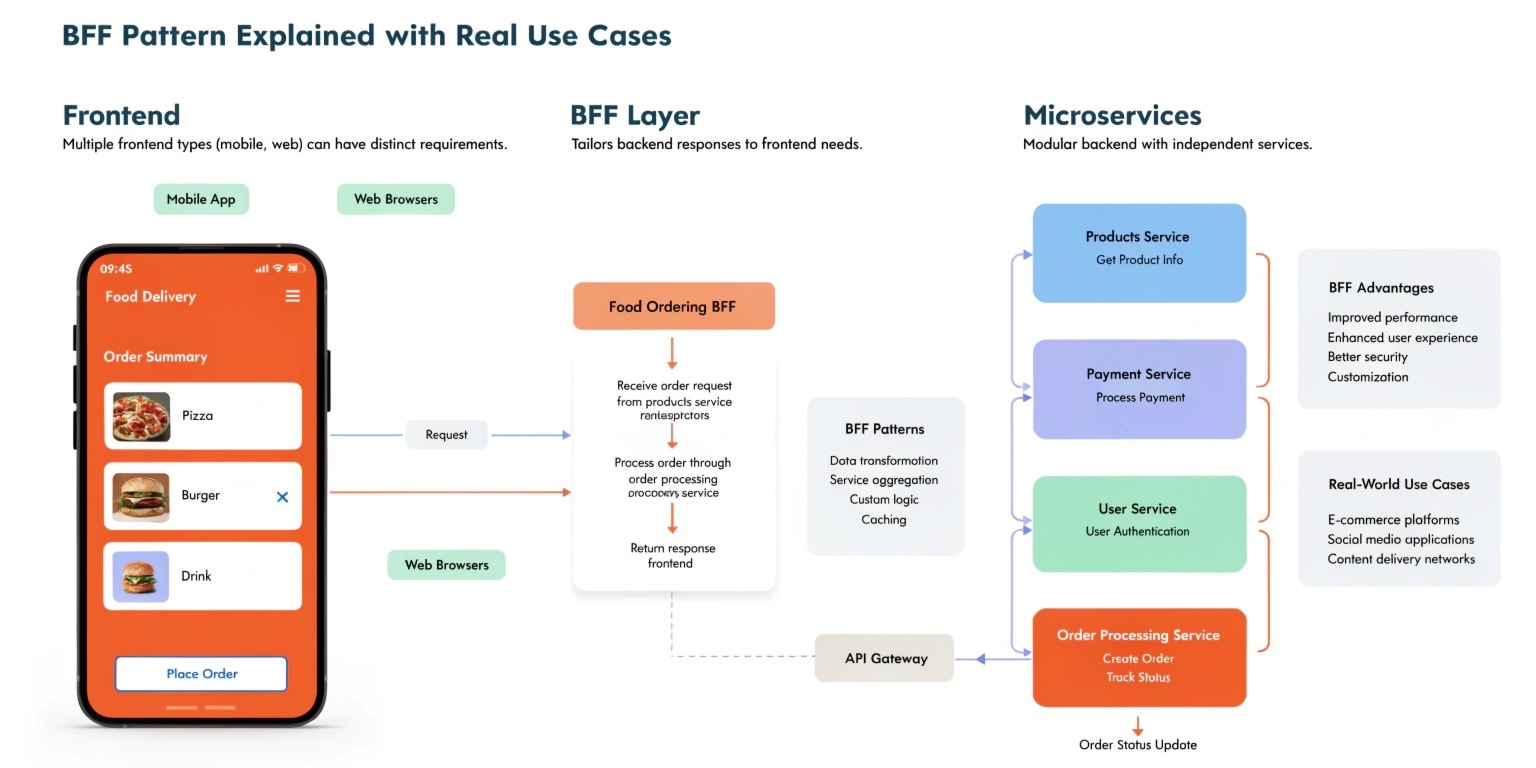
Modern applications rarely serve a single type of client anymore. A single platform might include a web application, mobile app, admin dashboard, partner portal, and even smart devices. All of them interact with the same backend services—but their needs are completely different.
This is exactly the problem the Backend For Frontend (BFF) pattern solves.
Instead of forcing every client to communicate directly with complex microservices, a dedicated backend is created for each frontend. This architectural approach significantly improves performance, flexibility, and developer productivity.
Let’s understand it properly.
The Problem with Traditional Architecture
In a typical microservices system, multiple backend services exist:
- Authentication service
- Product service
- Order service
- Payment service
- Notification service
If a frontend application directly communicates with all these services, several issues arise:
- Too many API calls
- High latency
- Complex frontend logic
- Security exposure
- Difficult version management
For example, a product page in an e-commerce app may need:
- product details
- reviews
- recommendations
- inventory status
- pricing
The frontend ends up orchestrating multiple APIs — which it was never designed to do.
This leads to fragile UI code and slower performance.
What is the BFF Pattern?
The Backend For Frontend (BFF) pattern introduces an intermediate backend layer dedicated to a specific client (web, mobile, or device).
Instead of:
Frontend → Many Microservices
We use:
Frontend → BFF → Microservices
Each frontend gets its own optimized backend.
Key Idea:
The frontend no longer handles orchestration. The BFF aggregates, transforms, and prepares data in a format perfect for that specific client.
Why Different Frontends Need Different Backends
A mobile app and a desktop website have completely different constraints.
Mobile App Needs:
- Low bandwidth
- Fewer requests
- Smaller payload
- Fast responses
Web App Needs:
- Rich data
- Detailed content
- SEO support
Admin Dashboard Needs:
- Bulk data
- Filtering
- Analytics metrics
A single generic API cannot efficiently serve all of them. The BFF tailors responses for each.
How BFF Works
- User requests data from the frontend (mobile/web).
- Request goes to the dedicated BFF.
- BFF calls multiple microservices internally.
- BFF aggregates and formats the response.
- Frontend receives ready-to-render data.
The frontend now focuses only on UI, not backend orchestration.
Real-World Use Cases
1. E-Commerce Platform
A product page requires:
- product info (catalog service)
- availability (inventory service)
- reviews (review service)
- pricing (pricing service)
Instead of 4–5 API calls from the browser, the web BFF fetches all data and returns a single structured response.
Mobile BFF may send only essential fields, reducing payload size and improving loading speed.
2. Banking Applications
A banking mobile app dashboard shows:
- account balance
- recent transactions
- offers
- alerts
A BFF aggregates sensitive data securely and enforces stricter authentication rules compared to a web client.
3. Streaming Platforms
Smart TVs, mobile apps, and websites all consume the same video platform but require different layouts, image sizes, and recommendation logic.
A separate BFF allows each client to receive optimized content without modifying core services.
BFF vs API Gateway
This is a common confusion.
API GatewayBFFGeneral entry pointClient-specific backendHandles routing, auth, rate limitsHandles data shaping & orchestrationSame for all clientsSeparate per frontend
Often, systems use both:
Client → API Gateway → BFF → Services
Benefits of BFF
1. Performance Improvement
Reduces network round trips and payload size.
2. Frontend Simplicity
Frontend developers no longer manage complex API orchestration.
3. Independent Development
Frontend and backend teams can work independently.
4. Better Security
Microservices are not directly exposed to the public internet.
5. Faster Feature Delivery
UI changes rarely require changes in core backend services.
Trade-offs and Challenges
BFF is powerful but not free.
- More services to maintain
- Deployment overhead
- Potential duplication logic
- Requires good DevOps practices
It works best when you have multiple frontends and microservices.
When Should You Use BFF?
Use BFF if:
- You have mobile + web + dashboard apps
- You use microservices architecture
- You need optimized performance
- Frontend complexity is growing
Avoid BFF if:
- You have a simple monolithic backend
- Only one frontend client exists
- Your APIs are already minimal
Implementation Technologies
Common BFF technologies:
- Node.js (most popular)
- .NET
- Spring Boot
- GraphQL servers
GraphQL is often paired with BFF because it allows flexible data fetching.
Final Thoughts
The Backend For Frontend pattern is a crucial evolution in modern system design. As applications grow into multi-platform ecosystems, a single generic backend becomes inefficient.
BFF shifts responsibility away from the UI and into a dedicated orchestration layer, improving performance, scalability, and developer experience.
If your frontend is becoming complex, slow, or tightly coupled with microservices, introducing a BFF may be the architectural upgrade your system needs.