Many companies are excited about generative AI — but also worried.
Public AI tools are powerful, yet enterprises hesitate to use them because of one major concern: data security. Businesses cannot risk exposing confidential contracts, HR records, financial data, or intellectual property to external systems.
This challenge has led to the rise of Private GPT — an internal AI assistant trained on company knowledge while keeping data fully secure.
Instead of sending sensitive data to public models, organizations deploy controlled AI environments that understand internal documents and answer employee queries safely.
Let’s explore how it works.
What is a Private GPT?
A Private GPT is an enterprise AI system that allows employees to interact with company knowledge using natural language while keeping all sensitive data protected.
Employees can ask:
- “Show the leave policy”
- “Summarize this contract”
- “What is our refund policy?”
- “Explain last quarter’s sales report”
The AI retrieves answers from internal data sources instead of public internet training data.
Important clarification:
The model is not trained on company data in the traditional sense. Instead, it retrieves information dynamically using a Retrieval-Augmented Generation (RAG) pipeline.
Why Enterprises Need It
Organizations face a knowledge access problem.
Company information exists across:
- PDFs
- emails
- Notion/Confluence
- Google Drive
- SharePoint
- databases
Employees spend hours searching for documents or contacting other departments.
Private GPT converts company knowledge into a searchable conversational interface.
Benefits:
- Faster decision making
- Reduced support workload
- Improved employee productivity
- Knowledge retention
- Internal automation
Core Architecture
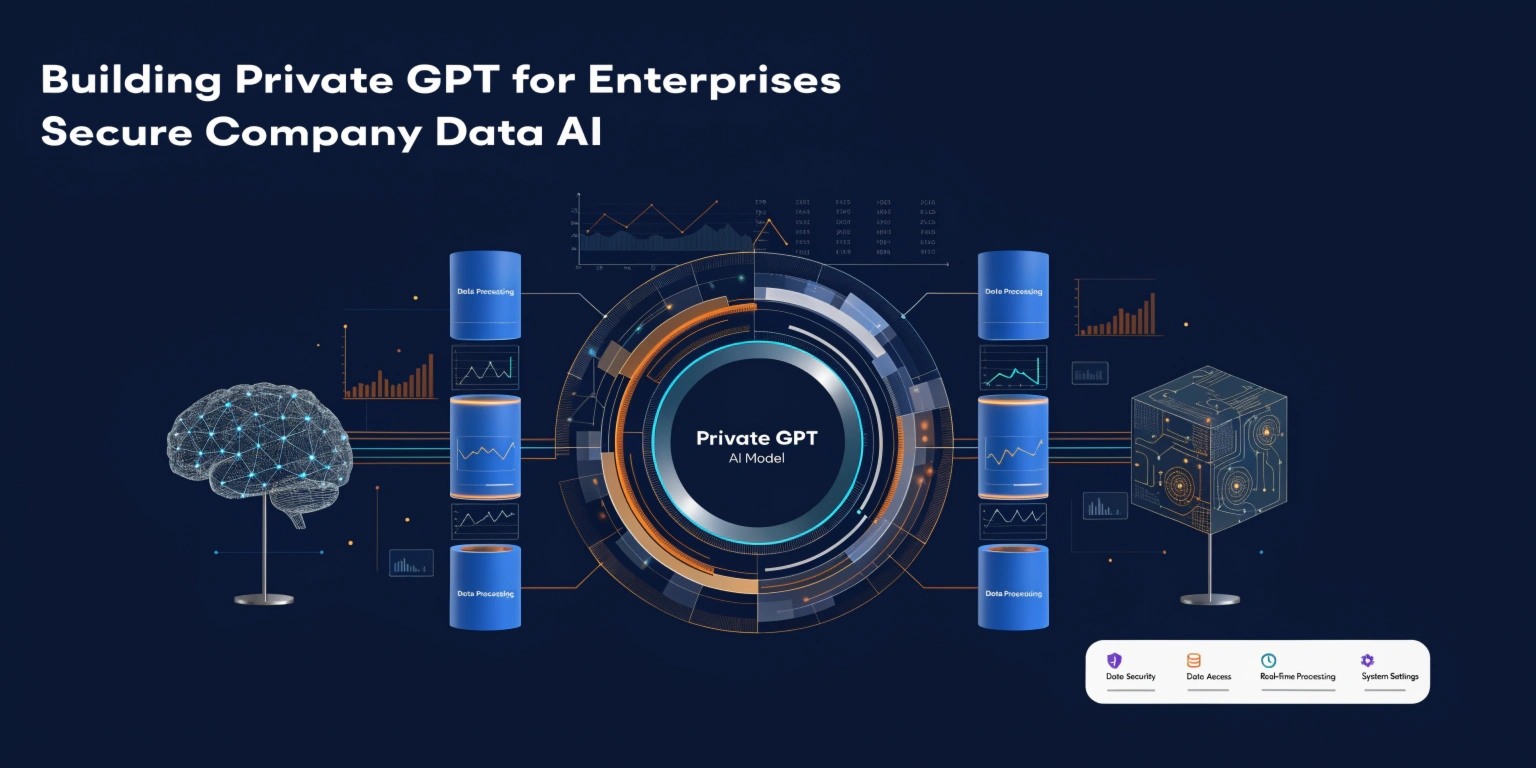
A typical Private GPT system consists of five major components.
1. Data Ingestion Layer
Company documents are collected:
- HR policies
- technical documentation
- contracts
- SOPs
- training manuals
The system parses and cleans the data.
2. Embedding Generation
Documents are converted into vector embeddings using an embedding model. These embeddings represent the meaning of text rather than keywords.
3. Vector Database
Embeddings are stored in a vector database. This allows semantic retrieval when users ask questions.
4. LLM Processing
When a user asks a question:
- The system searches relevant documents.
- Retrieved content is passed to the LLM.
- The model generates a contextual response.
This avoids exposing raw documents while still producing accurate answers.
5. Secure Interface
Employees interact via:
- web dashboard
- Slack/Teams bot
- internal portal
Access permissions determine what data each employee can view.
Security Considerations
Security is the main reason Private GPT exists.
Key protections include:
Access Control
Role-based permissions ensure HR data is not accessible to everyone.
Data Isolation
Each department’s knowledge can be restricted.
On-Premise or Private Cloud
Some companies deploy entirely inside their own infrastructure.
No Data Training Leakage
The model does not permanently learn confidential information.
Encryption
Data encrypted at rest and in transit.
Real Enterprise Use Cases
HR Assistant
Employees can instantly check:
- leave balance
- policies
- onboarding steps
HR teams save significant time.
IT Support
Internal AI answers:
- VPN setup
- password reset
- software installation
Reduces ticket volume dramatically.
Legal & Compliance
AI summarizes contracts and policies while keeping documents secure.
Sales Enablement
Sales teams ask:
- product specifications
- proposal templates
- pricing guidelines
This improves response speed to prospects.
Knowledge Management
Instead of searching folders, employees simply ask questions.
Private GPT vs Public AI Tools
Public AIPrivate GPTGeneral knowledgeCompany knowledgeInternet trainedInternal documentsData riskControlled securityNo permissionsRole-based access
Private GPT gives companies AI capability without losing data control.
Challenges
- Data preparation effort
- Access management complexity
- Infrastructure cost
- Ongoing document updates
- Governance policies
However, benefits usually outweigh implementation effort.
Best Practices
- Start with one department (HR or Support).
- Use RAG instead of full model training.
- Implement strong authentication.
- Monitor AI responses.
- Maintain updated documents.
Future of Enterprise AI
Private GPT represents the next stage of workplace software.
Instead of employees learning software tools, software will understand employees. The interface shifts from dashboards to conversations.
Companies adopting internal AI assistants early will gain productivity and operational efficiency advantages.
Final Thoughts
Private GPT enables organizations to safely unlock the value of their internal data. It bridges the gap between powerful AI capabilities and strict enterprise security requirements.
Rather than replacing employees, it acts as a knowledge accelerator — helping teams find answers instantly and work smarter.
The real competitive advantage in the AI era will not be who uses AI, but who uses their own knowledge with AI.