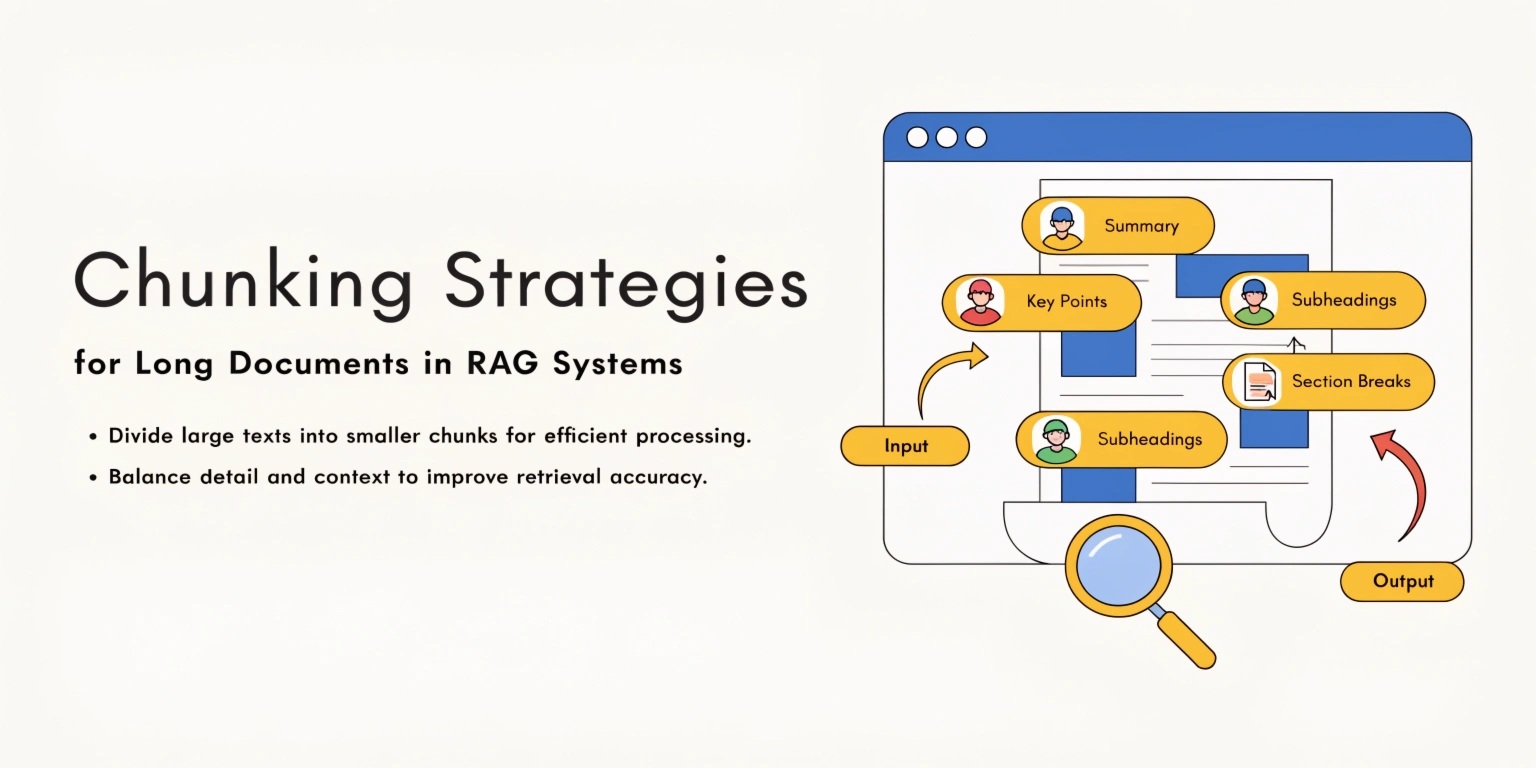
Retrieval-Augmented Generation (RAG) systems have become one of the most important architectures in modern artificial intelligence applications. As organizations increasingly rely on large language models (LLMs) for question answering, enterprise search, AI assistants, and knowledge management, efficient retrieval mechanisms are critical for delivering accurate and context-aware responses.
One of the most important components of a RAG pipeline is document chunking.
Chunking refers to the process of splitting large documents into smaller sections before generating embeddings and storing them in vector databases. Proper chunking strategies directly impact:
- Retrieval accuracy
- Semantic understanding
- Context relevance
- Response quality
- System efficiency
Poor chunking can significantly reduce RAG performance, even when powerful language models and advanced vector databases are used.
As enterprise AI systems continue handling increasingly massive knowledge bases, chunking strategies are becoming a core optimization challenge in modern AI engineering.
What is a RAG System?
Retrieval-Augmented Generation combines:
- Information retrieval systems
- Large language models
- Vector similarity search
Instead of relying only on pre-trained model knowledge, RAG systems retrieve relevant external documents during inference.
The workflow generally includes:
- User query input
- Query embedding generation
- Similarity search in vector database
- Relevant chunk retrieval
- Context injection into LLM
- Response generation
This architecture improves:
- Factual accuracy
- Domain-specific responses
- Knowledge freshness
- Enterprise AI reliability
RAG systems are widely used in:
- AI chatbots
- Enterprise search engines
- Customer support systems
- Legal document analysis
- Healthcare knowledge systems
- Research assistants
Why Chunking Matters in RAG Systems
Large documents often exceed LLM context limits.
For example:
- Research papers
- Technical documentation
- Legal contracts
- Medical records
- Company knowledge bases
These documents cannot simply be embedded as one massive block of text.
Chunking solves this problem by breaking documents into manageable sections.
However, chunk size and structure greatly influence:
- Retrieval precision
- Semantic coherence
- Information completeness
- Token efficiency
Incorrect chunking may cause:
- Context fragmentation
- Missing information
- Redundant retrieval
- Poor answer generation
Effective chunking ensures relevant information remains semantically meaningful during retrieval.
Fixed-Size Chunking
Fixed-size chunking is one of the simplest approaches.
Documents are divided into equal-length segments based on:
- Character count
- Word count
- Token count
For example:
- 500-token chunks
- 1000-character chunks
Advantages include:
- Easy implementation
- Consistent chunk sizes
- Predictable embedding behavior
However, fixed-size chunking may split:
- Sentences
- Paragraphs
- Logical ideas
This can reduce semantic coherence and retrieval quality.
Overlapping Chunking
To reduce information loss, many RAG systems use overlapping chunks.
In overlapping chunking:
- Consecutive chunks share partial content
Example:
- Chunk 1: Tokens 1–500
- Chunk 2: Tokens 400–900
Overlap helps preserve context continuity across chunk boundaries.
Benefits include:
- Better semantic retention
- Improved retrieval accuracy
- Reduced fragmentation problems
However, excessive overlap increases:
- Storage requirements
- Embedding costs
- Retrieval redundancy
Finding the right overlap balance is important for system optimization.
Semantic Chunking
Semantic chunking is a more advanced strategy that splits documents based on meaning rather than fixed size.
This approach uses:
- Sentence boundaries
- Topic transitions
- Paragraph structures
- NLP-based semantic analysis
Instead of arbitrary splitting, semantic chunking preserves logical information units.
Advantages include:
- Better context integrity
- Improved retrieval precision
- Higher-quality LLM responses
Semantic chunking works especially well for:
- Technical documentation
- Research papers
- Knowledge bases
- Legal documents
However, semantic chunking is computationally more complex.
Recursive Chunking
Recursive chunking combines hierarchical splitting techniques.
The process typically follows:
- Split by sections
- Split by paragraphs
- Split by sentences if needed
This creates flexible chunk sizes while preserving document structure.
Recursive chunking is widely used because it balances:
- Semantic quality
- Chunk consistency
- Context preservation
Modern RAG frameworks often implement recursive chunking strategies by default.
Context Window Considerations
Chunking strategy must align with LLM context limitations.
Different models support different context windows.
Larger context windows allow:
- Bigger chunks
- More retrieved context
- Richer reasoning capabilities
However, larger chunks may reduce retrieval precision because embeddings become less focused.
The ideal chunk size depends on:
- Document type
- Query complexity
- Retrieval goals
- Model architecture
There is no universal chunk size suitable for all applications.
Metadata-Aware Chunking
Modern enterprise RAG systems increasingly use metadata-enhanced chunking.
Chunks may include metadata such as:
- Document title
- Author
- Section headers
- Timestamps
- Source references
- Tags
Metadata improves retrieval filtering and contextual relevance.
For example:
- Legal AI systems may filter by case type
- Healthcare systems may filter by specialty
- Enterprise systems may filter by department
Metadata-aware retrieval significantly improves scalability.
Hybrid Chunking Strategies
Many production-grade RAG systems combine multiple chunking methods.
Hybrid strategies may include:
- Semantic chunking with overlap
- Recursive chunking with metadata
- Dynamic token-aware chunking
Hybrid approaches optimize:
- Retrieval relevance
- Computational efficiency
- Response quality
Enterprise AI systems increasingly rely on adaptive chunking pipelines.
Vector Databases and Chunking
Chunking directly impacts vector database performance.
Popular vector databases include:
- Pinecone
- Weaviate
- Milvus
Efficient chunking improves:
- Similarity search accuracy
- Embedding quality
- Query latency
- Storage optimization
Poor chunk structures reduce embedding effectiveness and retrieval quality.
Challenges in Document Chunking
Despite its importance, chunking introduces several technical challenges.
Context Fragmentation
Important information may become split across multiple chunks.
Redundant Retrieval
Overlapping chunks may generate duplicate search results.
Token Limit Constraints
Large chunks may exceed embedding or model token limits.
Computational Cost
Advanced semantic chunking increases preprocessing complexity.
Dynamic Content Handling
Updating documents requires re-indexing affected chunks efficiently.
Balancing these trade-offs is a major challenge in production RAG systems.
AI-Powered Adaptive Chunking
Future RAG systems may use AI-driven adaptive chunking techniques.
These systems could dynamically adjust chunking based on:
- Query intent
- Document structure
- Semantic density
- User behavior
- Retrieval history
Adaptive chunking may significantly improve enterprise AI performance.
Best Practices for Chunking in RAG Systems
Preserve Semantic Meaning
Avoid splitting related ideas unnaturally.
Use Moderate Overlap
Maintain context continuity without excessive redundancy.
Match Chunk Size to Use Case
Different applications require different chunk structures.
Include Metadata
Metadata improves filtering and contextual retrieval.
Test Retrieval Performance Continuously
Chunking should be optimized using evaluation metrics and real-world queries.
Conclusion
Chunking strategies play a foundational role in the performance of Retrieval-Augmented Generation (RAG) systems. Effective chunking directly impacts retrieval quality, semantic relevance, LLM accuracy, and overall system scalability.
As enterprise AI adoption continues growing, optimizing document chunking will become increasingly important for building reliable AI assistants, intelligent search systems, and knowledge-driven applications.
Organizations that carefully design chunking strategies based on semantic structure, retrieval goals, and model architecture will gain significant advantages in AI system performance, efficiency, and user experience.