As organizations increasingly migrate their infrastructure, applications, and services to the cloud, managing cloud expenses has become a critical business priority. While cloud computing offers scalability, flexibility, and innovation, uncontrolled spending can quickly lead to budget overruns and reduced profitability.
This challenge has given rise to FinOps (Financial Operations), a rapidly growing discipline that combines finance, technology, and business operations to optimize cloud spending. Among cloud platforms, Amazon Web Services (AWS) remains the most widely adopted, making AWS FinOps skills some of the most sought-after capabilities in today's technology landscape.
Organizations are actively seeking professionals who can balance innovation with cost efficiency while ensuring maximum value from cloud investments.
What is FinOps?
FinOps, short for Financial Operations, is a cloud financial management practice that helps organizations gain visibility, control, and accountability over cloud expenditures.
Rather than treating cloud costs as a fixed IT expense, FinOps encourages collaboration among engineering, finance, and business teams to make informed spending decisions.
The primary objectives of FinOps include:
- Optimizing cloud spending
- Increasing cost transparency
- Improving financial accountability
- Enhancing resource efficiency
- Maximizing business value
As cloud adoption continues to accelerate, FinOps has become an essential strategy for sustainable growth.
Why AWS Cost Optimization Matters
AWS offers hundreds of services that provide incredible flexibility. However, this flexibility can also result in wasted resources if not properly managed.
Common causes of unnecessary AWS spending include:
- Idle virtual machines
- Overprovisioned resources
- Unused storage volumes
- Inefficient database configurations
- Lack of cost monitoring
- Poor resource tagging practices
Without proper governance, cloud costs can increase significantly over time.
AWS FinOps professionals help organizations identify inefficiencies and implement optimization strategies that reduce expenses without compromising performance.
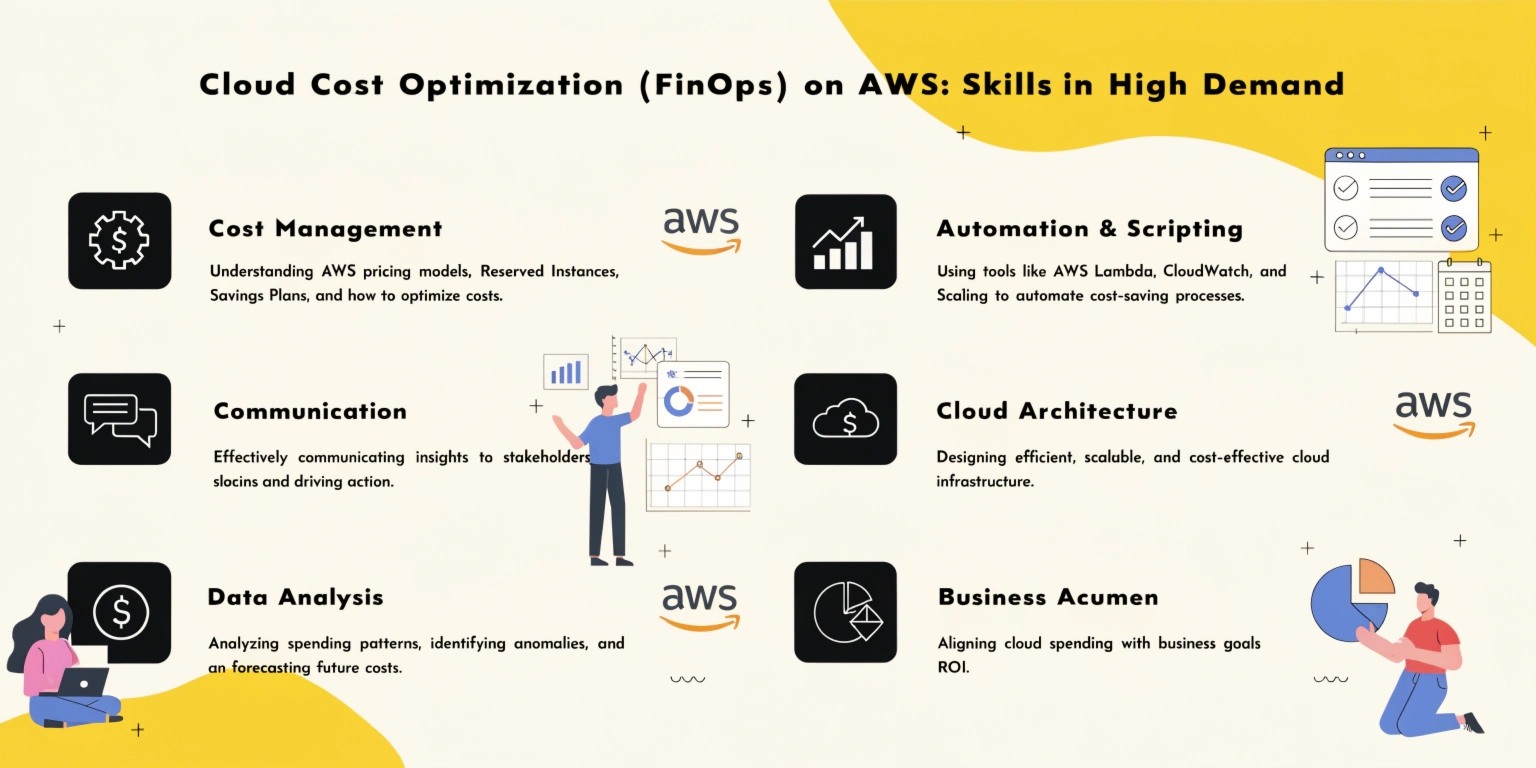
Essential AWS FinOps Skills in High Demand
1. AWS Cost Monitoring and Analysis
One of the foundational FinOps skills is the ability to analyze cloud spending patterns.
Professionals should be proficient with:
- AWS Cost Explorer
- AWS Budgets
- AWS Billing Dashboard
- AWS Cost and Usage Reports
These tools provide visibility into spending trends, service utilization, and cost drivers.
By understanding where money is being spent, organizations can make informed optimization decisions.
2. Resource Rightsizing
Rightsizing involves matching cloud resources to actual workload requirements.
Many organizations deploy larger instances than necessary, resulting in excessive costs.
FinOps specialists evaluate:
- CPU utilization
- Memory usage
- Storage consumption
- Network traffic
Based on usage patterns, they recommend appropriately sized resources that maintain performance while reducing expenses.
Rightsizing often delivers immediate and substantial cost savings.
3. Reserved Instances and Savings Plans Management
AWS provides pricing models designed to reduce long-term costs.
Key options include:
- Reserved Instances (RIs)
- Savings Plans
- Spot Instances
FinOps professionals must understand when and how to leverage these pricing models effectively.
By strategically purchasing commitments based on workload patterns, organizations can achieve significant savings compared to on-demand pricing.
4. Cloud Cost Forecasting and Budgeting
Accurate forecasting is essential for financial planning.
AWS FinOps professionals use historical spending data and growth projections to:
- Predict future costs
- Set departmental budgets
- Identify spending anomalies
- Improve financial planning
Cost forecasting helps businesses avoid unexpected expenses while supporting long-term cloud strategies.
5. Automation for Cost Optimization
Manual cost management becomes increasingly difficult as cloud environments scale.
Automation is therefore a highly valuable FinOps skill.
Common automation initiatives include:
- Automatic resource shutdown schedules
- Idle resource detection
- Storage lifecycle policies
- Auto-scaling configurations
- Cost anomaly alerts
Automation reduces human intervention while ensuring continuous optimization.
6. Resource Tagging and Cost Allocation
Effective cost allocation requires proper resource tagging.
AWS tagging enables organizations to categorize resources by:
- Department
- Project
- Environment
- Business unit
- Application
This improves financial visibility and accountability across teams.
Accurate tagging also supports chargeback and showback models commonly used in enterprise environments.
7. Cloud Governance and Compliance
Strong governance practices prevent unnecessary spending and promote responsible cloud usage.
FinOps professionals establish policies that define:
- Resource provisioning standards
- Budget thresholds
- Approval workflows
- Cost accountability measures
Governance frameworks ensure cloud environments remain efficient as organizations grow.
8. Data Analytics and Reporting
Cloud cost optimization relies heavily on data-driven decision-making.
AWS FinOps professionals must be comfortable working with:
- Financial reports
- Utilization metrics
- Cost dashboards
- Trend analysis
- Executive reporting
The ability to translate technical spending data into business insights is highly valued by organizations.
The Growing Demand for AWS FinOps Professionals
Cloud spending continues to increase globally, creating strong demand for professionals with FinOps expertise.
Companies are actively hiring:
- FinOps Analysts
- Cloud Financial Managers
- Cloud Economists
- AWS Solutions Architects
- Cloud Operations Engineers
- DevOps Engineers with FinOps skills
Organizations recognize that every dollar saved through optimization can be reinvested into innovation, growth, and digital transformation initiatives.
As a result, FinOps expertise is becoming a strategic business capability rather than simply a technical function.
Best Practices for AWS Cost Optimization
Successful AWS FinOps programs typically follow several proven strategies:
Establish Cost Visibility
Create centralized dashboards that provide real-time visibility into cloud spending.
Implement Continuous Monitoring
Monitor costs regularly rather than conducting periodic reviews.
Optimize Resource Utilization
Continuously identify and eliminate underutilized resources.
Encourage Cross-Functional Collaboration
Bring finance, engineering, and leadership teams together to align cloud spending with business objectives.
Leverage AWS Native Tools
Utilize AWS Cost Explorer, Budgets, Trusted Advisor, and Compute Optimizer to identify optimization opportunities.
The Future of FinOps on AWS
The FinOps landscape continues to evolve alongside cloud technologies.
Emerging trends include:
- AI-powered cost optimization
- Predictive cloud budgeting
- Automated cost governance
- Multi-cloud FinOps management
- Real-time spending analytics
As organizations continue expanding their cloud footprints, FinOps will play an increasingly important role in maximizing efficiency and profitability.
Professionals who develop AWS FinOps expertise today position themselves for strong career growth and exciting opportunities in cloud management.
Conclusion
Cloud Cost Optimization through FinOps has become a critical business function in the AWS ecosystem. Organizations are no longer focused solely on cloud adoption—they are focused on cloud efficiency.
From resource rightsizing and budgeting to automation and governance, AWS FinOps professionals help businesses achieve greater financial control while maintaining performance and scalability. As cloud investments continue to grow, the demand for FinOps expertise will only increase.
Developing AWS FinOps skills is an excellent opportunity for IT professionals seeking to advance their careers while helping organizations unlock greater value from their cloud infrastructure.