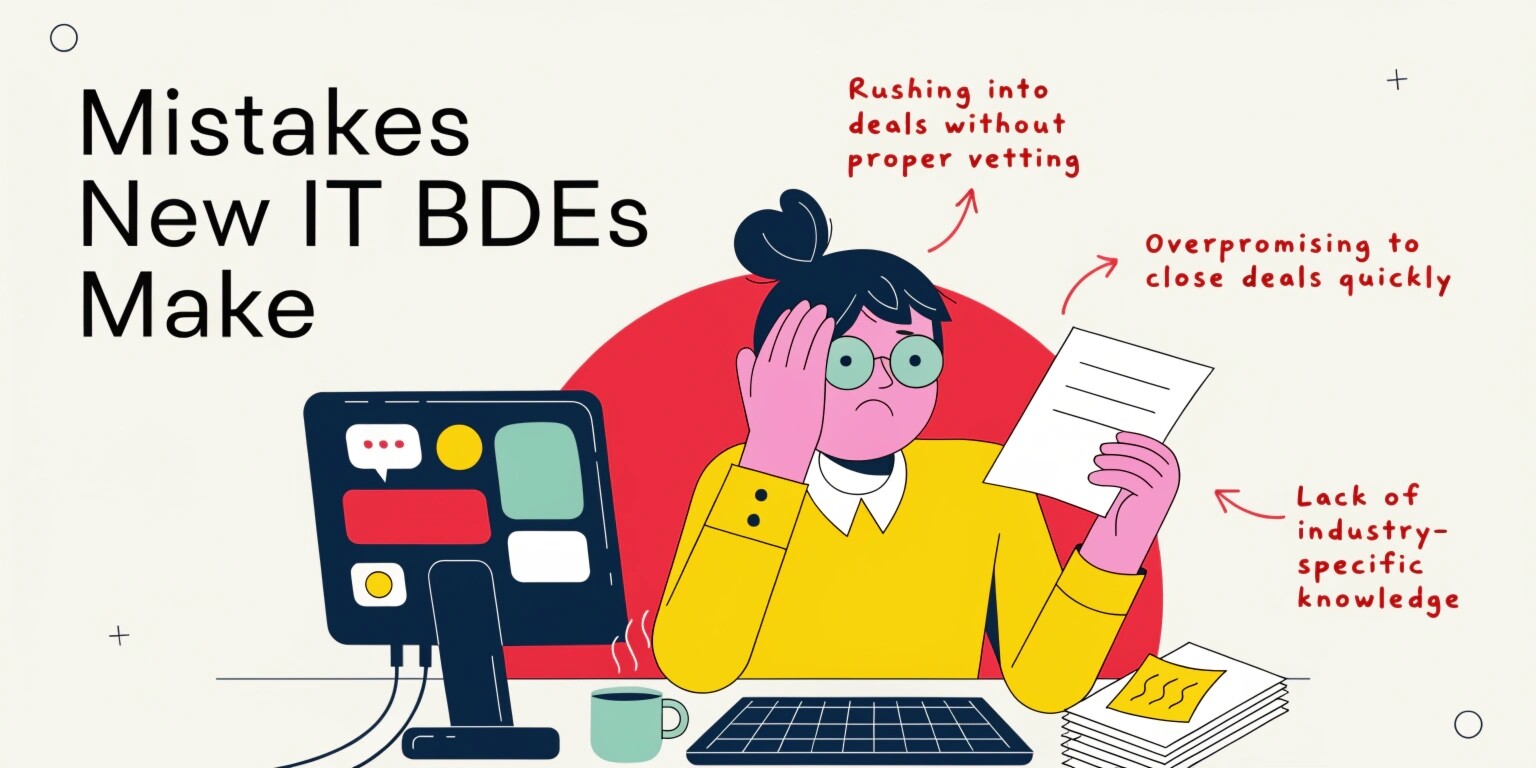
Starting a career as an IT Business Development Executive (BDE) can be exciting and challenging at the same time. The IT industry is highly competitive, and companies expect BDEs to generate quality leads, build client relationships, and bring business opportunities consistently.
However, many new IT BDEs make common mistakes that reduce conversions, damage client trust, and slow career growth.
The good news is that most of these mistakes are avoidable with the right mindset, strategy, and communication skills.
Let’s explore the most common mistakes new IT BDEs make and how to avoid them effectively.
1. Focusing on Quantity Instead of Quality
One of the biggest mistakes beginners make is sending hundreds of random messages without targeting the right audience.
Many new BDEs believe:
“More messages = More clients.”
But in reality:
Poorly targeted outreach wastes time and lowers response rates.
Instead:
- Research the client’s business
- Understand their requirements
- Personalize communication
- Focus on relevant industries
A few high-quality leads are far more valuable than hundreds of irrelevant contacts.
2. Lack of Technical Understanding
An IT BDE does not need to become a developer, but basic technical understanding is essential.
Many beginners fail because they:
- Cannot explain services properly
- Use incorrect technical terms
- Overpromise unrealistic features
Clients trust BDEs who understand:
- Web development
- Mobile applications
- AI/ML solutions
- UI/UX concepts
- Software workflows
The more technically aware you are, the more confidently you can communicate with clients.
3. Writing Generic Proposals
Another major mistake is copying the same proposal for every client.
Clients receive dozens of proposals daily. Generic messages like:
“We can do your project perfectly.”
Usually get ignored.
Instead:
- Mention the client’s exact requirement
- Explain how your company can help
- Highlight relevant experience
- Keep the proposal concise and professional
Personalized proposals increase response rates significantly.
4. Poor Follow-Up Strategy
Many new BDEs either:
- Never follow up
- OR
- Follow up too aggressively
Both are harmful.
Clients are busy and may not respond immediately. A professional follow-up strategy is important.
Good follow-up practices:
- Wait 2–3 days before following up
- Keep messages polite and short
- Add value instead of just asking for updates
Example:
Instead of:
“Any update?”
Say:
“I wanted to share a few additional ideas that may help your project.”
Smart follow-ups keep conversations active without annoying clients.
5. Talking Too Much About Services
New BDEs often focus only on company services instead of client problems.
Clients do not care about:
- Your company history
- Office size
- Team count
They care about:
- Solving their problem
- Saving time
- Increasing revenue
- Improving efficiency
Shift the conversation from:
“What we do”
To:
“How we help businesses.”
This creates stronger client interest.
6. Ignoring LinkedIn Optimization
LinkedIn is one of the most powerful platforms for IT business development.
However, many beginners:
- Have incomplete profiles
- Use unprofessional messages
- Do not post industry content
A strong LinkedIn presence builds credibility.
Best practices:
- Use professional profile photos
- Add clear headlines
- Share valuable content regularly
- Engage with industry discussions
Clients often check LinkedIn before responding.
7. Fear of Rejection
Rejection is normal in business development.
Many new BDEs become discouraged after:
- Ignored messages
- Rejected proposals
- Unanswered emails
But experienced professionals understand:
Business development is a numbers and consistency game.
Every rejection improves:
- Communication
- Targeting
- Sales understanding
Confidence grows with experience.
8. Not Understanding Client Requirements Properly
Sometimes beginners rush to close deals without fully understanding project requirements.
This creates:
- Miscommunication
- Wrong quotations
- Client dissatisfaction
Always ask:
- Project goals
- Features required
- Budget expectations
- Timeline
- Target audience
Good requirement analysis improves both trust and project success.
9. Depending on Only One Lead Source
Many BDEs rely only on:
- Upwork
- Freelancer
This limits opportunities.
Successful BDEs use multiple channels:
- Cold emails
- LinkedIn outreach
- Networking
- Referrals
- Social media marketing
- Content marketing
Diversified lead generation creates stable business opportunities.
10. Lack of Patience and Consistency
Business development takes time.
Many beginners expect instant results within days.
In reality:
- Trust takes time
- Relationships take time
- Conversions take time
Consistency is the key to success.
Daily habits matter:
- Prospecting
- Learning
- Networking
- Follow-ups
- Content sharing
Small consistent actions produce long-term growth.
Conclusion
The journey of an IT BDE is full of learning experiences. Mistakes are natural, especially in the beginning. What matters most is the ability to learn, adapt, and improve continuously.
The most successful IT BDEs are not necessarily the most aggressive sellers — they are the best communicators, problem solvers, and relationship builders.
By avoiding these common mistakes and focusing on value-driven communication, new BDEs can build stronger client relationships, improve conversions, and create a successful career in the IT industry.
Because in business development:
Trust closes more deals than sales pressure ever will.