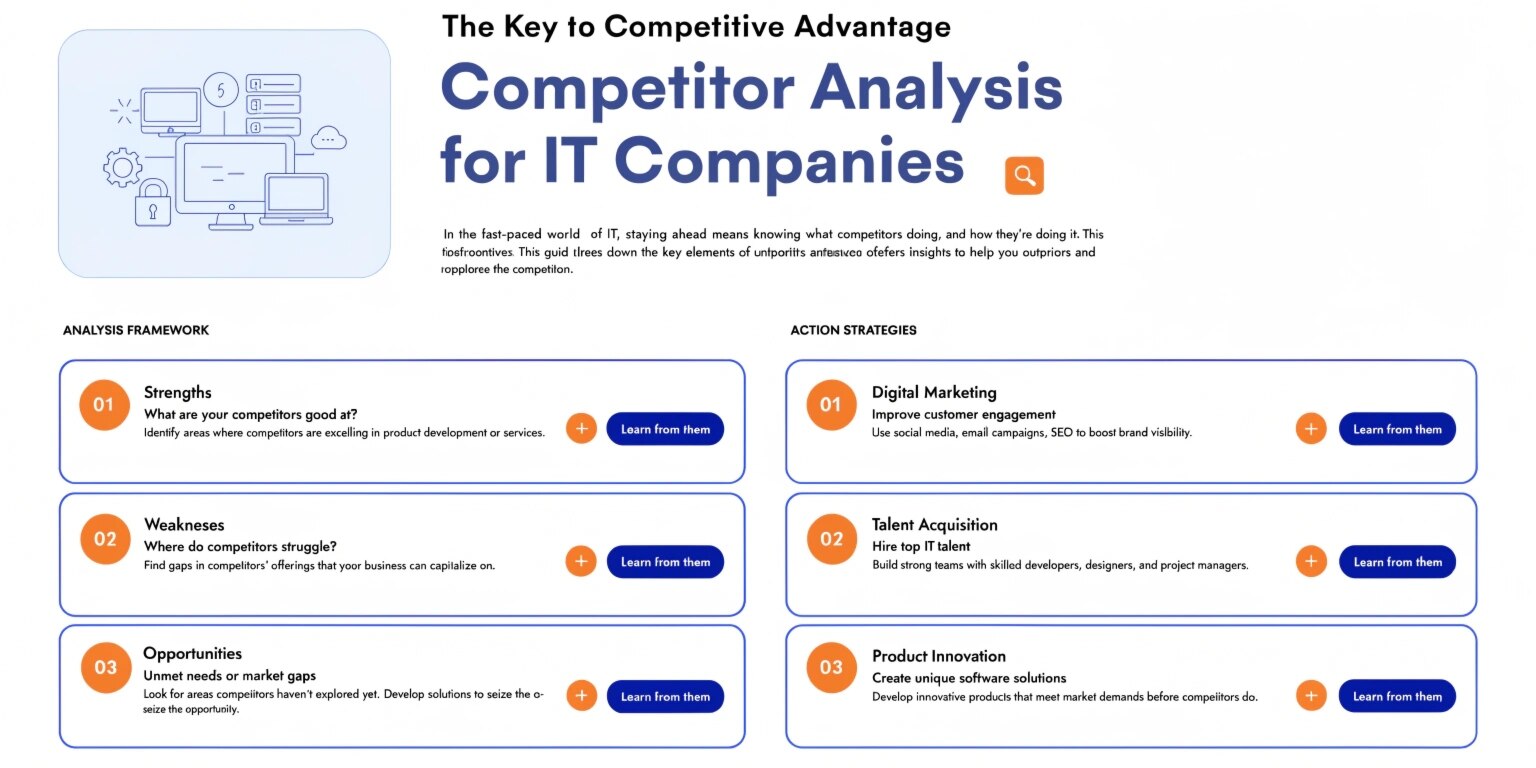
In today’s competitive IT landscape, offering quality services alone is not enough. To grow and stay ahead, IT companies must understand what their competitors are doing—and how they can do it better.
Competitor analysis is a strategic process that helps businesses evaluate their rivals, identify market gaps, and refine their own strategies. For IT companies, this can directly impact client acquisition, pricing, and overall business growth.
What is Competitor Analysis?
Competitor analysis involves researching and evaluating other companies in your industry to understand:
- Their services and offerings
- Pricing models
- Marketing strategies
- Strengths and weaknesses
The goal is not to copy competitors but to differentiate and outperform them.
Why Competitor Analysis is Important for IT Companies
1. Identify Market Gaps
By analyzing competitors, you can find underserved areas or niches that your company can target.
2. Improve Service Offerings
Understanding competitor services helps you enhance your own offerings.
3. Better Pricing Strategy
You can position your pricing competitively without undervaluing your services.
4. Stronger Client Acquisition
Insights from competitors help refine your sales and marketing strategies.
Step-by-Step Competitor Analysis Process
1. Identify Your Competitors
Start by categorizing competitors into:
- Direct competitors (same services, same audience)
- Indirect competitors (similar solutions, different approach)
Platforms like Upwork and Clutch can help identify competitors in your niche.
2. Analyze Their Services
Evaluate:
- Core services offered
- Technology stack
- Specializations
Look for gaps where your company can provide better or unique solutions.
3. Study Their Online Presence
Check:
- Website design and content
- SEO strategies
- Social media activity
Tools like SEMrush and Ahrefs can help analyze traffic, keywords, and backlinks.
4. Evaluate Pricing Models
Understand how competitors price their services:
- Fixed pricing
- Hourly rates
- Subscription models
This helps you position your pricing strategically.
5. Analyze Client Reviews & Feedback
Client reviews provide valuable insights into:
- Strengths
- Weaknesses
- Customer expectations
Look for patterns in complaints and use them as opportunities.
6. Conduct SWOT Analysis
Perform a SWOT (Strengths, Weaknesses, Opportunities, Threats) analysis for each competitor.
This helps you:
- Identify your advantages
- Spot improvement areas
- Plan strategic actions
Key Metrics to Track
- Website traffic
- Conversion rates
- Client acquisition channels
- Project pricing
- Service demand
Tracking these metrics helps you benchmark performance.
Competitor Analysis Tools for IT Companies
- SEMrush – SEO and traffic analysis
- Ahrefs – backlink and keyword research
- Google Analytics – performance tracking
- Clutch – client reviews and ratings
How to Use Competitor Insights Effectively
1. Differentiate Your Services
Offer unique value instead of copying competitors.
2. Improve Your Marketing Strategy
Adopt strategies that work while avoiding ineffective ones.
3. Enhance Client Communication
Address common pain points identified in competitor reviews.
4. Focus on Niche Expertise
Specialization helps you stand out in a crowded market.
Common Mistakes to Avoid
- Copying competitors blindly
- Ignoring smaller competitors
- Focusing only on pricing
- Not updating analysis regularly
Competitor analysis should be an ongoing process.
Advanced Strategies for IT Companies
1. Reverse Engineer Competitor Funnels
Analyze how competitors attract, convert, and retain clients.
2. Content Gap Analysis
Identify topics competitors haven’t covered and create valuable content.
3. BDE Intelligence Strategy
Train your Business Development team to:
- Understand competitor positioning
- Pitch your strengths effectively
- Handle client objections confidently
Real-World Impact
Effective competitor analysis can lead to:
- Better positioning in the market
- Higher client conversion rates
- Improved service quality
- Stronger brand identity
Conclusion
Competitor analysis is not just about understanding your rivals—it’s about discovering opportunities to improve, innovate, and grow. For IT companies, it provides valuable insights that can shape business strategy, enhance client acquisition, and drive long-term success.
By continuously analyzing competitors and adapting your approach, you can stay ahead in a competitive market and build a strong, sustainable business.