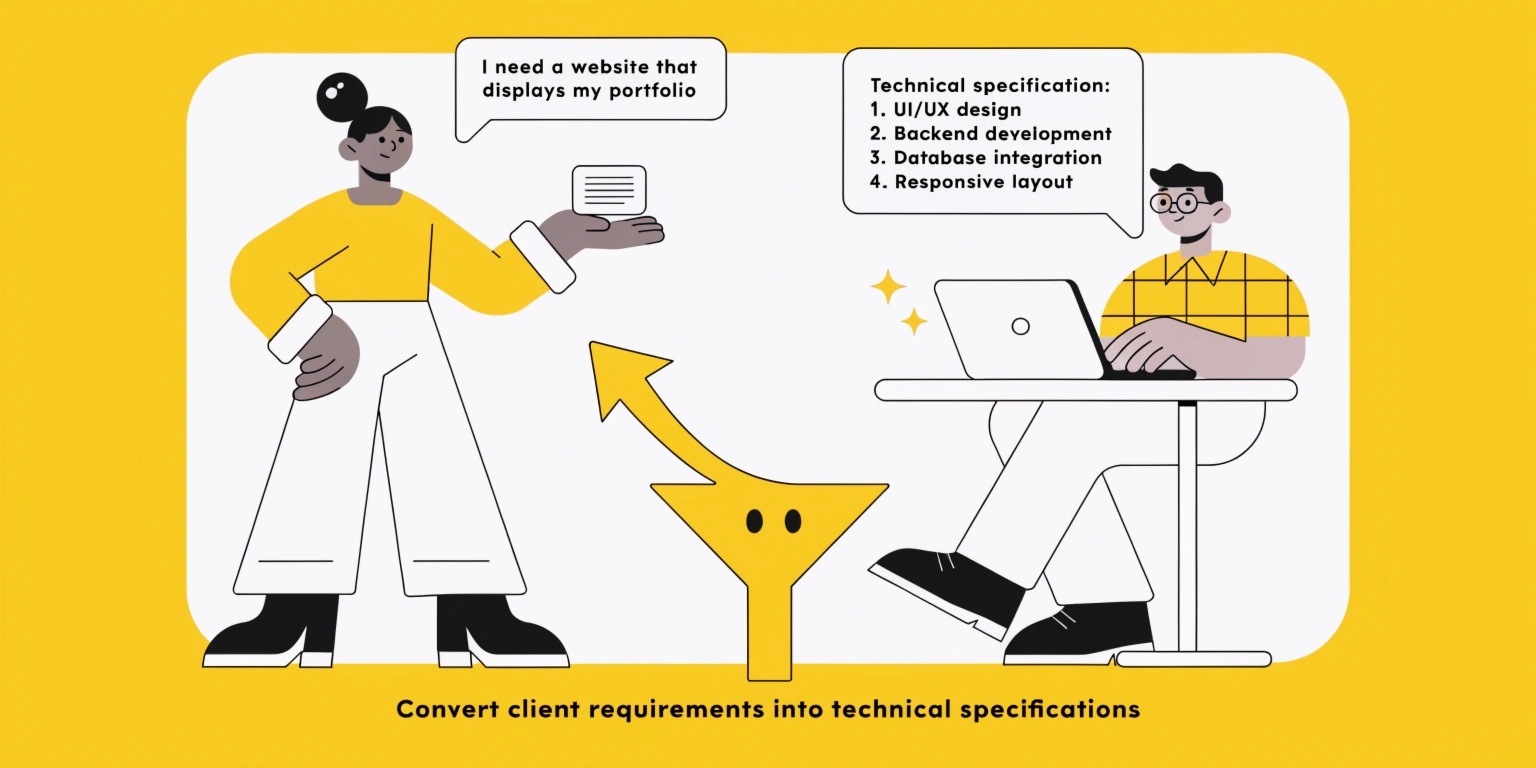
One of the biggest challenges in software development is transforming a client’s vision into a clear and executable technical plan. Clients often describe their ideas in business terms, while developers think in terms of architecture, frameworks, APIs, databases, and workflows.
Bridging this communication gap is essential for successful project execution. This is where the process of converting client requirements into technical specifications becomes critically important.
A well-prepared technical specification acts as the foundation of a software project. It helps development teams understand exactly what needs to be built while ensuring that the final product aligns with the client’s expectations.
Without clear specifications, projects often face:
- Scope creep
- Delays
- Budget overruns
- Miscommunication
- Poor user experience
- Failed deliverables
Modern software companies treat requirement analysis and technical documentation as strategic parts of the development lifecycle.
What Are Client Requirements?
Client requirements represent the business needs, goals, and expectations that a customer wants the software solution to fulfill.
These requirements may include:
- Business objectives
- User workflows
- Features and functionality
- Design preferences
- Performance expectations
- Security requirements
- Integration needs
Clients usually communicate requirements in non-technical language focused on outcomes rather than implementation details.
For example:
- “Users should be able to book appointments online.”
- “The system should send automated notifications.”
- “We need secure payment processing.”
The development team must translate these business expectations into technical instructions.
What Are Technical Specifications?
Technical specifications are detailed documents that describe how the software system will be designed, developed, and implemented.
They define:
- System architecture
- Functional requirements
- APIs and integrations
- Database structures
- User authentication methods
- Performance standards
- Technology stack
- Security measures
Technical specifications provide developers with a clear roadmap for execution.
Why Technical Specifications Matter
Well-defined technical specifications offer several advantages:
Improved Communication
Technical documentation creates a shared understanding between:
- Clients
- Business analysts
- Developers
- Designers
- QA teams
- Project managers
This reduces confusion and minimizes assumptions.
Reduced Project Risks
Clear specifications help identify:
- Missing requirements
- Technical limitations
- Resource dependencies
- Scalability concerns
Early identification prevents costly changes later in development.
Better Time and Cost Estimation
Accurate technical documentation allows teams to estimate:
- Development effort
- Infrastructure needs
- Timelines
- Testing requirements
Without detailed specifications, project estimation becomes unreliable.
Easier Quality Assurance
QA teams use technical specifications to validate whether the delivered system matches expected functionality.
This improves testing accuracy and product reliability.
Steps to Convert Client Requirements into Technical Specifications
1. Requirement Gathering
The first step is understanding the client’s business goals thoroughly.
This often involves:
- Client meetings
- Workshops
- Discovery sessions
- Surveys
- Stakeholder interviews
The objective is not just to collect features, but to understand:
- Why the feature is needed
- Who will use it
- What business problem it solves
Good requirement gathering reduces ambiguity significantly.
2. Requirement Analysis
After collecting information, teams analyze the requirements to identify:
- Functional requirements
- Non-functional requirements
- Technical dependencies
- Feasibility constraints
Functional requirements define what the system should do.
Example:
- User registration
- Product search
- Payment processing
Non-functional requirements define how the system should perform.
Example:
- Scalability
- Security
- Performance
- Reliability
Business analysts and solution architects often play a critical role in this stage.
3. Define User Flows and Use Cases
Understanding how users interact with the system helps convert business goals into structured workflows.
User flows define:
- Navigation paths
- Actions and responses
- System behavior
- Decision points
Use cases help developers understand practical implementation scenarios.
For example:
- Customer login process
- Admin dashboard workflow
- Order checkout process
Visual diagrams and wireframes are often useful during this phase.
4. Choose the Technical Architecture
Once requirements are clarified, technical teams determine the best architecture for the solution.
This includes:
- Frontend framework
- Backend technology
- Database system
- Cloud infrastructure
- API architecture
- Security protocols
Companies may use technologies from providers such as Amazon Web Services, Microsoft Azure, or Google Cloud Platform depending on scalability and infrastructure needs.
Architecture decisions directly affect:
- Performance
- Scalability
- Maintenance costs
- Future expansion
5. Document Functional Specifications
Functional specifications describe how each feature should behave.
This may include:
- Inputs and outputs
- Validation rules
- User permissions
- API responses
- Workflow logic
- Business rules
Clear functional documentation ensures consistency during development.
6. Define Non-Functional Specifications
Non-functional specifications focus on system quality attributes.
These include:
- Security standards
- Load handling capacity
- Performance benchmarks
- Backup and recovery plans
- Compliance requirements
For enterprise applications, non-functional requirements are often as important as features themselves.
7. Create API and Database Specifications
Modern applications rely heavily on APIs and structured databases.
Technical documentation should define:
- API endpoints
- Authentication methods
- Data schemas
- Database relationships
- Third-party integrations
This helps frontend and backend teams work efficiently in parallel.
8. Validate Specifications with Stakeholders
Before development begins, technical specifications should be reviewed and approved by:
- Clients
- Project managers
- Developers
- QA teams
Validation helps ensure:
- Requirements are understood correctly
- Technical feasibility is confirmed
- Business goals remain aligned
This step significantly reduces future rework.
Common Challenges in Requirement Conversion
Ambiguous Client Expectations
Clients may not always express requirements clearly.
Skilled analysts must ask:
- Clarifying questions
- Real-world usage scenarios
- Priority discussions
Scope Creep
Requirements often evolve during development.
Strong documentation and change management processes help control uncontrolled scope expansion.
Technical Limitations
Some client expectations may exceed technical or budget limitations.
Teams must balance:
- Feasibility
- Cost
- Performance
- Delivery timelines
Best Practices for Effective Technical Specifications
Use Clear Language
Avoid overly complex technical jargon when possible.
Documentation should remain understandable for both technical and non-technical stakeholders.
Keep Documentation Structured
Well-organized documentation improves readability and collaboration.
Use Visual Aids
Diagrams, flowcharts, wireframes, and architecture visuals improve understanding significantly.
Maintain Continuous Communication
Frequent communication between clients and technical teams reduces misunderstandings.
Conclusion
Converting client requirements into technical specifications is one of the most important steps in successful software development. It bridges the gap between business vision and technical execution while reducing project risks and improving development efficiency.
Clear technical specifications help teams build scalable, reliable, and user-focused solutions that align with business goals. As software systems become increasingly complex, organizations that invest in strong requirement analysis and technical documentation processes gain a significant competitive advantage in delivering high-quality digital products.