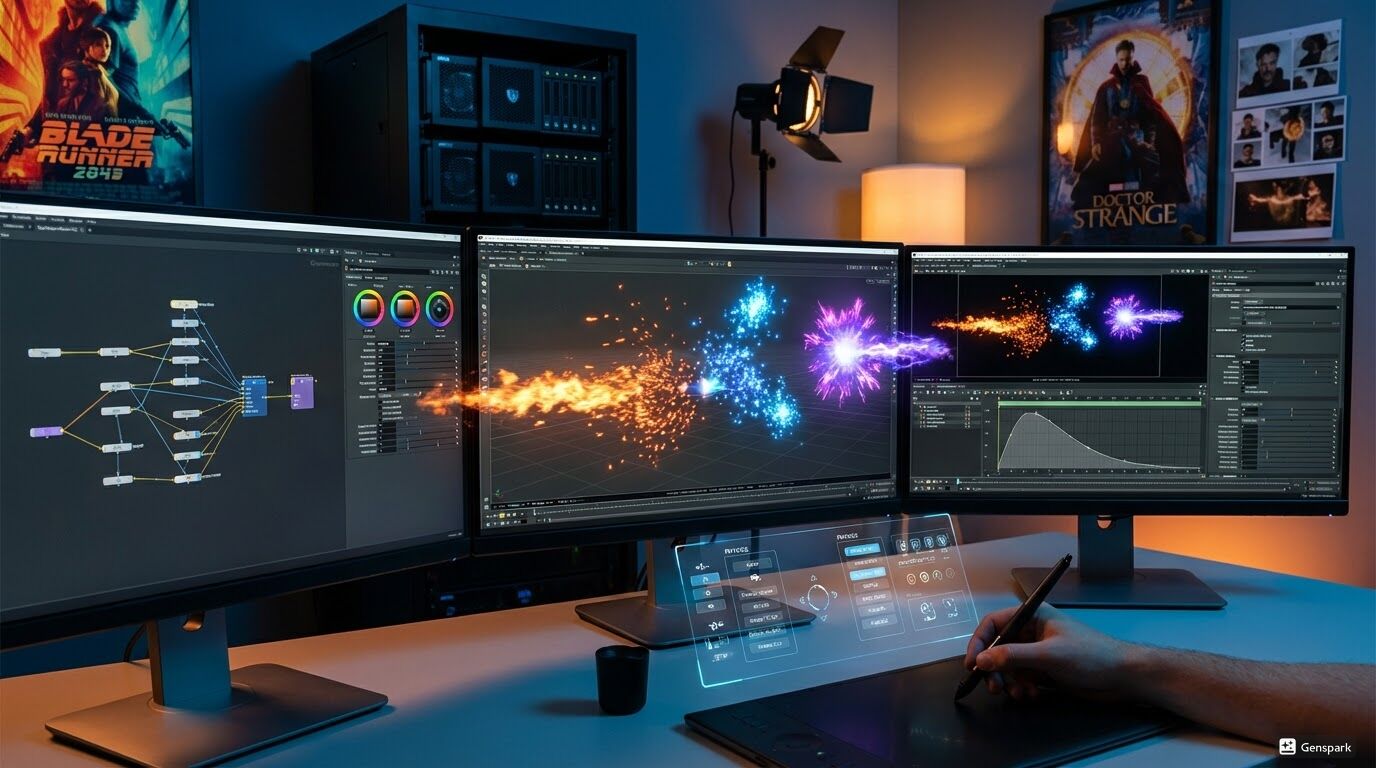
Visual effects are what make a game feel alive. When a sword strikes, a gun fires, or a car crashes, players expect a satisfying visual response. These effects — sparks, smoke, dust, rain, fire, or magic — are created using particle systems.
A particle system is a technique used in game development to simulate many small objects (particles) that behave together to form a larger visual effect. Instead of animating each object manually, developers control groups of particles using physics rules and parameters. This allows games to produce complex effects efficiently in real time.
What is a Particle System?
A particle system consists of thousands (sometimes millions) of tiny sprites or points rendered on screen. Each particle has properties such as:
- Position
- Velocity
- Lifetime
- Size
- Color
- Rotation
- Transparency
Individually, a particle looks like a dot or small texture. Together, they create effects such as smoke, fire, water splashes, or magic spells.
Key Components of Particle Systems
1. Emitter
The emitter is the source that generates particles. It controls:
- Spawn rate (particles per second)
- Direction
- Shape of emission
Emitter shapes include:
- Point (torch fire)
- Cone (rocket trail)
- Sphere (explosion)
- Box (rainfall)
The emitter determines the base appearance of the effect.
2. Particle Lifetime
Lifetime defines how long a particle exists. For example:
- Sparks: 0.2–0.5 seconds
- Smoke: 2–5 seconds
- Fog: 10+ seconds
As the particle ages, its size, color, and opacity can change to create natural motion.
3. Velocity and Forces
Particles move using velocity and forces. Developers simulate natural behavior using:
- Gravity
- Wind
- Drag
- Turbulence
Example:
- Smoke rises upward (negative gravity)
- Rain falls downward (positive gravity)
4. Size and Color Over Time
One of the most important techniques is changing particle properties during its life.
Typical transitions:
- Fire: yellow → orange → dark red → transparent
- Smoke: dark grey → light grey → invisible
- Explosion: bright flash → expanding smoke
This gives realism without complex 3D animation.
5. Textures & Shaders
Particles usually use transparent textures like:
- Soft circles
- Flames
- Clouds
- Spark shapes
Shaders control how particles interact with light. Additive blending is commonly used for glowing effects like fire, laser, or magic spells.
Types of Game Effects Created with Particle Systems
Environmental Effects
- Rain
- Snow
- Fog
- Sandstorms
- Waterfalls
Combat Effects
- Bullet impacts
- Blood splatter
- Explosion blasts
- Weapon trails
Fantasy & Magic Effects
- Spells
- Energy beams
- Portals
- Aura effects
Particle systems are essential in almost every modern game.
Particle Systems in Unity
Unity provides a built-in Shuriken Particle System. It includes modules like:
- Emission
- Shape
- Velocity over Lifetime
- Color over Lifetime
- Collision
Unity allows developers to visually edit particles in real time without coding. You can create fire or smoke effects in minutes using presets and adjust them interactively.
Particle Systems in Unreal Engine
Unreal Engine uses:
- Niagara System (modern)
- Cascade (legacy)
Niagara is node-based and extremely powerful. Developers can control physics, forces, and even particle behavior using scripting logic, making it ideal for AAA-quality VFX.
Optimization Techniques
Particle systems can reduce performance if not optimized. Important practices include:
- Limit particle count
- Use GPU particles when possible
- Use texture atlases
- Reduce overdraw (transparent layers)
- Disable particles outside camera view
- Use Level of Detail (LOD)
Mobile games especially require careful optimization.
Common Beginner Mistakes
- Too many particles
- Incorrect lifetime settings
- No fading transparency
- Large texture sizes
- Ignoring performance testing
Good VFX is not about more particles — it is about smart behavior.
Conclusion
Particle systems are one of the most powerful tools in game development. They allow developers to simulate natural phenomena like fire, smoke, explosions, and weather without heavy 3D modeling.
By mastering emitters, lifetime, forces, and shaders, developers can create cinematic-quality visual effects that enhance gameplay immersion. Whether you are building a mobile game or a high-end PC title, understanding particle systems is essential for professional game design.
In simple terms:
Game mechanics make a game playable.
Visual effects make a game memorable.