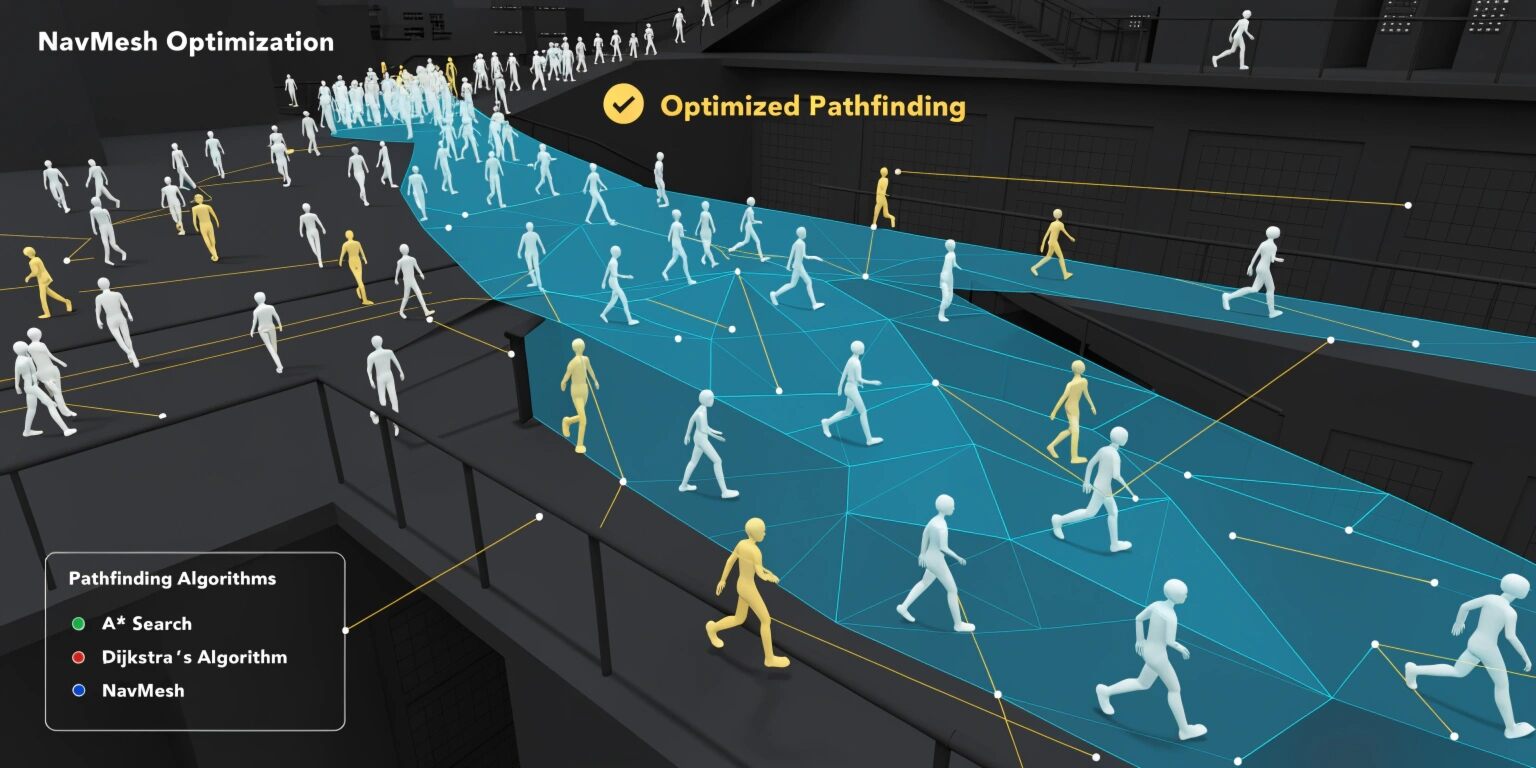
Creating believable crowds is one of the biggest challenges in modern game development. Whether it's pedestrians walking through a bustling city, soldiers charging across a battlefield, spectators filling a sports stadium, or civilians evacuating during an emergency, players expect non-player characters (NPCs) to move naturally without getting stuck, colliding excessively, or behaving unrealistically.
Traditional pathfinding techniques work well for a handful of AI agents, but they struggle when hundreds or thousands of characters move simultaneously. This is where NavMesh optimization becomes essential. By combining Navigation Meshes (NavMeshes), intelligent pathfinding, local avoidance algorithms, and performance optimization techniques, developers can create scalable crowd simulation systems that remain efficient even in massive game worlds.
In this article, we'll explore how NavMesh optimization enables realistic crowd simulation and examine the techniques used in modern game engines.
What Is Crowd Simulation?
Crowd simulation is the process of controlling the movement and interactions of large numbers of AI agents within a virtual environment.
Unlike individual NPC navigation, crowd simulation must consider:
- Multiple moving agents
- Collision avoidance
- Group behavior
- Dynamic obstacles
- Performance constraints
- Natural movement patterns
The objective is to make large groups behave like real crowds while maintaining smooth gameplay.
Understanding NavMesh
A Navigation Mesh (NavMesh) is a simplified representation of walkable areas within a game world.
Instead of calculating movement across every pixel or terrain point, AI agents navigate across connected polygons representing valid movement surfaces.
Advantages include:
- Faster pathfinding
- Reduced computational overhead
- Natural movement
- Easier obstacle management
- Improved scalability
Most modern game engines, including Unity and Unreal Engine, include built-in NavMesh systems.
Why NavMesh Is Ideal for Crowd Simulation
Without a NavMesh, every AI agent would need to calculate movement across the entire environment, consuming significant processing power.
NavMeshes improve efficiency by:
- Restricting movement to walkable regions
- Eliminating unnecessary path searches
- Simplifying navigation calculations
- Supporting dynamic obstacle updates
This allows developers to simulate large crowds without overwhelming the CPU.
Pathfinding with A* Algorithm
Most NavMesh systems use the A* (A-Star) algorithm to calculate optimal paths.
The algorithm evaluates:
- Distance to the destination
- Travel cost
- Walkable polygons
- Navigation constraints
Once the path is generated, agents follow it while continuously adjusting for nearby obstacles and other characters.
Local Avoidance
Pathfinding alone cannot prevent agents from colliding.
Local avoidance systems allow nearby characters to react to each other in real time.
These systems enable agents to:
- Slow down
- Change direction
- Walk around obstacles
- Maintain personal space
- Avoid bottlenecks
This creates smoother and more believable crowd movement.
Dynamic Obstacle Handling
Game environments constantly change.
Examples include:
- Moving vehicles
- Opening doors
- Falling debris
- Temporary barriers
- Other NPCs
- Player movement
Modern NavMesh systems update navigation data dynamically, allowing AI agents to reroute when obstacles appear or disappear.
Dynamic obstacle handling ensures that crowds adapt naturally to changing environments.
Hierarchical Navigation
For massive maps, calculating complete paths for every agent can become expensive.
Hierarchical navigation improves performance by dividing the world into regions.
Navigation occurs in two stages:
- Determine the optimal route between regions.
- Calculate detailed paths within the local region.
This significantly reduces computation while preserving accurate navigation.
Crowd Steering Behaviors
Beyond reaching destinations, realistic crowds require intelligent movement behaviors.
Common steering behaviors include:
- Separation to prevent collisions
- Alignment with nearby agents
- Cohesion within groups
- Goal seeking
- Obstacle avoidance
- Queue formation
These behaviors produce movement that resembles real human crowds.
Performance Optimization Techniques
Large-scale crowd simulation requires careful optimization.
Popular techniques include:
Agent Level of Detail (LOD)
Only nearby agents receive full AI calculations.
Distant characters use simplified movement logic.
Asynchronous Pathfinding
Path calculations are distributed over multiple frames rather than processed simultaneously.
Path Sharing
Agents traveling to similar destinations can reuse existing paths instead of generating new ones.
Navigation Caching
Frequently used routes are stored for reuse, reducing repeated pathfinding calculations.
World Partitioning
Large environments are divided into sectors so AI only calculates navigation within active regions.
Together, these strategies allow developers to simulate thousands of agents while maintaining stable frame rates.
Applications Beyond Games
Crowd simulation powered by NavMesh optimization is used in many industries.
Examples include:
- Urban planning
- Emergency evacuation analysis
- Robotics
- Autonomous vehicles
- Virtual reality
- Military training
- Architecture
- Theme park design
These applications help engineers model realistic human movement and improve safety, logistics, and operational planning.
Common Challenges
Developers implementing crowd simulation often face issues such as:
- Congestion at narrow passages
- Oscillating movement
- Deadlocks between agents
- Unrealistic group behavior
- High CPU usage
- Frequent path recalculations
Balancing realism with performance requires careful tuning of navigation parameters and AI behaviors.
Future Trends
Advancements in artificial intelligence continue to improve crowd simulation.
Emerging innovations include:
- Machine learning-based navigation
- Reinforcement learning for agent behavior
- GPU-accelerated pathfinding
- Predictive collision avoidance
- Cloud-assisted AI simulation
- Procedural crowd generation
- Emotion-driven crowd responses
These technologies promise even more realistic and scalable crowd behavior in future games and simulations.
Best Practices
To build efficient crowd simulation systems:
- Generate accurate NavMeshes.
- Use local avoidance for collision prevention.
- Implement hierarchical navigation for large worlds.
- Cache frequently used paths.
- Reduce unnecessary path recalculations.
- Apply AI Level of Detail for distant agents.
- Continuously profile CPU and memory usage.
These practices improve scalability while maintaining believable AI movement.
Conclusion
Crowd simulation is an essential component of immersive game worlds and large-scale virtual environments. By leveraging NavMesh optimization, intelligent pathfinding, local avoidance, and advanced performance techniques, developers can create crowds that move naturally while maintaining high frame rates. Whether simulating busy city streets, large battlefields, or open-world environments, optimized navigation systems ensure AI agents respond realistically to dynamic conditions.
As game engines continue to evolve and artificial intelligence becomes more sophisticated, crowd simulation will become increasingly realistic, adaptive, and efficient. Developers who master NavMesh optimization will be well-positioned to build engaging, scalable experiences that enhance both gameplay and player immersion.