As blockchain technology continues to gain adoption, cryptocurrency wallets have become essential tools for managing digital assets. Whether users are sending cryptocurrencies, storing tokens, interacting with decentralized applications (dApps), or participating in decentralized finance (DeFi), crypto wallets provide the interface between users and blockchain networks.
Building a crypto wallet involves much more than creating an attractive user interface. Developers must design an architecture that prioritizes security, scalability, reliability, and usability while supporting multiple blockchain protocols and handling sensitive cryptographic operations.
A robust crypto wallet architecture combines secure key management, blockchain communication, transaction processing, authentication, and user-friendly design. This article explores the core architectural components, security considerations, development best practices, and future trends in crypto wallet application development.
What Is a Crypto Wallet?
A crypto wallet is a software application that enables users to securely manage cryptographic keys, view digital asset balances, sign blockchain transactions, and interact with blockchain-based services.
Unlike a traditional wallet that stores physical currency, a crypto wallet stores private keys, which authorize transactions on blockchain networks. The digital assets themselves remain recorded on the blockchain.
Typical wallet capabilities include:
- Viewing account balances
- Sending and receiving cryptocurrencies
- Managing multiple wallets
- Supporting various blockchain networks
- Viewing transaction history
- Connecting to decentralized applications
- Managing digital collectibles (NFTs)
- Token management
Types of Crypto Wallets
Different wallet types address different security and usability requirements.
Hot Wallets
Hot wallets remain connected to the internet.
Advantages:
- Quick access
- Easy transactions
- Suitable for everyday use
Limitations:
- Greater exposure to online threats
Cold Wallets
Cold wallets store private keys offline.
Benefits include:
- Enhanced security
- Reduced exposure to cyberattacks
- Long-term asset protection
These wallets are commonly used for storing significant cryptocurrency holdings.
Custodial Wallets
In custodial wallets, a third party manages private keys on behalf of users.
Benefits:
- Simplified account recovery
- Easier onboarding
Consideration:
- Users rely on the service provider to safeguard assets.
Non-Custodial Wallets
Non-custodial wallets give users full control over their private keys.
Advantages:
- Greater ownership
- Enhanced privacy
- Direct blockchain interaction
Users are responsible for securely storing their recovery phrase and private keys.
Core Components of Wallet Architecture
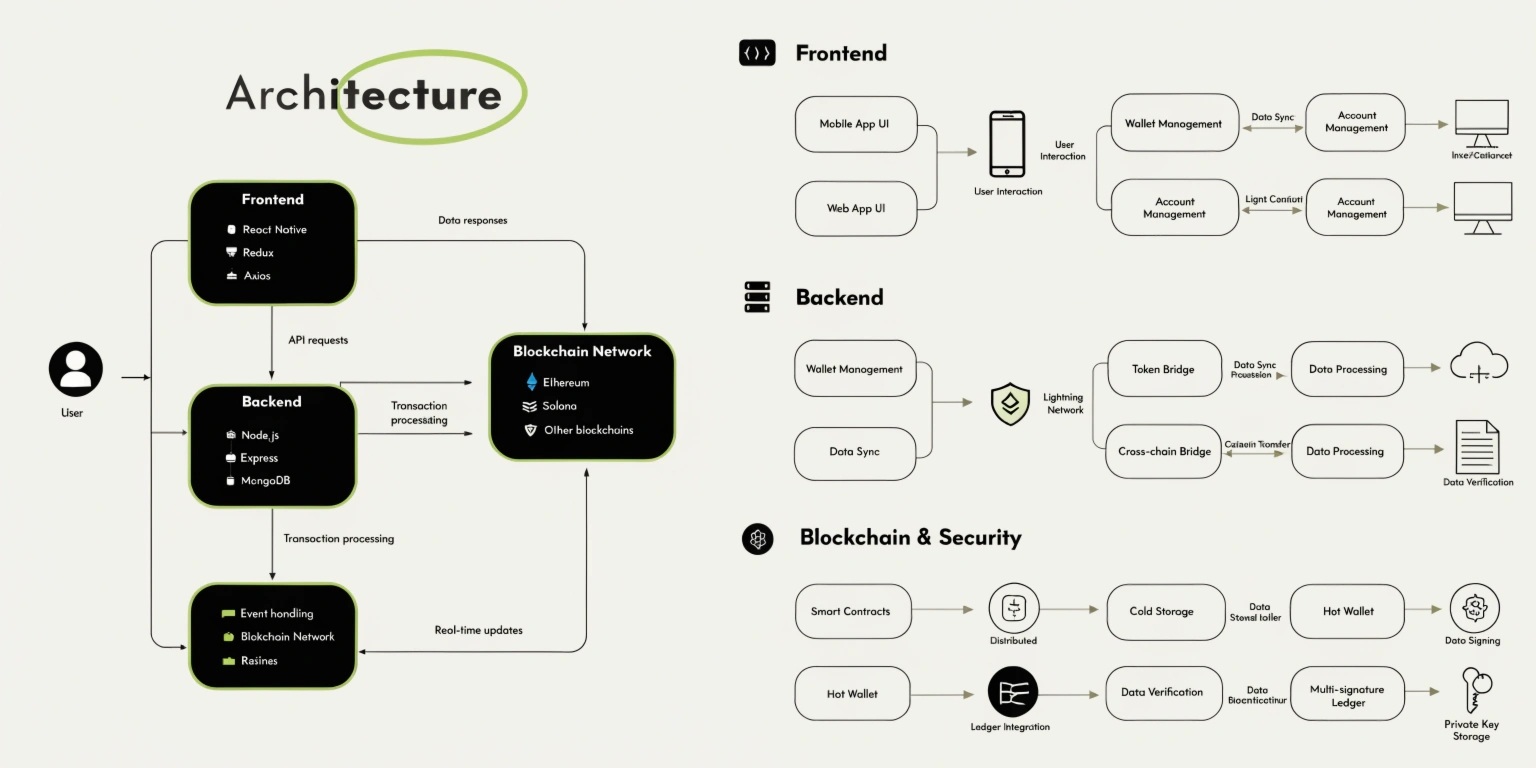
User Interface Layer
The front end provides an intuitive experience for managing digital assets.
Common features include:
- Portfolio dashboard
- Asset balances
- QR code scanning
- Transaction history
- Token management
- Wallet settings
- Network selection
A responsive interface improves accessibility for both beginners and experienced users.
Wallet Management Layer
This layer manages wallet creation and configuration.
Responsibilities include:
- Wallet generation
- Account management
- Address generation
- Multi-account support
- Backup and recovery options
It also helps organize wallets across multiple blockchain networks.
Key Management System
Private keys are the foundation of wallet security.
The key management system is responsible for:
- Key generation
- Secure storage
- Encryption
- Digital signing
- Recovery phrase management
Keys should never be transmitted or exposed in plain text.
Blockchain Communication Layer
Wallets interact with blockchain networks through dedicated communication services.
This layer handles:
- Transaction broadcasting
- Balance retrieval
- Block synchronization
- Smart contract interaction
- Network status monitoring
Supporting multiple blockchain networks requires flexible integration mechanisms.
Transaction Processing
Every transaction follows a structured workflow:
- User initiates a transaction.
- The application validates input data.
- The transaction is digitally signed using the private key.
- The signed transaction is broadcast to the blockchain network.
- The wallet monitors confirmation status.
- The transaction history is updated after confirmation.
Proper validation reduces failed transactions and improves reliability.
Security Best Practices
Security is the highest priority in crypto wallet development.
Essential measures include:
- End-to-end encryption
- Secure key storage
- Biometric authentication
- Multi-factor authentication (MFA)
- Secure recovery phrase handling
- Device integrity checks
- Session timeout mechanisms
- Encrypted local databases
Regular security audits and penetration testing help identify potential vulnerabilities before deployment.
Supporting Multiple Blockchain Networks
Modern wallets often support more than one blockchain ecosystem.
Multi-chain support enables users to:
- Manage diverse digital assets
- Switch between supported networks
- Interact with various decentralized applications
- Consolidate asset management into a single interface
A modular architecture simplifies adding new blockchain integrations as the ecosystem evolves.
Scalability Considerations
As the user base grows, wallet applications should maintain performance and reliability.
Scalable architectures often include:
- Cloud-based backend services for non-sensitive functions
- Efficient API management
- Caching mechanisms
- Load balancing
- Asynchronous transaction processing
- Real-time notifications
These practices help ensure responsive performance during periods of high activity.
Common Challenges
Developers face several technical and operational challenges when building crypto wallets.
These include:
- Protecting private keys
- Handling blockchain network congestion
- Supporting multiple protocols
- Preventing phishing attacks
- Ensuring compatibility across devices
- Maintaining compliance with regional regulations
- Delivering a user-friendly recovery process
Addressing these challenges requires careful architectural planning and ongoing maintenance.
Future Trends in Crypto Wallet Development
The evolution of blockchain technology is shaping the next generation of wallet applications.
Emerging trends include:
- AI-powered fraud detection
- Smart contract wallets
- Account abstraction
- Multi-party computation (MPC) wallets
- Cross-chain interoperability
- Biometric authentication improvements
- Integrated decentralized identity (DID)
- Enhanced support for tokenized real-world assets
These innovations aim to improve both security and user experience while expanding wallet functionality.
Best Practices
When designing a crypto wallet application:
- Prioritize security from the earliest development stages.
- Minimize the exposure of sensitive data.
- Encrypt private keys using proven cryptographic standards.
- Build modular components to simplify future upgrades.
- Support secure backup and recovery processes.
- Optimize transaction handling for speed and reliability.
- Test across multiple blockchain environments before release.
- Keep dependencies and security libraries regularly updated.
Following these principles helps create a resilient and trustworthy wallet platform.
Conclusion
Crypto wallet applications serve as the gateway to blockchain ecosystems, making their architecture critical to both security and usability. A well-designed wallet integrates secure key management, reliable blockchain communication, efficient transaction processing, and scalable infrastructure while maintaining an intuitive user experience.
As Web3, decentralized finance, and digital assets continue to evolve, crypto wallets will play an increasingly important role in enabling secure and seamless interactions with blockchain technologies. By following architectural best practices and adopting emerging innovations, developers can build wallet applications that are prepared for the future of decentralized digital finance.