In today's digital economy, organizations generate and process enormous volumes of sensitive information, including customer records, financial transactions, healthcare data, intellectual property, and business-critical communications. As cyber threats continue to evolve, encrypting data is no longer optional—it has become a fundamental requirement for maintaining trust, ensuring compliance, and protecting organizational assets.
However, implementing encryption across millions of records, thousands of applications, and distributed cloud environments introduces significant complexity. This is where Key Management Services (KMS) and Hardware Security Modules (HSMs) play a crucial role in enabling data encryption at scale.
Why Encryption Matters
Encryption transforms readable data into an unreadable format using cryptographic algorithms and encryption keys. Even if attackers gain access to encrypted data, they cannot interpret it without the appropriate decryption key.
Organizations typically encrypt:
- Data at Rest (stored databases, files, backups)
- Data in Transit (network communications)
- Data in Use (advanced confidential computing environments)
The biggest challenge isn't encrypting data itself—it's managing encryption keys securely and efficiently.
The Key Management Challenge
As businesses scale, the number of encryption keys increases dramatically. Large enterprises may manage millions of keys across multiple cloud providers, applications, databases, and geographic regions.
Without proper key management, organizations face risks such as:
- Unauthorized key access
- Data breaches
- Compliance violations
- Operational complexity
- Key loss and data inaccessibility
This challenge led to the development of centralized Key Management Services.
Understanding Key Management Services (KMS)
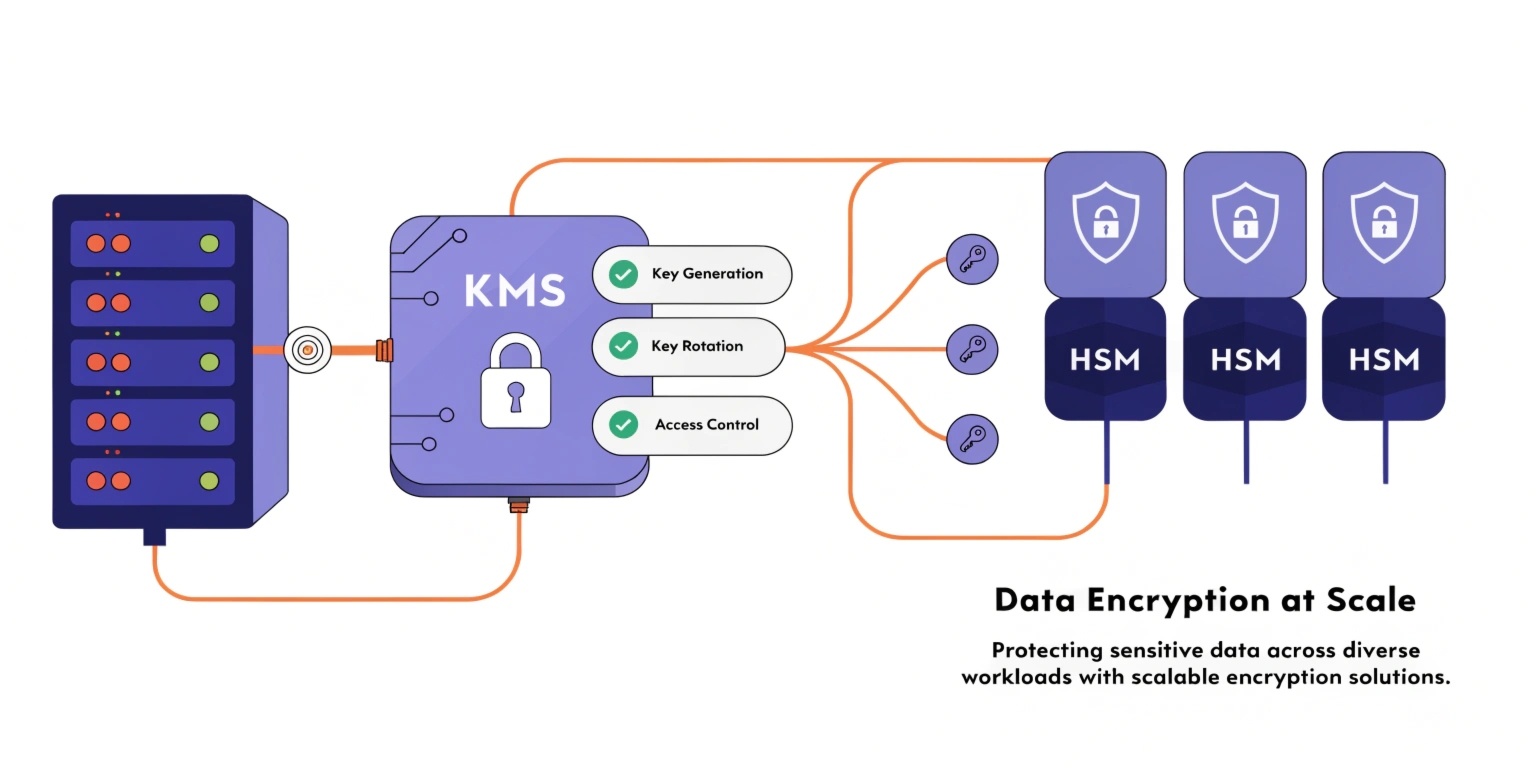
A Key Management Service (KMS) is a centralized platform that creates, stores, manages, rotates, and controls access to encryption keys.
Popular KMS solutions include:
- Amazon Web Services KMS
- Microsoft Azure Key Vault
- Google Cloud KMS
- HashiCorp Vault
A KMS allows developers and security teams to encrypt data without directly handling sensitive cryptographic keys.
Core Functions of KMS
Key Creation
Generate secure encryption keys using approved cryptographic standards.
Key Rotation
Automatically replace old keys with new ones to reduce security risks.
Access Control
Integrate with Identity and Access Management (IAM) systems to define who can use specific keys.
Auditing
Maintain detailed logs of every key-related action for compliance and security monitoring.
Lifecycle Management
Manage keys from creation to retirement in a controlled manner.
By centralizing these functions, organizations significantly reduce operational overhead while improving security.
What Are Hardware Security Modules (HSMs)?
A Hardware Security Module (HSM) is a specialized physical device designed to generate, store, and protect cryptographic keys within a tamper-resistant environment.
Unlike software-based key storage, HSMs provide hardware-level security and are often required for highly regulated industries such as banking, healthcare, and government.
Key Characteristics of HSMs
- Physical tamper resistance
- Secure cryptographic processing
- High-performance encryption operations
- FIPS 140-2 and FIPS 140-3 compliance
- Protection against insider threats
Even system administrators typically cannot extract private keys from an HSM.
KMS vs HSM: What's the Difference?
Although both technologies manage encryption keys, they serve different purposes.
KMS
- Software-based service
- Easier deployment
- Scalable cloud integration
- Cost-effective for most applications
- Simplifies key management
HSM
- Dedicated hardware appliance
- Maximum security protection
- Regulatory compliance support
- Secure key generation
- Suitable for highly sensitive workloads
In modern enterprise environments, KMS and HSM often work together.
How KMS and HSM Work Together
Many cloud providers use HSM-backed KMS architectures.
The process typically works as follows:
- HSM generates and protects master encryption keys.
- KMS manages operational encryption keys.
- Applications request encryption services through KMS APIs.
- Sensitive root keys remain protected within HSMs.
- Encryption and decryption operations occur without exposing keys.
This hybrid approach combines security, scalability, and operational efficiency.
Best Practices for Encryption at Scale
Implement Envelope Encryption
Instead of encrypting large datasets directly with master keys, use data encryption keys protected by a master key.
This improves performance and simplifies key rotation.
Enable Automatic Key Rotation
Regularly rotating keys limits the impact of potential key compromise.
Enforce Least Privilege Access
Only authorized users and services should access encryption keys.
Monitor and Audit Key Usage
Track all encryption-related activities to identify suspicious behavior.
Use HSMs for Critical Assets
Store highly sensitive keys such as payment processing, certificate authority, and government-related cryptographic material within HSMs.
Maintain Compliance
Ensure encryption systems align with standards such as:
- GDPR
- HIPAA
- PCI DSS
- ISO 27001
- SOC 2
The Future of Enterprise Encryption
As organizations adopt multi-cloud infrastructures, AI-powered applications, and edge computing environments, encryption strategies must evolve accordingly.
Emerging trends include:
- Confidential Computing
- Post-Quantum Cryptography
- Automated Key Lifecycle Management
- Zero Trust Security Models
- AI-driven Threat Detection
Future encryption systems will increasingly rely on intelligent key management, stronger hardware protections, and seamless integration across distributed environments.
Conclusion
Data encryption remains one of the most effective defenses against modern cyber threats. However, encryption is only as secure as the keys protecting it. By leveraging Key Management Services (KMS) and Hardware Security Modules (HSMs), organizations can implement scalable, compliant, and highly secure encryption architectures.
As data volumes continue to grow and regulatory requirements become stricter, businesses that invest in robust key management and encryption strategies will be better positioned to protect sensitive information, maintain customer trust, and reduce cybersecurity risks in an increasingly connected world.