Data has become one of the most valuable assets for modern organizations. Businesses rely on data to drive decision-making, power artificial intelligence models, optimize operations, and improve customer experiences. However, as data ecosystems become more complex, managing data accurately and consistently becomes increasingly challenging.
Organizations often face questions such as:
- Where did this data come from?
- What transformations were applied?
- Which datasets were used to train a machine learning model?
- Why did a report change from last month?
- Who modified the data and when?
The answers to these questions lie in two critical concepts: Data Versioning and Data Lineage Tracking. Together, they provide transparency, accountability, and trust in modern data pipelines.
What Is Data Versioning?
Data versioning is the process of maintaining historical versions of datasets over time.
Similar to how software developers use Git to track code changes, data versioning allows organizations to:
- Track dataset modifications
- Compare versions
- Roll back to previous states
- Reproduce results
- Audit data changes
Every time data changes, a new version is created while preserving previous versions.
For example:
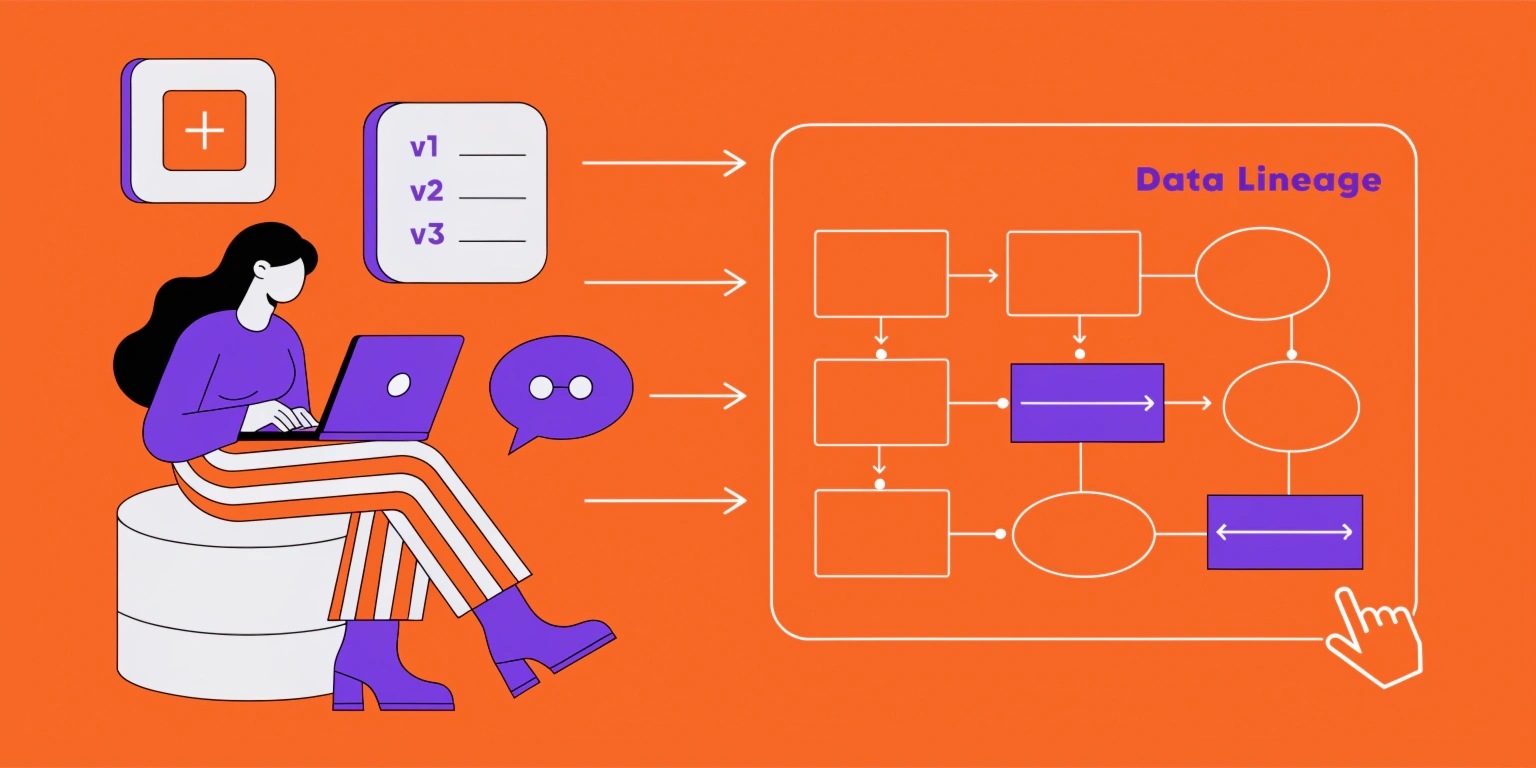
Version 1:
- Customer dataset contains 100,000 records.
Version 2:
- 10,000 new records added.
Version 3:
- Data cleaning rules applied.
Each version represents a specific state of the dataset and can be retrieved when needed.
Why Data Versioning Matters
Without versioning, teams often struggle to understand why reports, analytics results, or machine learning models produce different outcomes.
Benefits include:
Reproducibility
Data scientists can reproduce experiments using the exact dataset version originally used.
Auditability
Organizations can trace historical changes and identify who made modifications.
Error Recovery
Accidental changes can be reversed quickly.
Collaboration
Multiple teams can work on datasets without losing historical context.
These capabilities are essential for modern data-driven organizations.
What Is Data Lineage?
Data lineage refers to the ability to track the movement and transformation of data throughout its lifecycle.
It answers questions such as:
- Where did the data originate?
- Which systems processed it?
- What transformations occurred?
- Which reports depend on it?
Data lineage provides a visual map of data flow across systems.
Example:
CRM System
↓
Data Warehouse
↓
Data Transformation
↓
Analytics Dashboard
This visibility helps teams understand how information moves through their organization.
Why Data Lineage Is Important
As data pipelines grow, understanding dependencies becomes critical.
Improved Data Quality
Lineage helps identify the source of errors and inconsistencies.
Faster Troubleshooting
Engineers can quickly locate problematic transformations.
Regulatory Compliance
Many regulations require organizations to demonstrate how data is collected, processed, and used.
Impact Analysis
Teams can assess how changes affect downstream systems.
Lineage transforms data environments from opaque systems into transparent ecosystems.
Data Versioning vs Data Lineage
Although related, these concepts solve different problems.
Data Versioning
Focuses on:
- Tracking dataset changes
- Maintaining historical records
- Supporting reproducibility
Answers:
"What did the data look like at a specific point in time?"
Data Lineage
Focuses on:
- Tracking data movement
- Understanding dependencies
- Monitoring transformations
Answers:
"How did this data reach its current state?"
Together, they provide complete visibility into data operations.
Real-World Applications
Machine Learning and AI
Machine learning models depend heavily on training data.
Without versioning and lineage:
- Models become difficult to reproduce.
- Performance changes become harder to explain.
- Regulatory requirements become challenging.
Versioning ensures teams know exactly which dataset trained a model.
Lineage reveals every transformation applied before training.
Business Intelligence
Organizations rely on dashboards for strategic decisions.
When metrics suddenly change, lineage helps identify:
- Data source updates
- ETL failures
- Transformation errors
This improves confidence in reporting systems.
Healthcare
Healthcare organizations must maintain strict records regarding patient data processing.
Lineage supports:
- Compliance audits
- Data traceability
- Risk management
Financial Services
Banks and financial institutions use lineage to:
- Track risk calculations
- Meet regulatory requirements
- Investigate anomalies
Transparency is critical in highly regulated industries.
Best Practices for Data Versioning
Version Critical Datasets
Not every dataset requires versioning.
Focus on:
- Training datasets
- Financial data
- Regulatory records
- Business-critical information
Automate Version Creation
Manual version management often leads to inconsistencies.
Automation ensures reliability and consistency.
Maintain Metadata
Store information such as:
- Creation date
- Author
- Data source
- Transformation history
Metadata provides valuable context.
Integrate with CI/CD Pipelines
Modern data workflows should incorporate versioning into deployment and testing processes.
Best Practices for Data Lineage Tracking
Capture Lineage Automatically
Manual lineage documentation quickly becomes outdated.
Automated lineage tools provide more accurate visibility.
Monitor Data Transformations
Track every step within ETL and ELT pipelines.
Visualize Dependencies
Graphical lineage views improve understanding and troubleshooting.
Establish Governance Policies
Define standards for tracking, documenting, and auditing data flows.
Strong governance improves data reliability.
Popular Tools for Data Versioning and Lineage
Several platforms help organizations implement these capabilities.
Data Versioning Tools
- DVC (Data Version Control)
- Delta Lake
- LakeFS
- Pachyderm
Data Lineage Tools
- OpenLineage
- Apache Atlas
- DataHub
- Collibra
- Alation
These tools provide automation, visibility, and governance features.
Challenges in Implementation
Despite their benefits, organizations may encounter challenges.
Large Data Volumes
Versioning massive datasets can increase storage requirements.
Complex Pipelines
Modern architectures often contain hundreds of interconnected systems.
Metadata Management
Maintaining accurate metadata requires ongoing effort.
Cross-Platform Integration
Data often flows across multiple cloud providers and technologies.
Effective planning helps overcome these challenges.
The Future of Data Governance
As organizations adopt AI, machine learning, and real-time analytics, the importance of versioning and lineage will continue to grow.
Emerging trends include:
- Automated lineage discovery
- AI-powered metadata management
- Real-time lineage monitoring
- Data observability platforms
- Governance-as-Code frameworks
These innovations will further improve transparency and trust in enterprise data systems.
Conclusion
Data versioning and lineage tracking are essential components of modern data management. While versioning provides a historical record of dataset changes, lineage reveals how data flows and transforms across systems. Together, they enable reproducibility, compliance, governance, and operational efficiency.
As organizations increasingly depend on data for decision-making and AI-driven innovation, implementing robust versioning and lineage practices is no longer optional. Businesses that invest in these capabilities gain greater confidence in their data, faster troubleshooting, stronger regulatory compliance, and a foundation for scalable, trustworthy analytics.