When developers encounter slow application performance, the immediate instinct is to optimize frontend code or improve server logic. However, in most real-world scenarios, the root cause lies deeper—in the database. One of the most overlooked yet powerful tools for improving database performance is indexing.
What is Database Indexing?
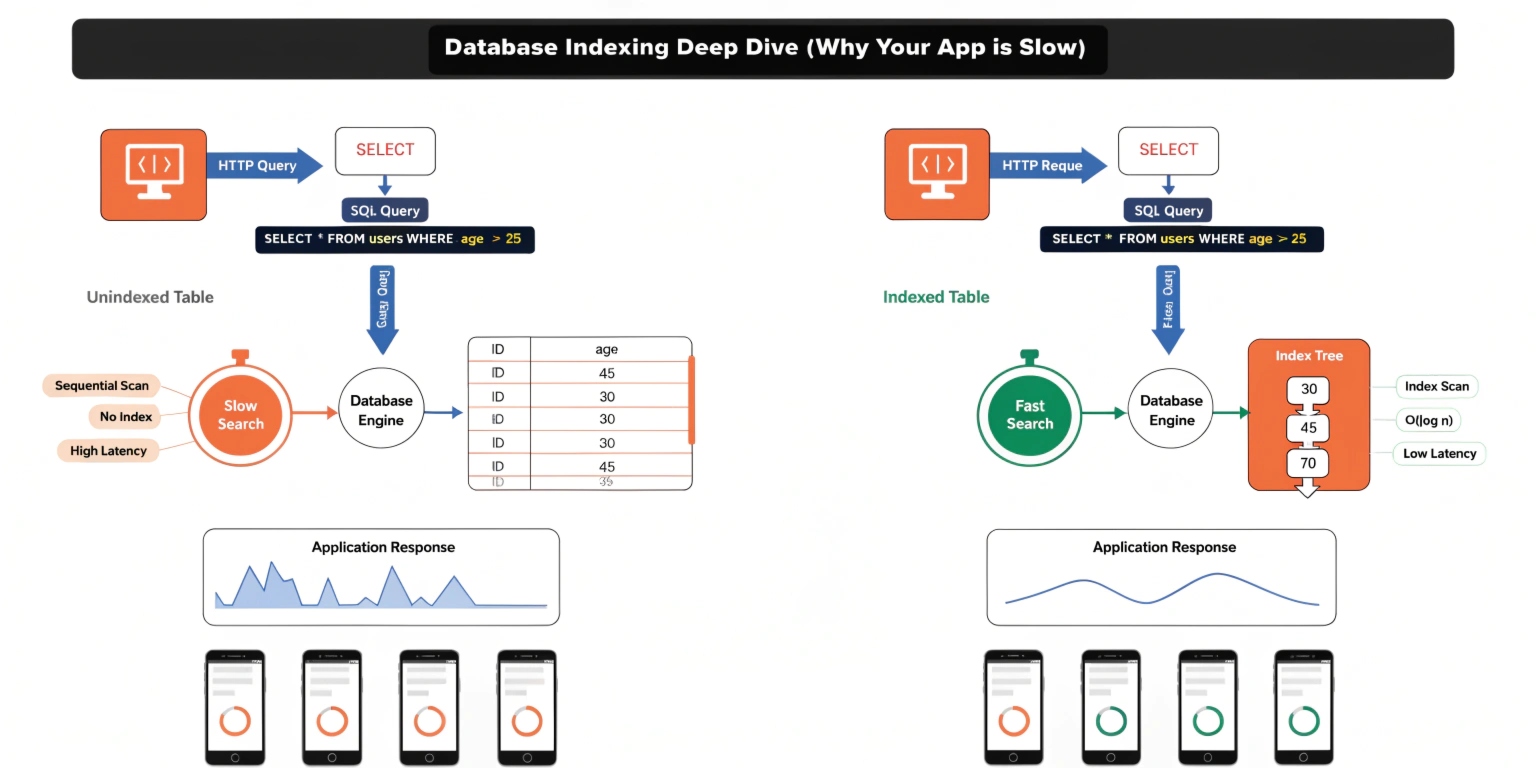
Database indexing is a technique used to speed up data retrieval operations. Without an index, the database performs a full table scan, meaning it checks every row to find matching data. This becomes extremely inefficient as your dataset grows.
Think of an index like a book’s table of contents. Instead of reading the entire book to find a topic, you jump directly to the relevant page.
Why Your App is Slow
If your app is slow, especially when handling large datasets, it is likely due to:
- Missing indexes on frequently queried columns
- Over-indexing causing write delays
- Poor query design
- Inefficient joins and filters
- Large datasets without proper optimization
For example, a query filtering users by email without an index will scan millions of rows, significantly increasing response time.
How Indexing Works
Indexes store a sorted structure of selected columns, allowing databases to locate data quickly. When you execute a query, the database engine uses the index to jump directly to relevant records instead of scanning the entire table.
The most commonly used data structure for indexing is the B-tree, which allows logarithmic time complexity for search operations.
Types of Indexes
Understanding index types is crucial for effective optimization:
1. Single Column Index
Indexes created on a single column. Ideal for simple queries.
CREATE INDEX idx_user_email ON users(email);
2. Composite Index
Indexes on multiple columns. Useful when queries filter on multiple fields.
CREATE INDEX idx_user_name_age ON users(name, age);
3. Unique Index
Ensures all values in a column are unique.
CREATE UNIQUE INDEX idx_unique_email ON users(email);
4. Full-Text Index
Used for searching large text fields efficiently.
5. Hash Index
Provides faster lookups for equality comparisons but is less flexible than B-tree.
Common Indexing Mistakes
Even though indexing improves performance, incorrect usage can backfire:
- Over-indexing: Too many indexes slow down INSERT, UPDATE, and DELETE operations
- Unused indexes: Waste storage and degrade performance
- Wrong column order in composite indexes: Reduces effectiveness
- Indexing low-cardinality columns: Columns with few unique values (e.g., gender) are poor candidates
When to Use Indexes
You should consider indexing when:
- Queries frequently filter (WHERE clause) on a column
- Columns are used in JOIN operations
- Sorting (ORDER BY) or grouping (GROUP BY) is common
- The dataset is large and growing
Avoid indexing when:
- Tables are small
- Columns are rarely queried
- Data is frequently updated
Indexing in SQL vs NoSQL
In SQL databases like MySQL and PostgreSQL, indexing is structured and predictable. You manually define indexes based on query patterns.
In NoSQL databases like MongoDB, indexes are also essential but more flexible. However, improper indexing can still lead to performance bottlenecks.
Real-World Example
Imagine an e-commerce application with millions of products. A search query like:
SELECT * FROM products WHERE category = 'Electronics';
Without an index, this query scans the entire table. With an index on the category column, the database directly fetches relevant rows, reducing execution time from seconds to milliseconds.
Best Practices for Indexing
To get the most out of indexing:
- Analyze slow queries using tools like EXPLAIN
- Index only necessary columns
- Use composite indexes wisely
- Regularly monitor and clean unused indexes
- Balance between read and write performance
- Keep indexes updated with database growth
Final Thoughts
Database indexing is not just a performance enhancement—it is a necessity for scalable applications. Poor indexing strategies can cripple even the most well-designed systems, while proper indexing can dramatically improve speed and efficiency.
If your app feels slow despite optimized code, it’s time to look at your database. A well-thought-out indexing strategy can be the difference between a sluggish application and a lightning-fast user experience.