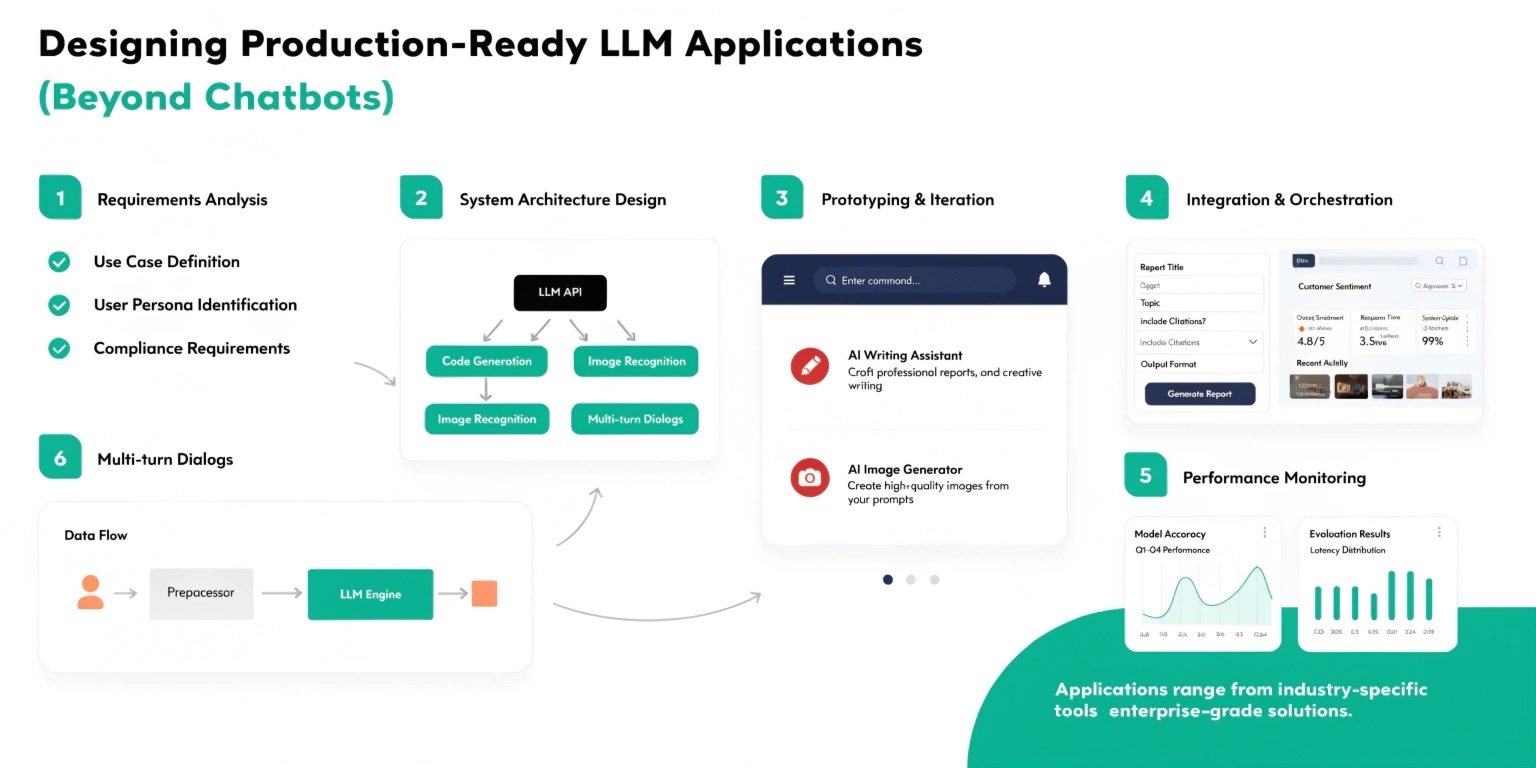
When most people hear AI applications, they immediately think about chatbots. However, in real industry environments, Large Language Models (LLMs) are not used merely for conversations. They are used to power internal tools, automate workflows, analyze documents, assist employees, generate reports, and make business software smarter.
A production-ready LLM application is not just a prompt connected to an API. It is a complete software system designed to be reliable, scalable, secure, and cost-efficient.
Let’s understand how real companies actually build LLM-powered products.
1. LLM Applications vs Chatbots
A chatbot answers questions.
A production LLM application performs tasks.
Examples:
• Automatic ticket classification in a support system
• AI-powered CRM notes generation
• Contract review assistant for legal teams
• AI document search across company data
• Automated email drafting for sales teams
In these systems, the LLM is a feature inside software, not the software itself.
This is the biggest mistake many teams make — they treat AI as a UI product instead of an infrastructure layer.
2. The Core Architecture of a Production LLM System
A real LLM system typically contains:
- Application Backend (API layer)
- Prompt Processing Layer
- Retrieval System (RAG)
- Vector Database
- LLM Provider (OpenAI, Claude, Llama, etc.)
- Guardrails & Validation
- Monitoring & Logging
This architecture exists because LLMs do not store knowledge about your company. They only understand patterns in language. Therefore, you must connect them to your data.
3. Retrieval-Augmented Generation (RAG)
RAG is the most important concept in modern AI applications.
Instead of training a model every time your data changes, you:
- Convert documents into embeddings
- Store them in a vector database
- Retrieve relevant data during user queries
- Send that context to the LLM
This allows the AI to answer using your company’s real information.
Without RAG:
AI hallucinates.
With RAG:
AI becomes useful.
Common use cases:
• Knowledge base assistants
• Internal employee helpdesk
• Policy search systems
• Product documentation AI
4. Vector Databases
A vector database stores meaning, not text.
Traditional databases search keywords.
Vector databases search semantic similarity.
Popular options:
• Pinecone
• Weaviate
• Chroma
• Milvus
These databases allow AI to find the most relevant information before generating an answer.
This dramatically improves accuracy.
5. Prompt Pipelines (Not Just Prompt Engineering)
In production systems, prompts are not single messages. They are pipelines.
Typical pipeline:
User Input → Clean → Intent Detection → Context Retrieval → System Prompt → LLM → Post-Processing → Validation → Response
This is called programmatic prompting.
You are not asking a question.
You are orchestrating an AI workflow.
6. Guardrails and Hallucination Prevention
One of the biggest risks of LLMs is hallucination — confidently wrong answers.
Production systems solve this using:
• Context-restricted answering
• Source citation enforcement
• Output validation rules
• JSON structured outputs
• Confidence scoring
For example, a financial application must never allow AI to invent numbers. The system must verify the output before showing it to users.
7. Monitoring and Observability
Unlike normal APIs, LLMs are probabilistic. That means their behavior changes.
Therefore, monitoring is critical.
You must track:
• Token usage
• Response quality
• Latency
• Error rates
• Prompt performance
• Cost per request
Tools commonly used:
• LangSmith
• Weights & Biases
• OpenTelemetry logging
Without monitoring, AI applications silently fail.
8. Scaling and Cost Optimization
LLM APIs are expensive. Poor architecture leads to massive bills.
Optimization techniques:
• Response caching
• Embedding reuse
• Smaller model fallback
• Streaming outputs
• Rate limiting
• Batch processing
A well-designed system can reduce AI cost by 70% without affecting performance.
9. Security and Data Privacy
Enterprises will not adopt AI unless data is protected.
Production AI must include:
• PII redaction
• Encrypted storage
• Role-based access
• Prompt injection protection
• On-premise model options
Many companies now build Private GPT systems to ensure company data never leaves their infrastructure.
Conclusion
Chatbots were the introduction to AI. Production LLM applications are the real revolution.
The future of software is not AI replacing applications — it is AI embedded inside every application. Companies that treat LLMs as infrastructure, not novelty, will build powerful products, automate workflows, and gain a major competitive advantage.
The goal is simple:
Don’t build an AI demo. Build an AI system.