Designing scalable multiplayer game architectures is one of the most complex challenges in modern game development. As player expectations grow and games evolve into persistent, real-time experiences, developers must build systems that can handle massive concurrency without compromising performance or user experience.
Understanding the Core Challenges
Multiplayer games introduce unique challenges compared to single-player systems. These include:
- Real-time synchronization across players
- Low-latency communication
- High concurrency (thousands or millions of users)
- Data consistency and fault tolerance
A poorly designed architecture can lead to lag, server crashes, or inconsistent gameplay—issues that can quickly drive players away.
Choosing the Right Architecture Model
There are several architectural models used in multiplayer games:
1. Client-Server Model
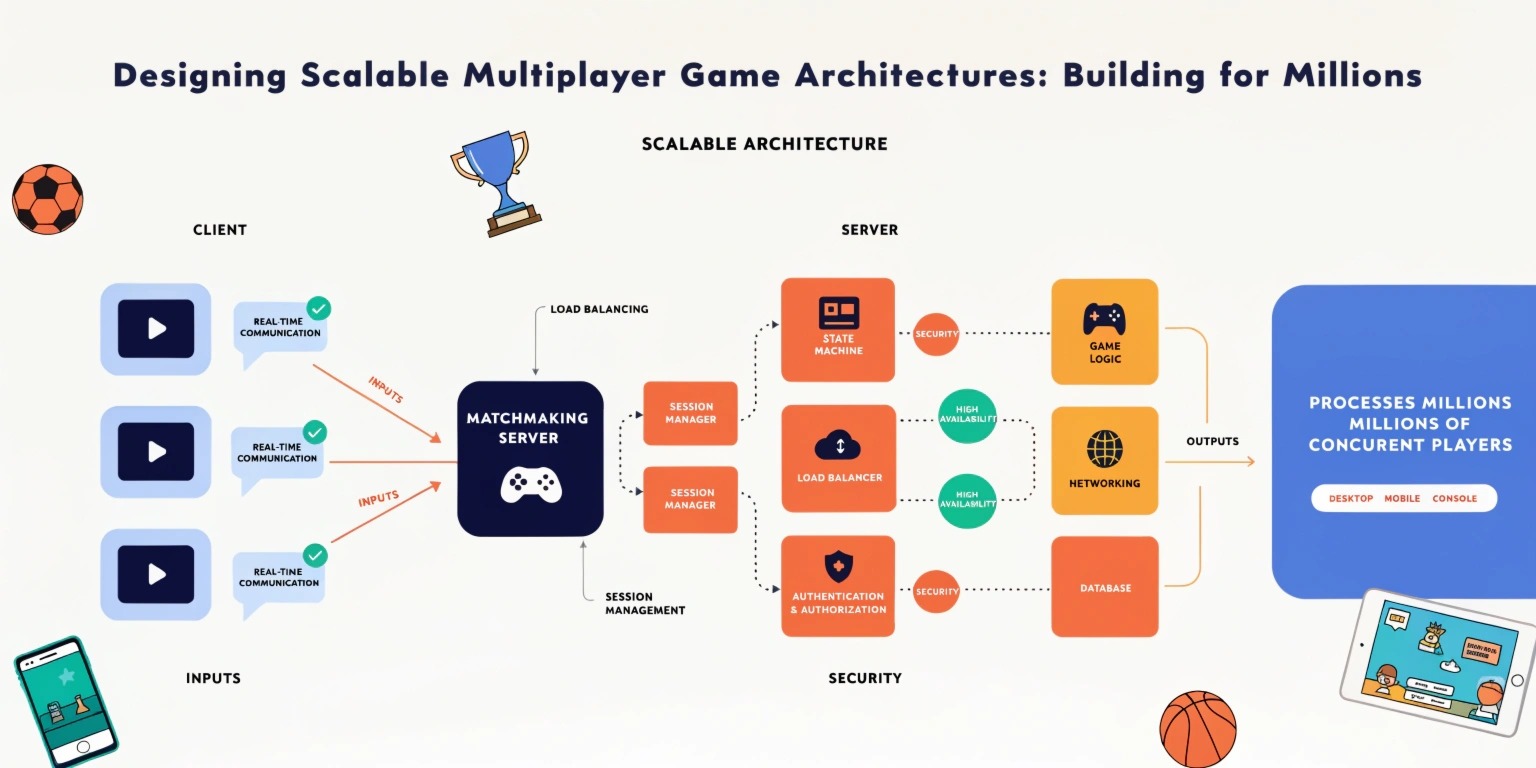
This is the most common approach. A central server manages game state, while clients (players) send inputs and receive updates.
Pros:
- Better security (server authority)
- Easier cheat prevention
- Centralized control
Cons:
- Server bottlenecks
- Infrastructure cost
2. Peer-to-Peer (P2P)
Players communicate directly without a central server.
Pros:
- Lower server cost
- Reduced latency in small groups
Cons:
- High risk of cheating
- NAT/firewall issues
- Poor scalability
3. Hybrid Model
Combines both approaches—central servers for critical logic and P2P for less sensitive interactions.
Scaling Strategies for Multiplayer Games
To support large numbers of players, scalability must be built into the system from the start.
Horizontal Scaling
Instead of relying on a single powerful server, distribute the load across multiple servers. This allows systems to scale dynamically based on demand.
Load Balancing
Distribute incoming traffic evenly across servers to prevent overload. Smart load balancers can route players based on region or server health.
Sharding
Divide the game world into smaller segments (shards), each handled by different servers. Common in MMORPGs, this reduces load and improves performance.
Real-Time Communication and Networking
Multiplayer games rely heavily on efficient communication protocols.
UDP vs TCP
- UDP is preferred for real-time games due to lower latency
- TCP is used for reliable data transmission (e.g., login, transactions)
State Synchronization Techniques
- Delta updates: Send only changes instead of full state
- Client prediction: Reduce perceived latency by predicting actions
- Server reconciliation: Correct client-side errors
These techniques ensure smooth gameplay even under network constraints.
Cloud Infrastructure and Microservices
Modern multiplayer games increasingly use cloud platforms to achieve scalability and reliability.
Cloud Benefits:
- Auto-scaling based on traffic
- Global server distribution
- High availability
Microservices Architecture
Breaking the backend into smaller services (authentication, matchmaking, leaderboards, etc.) improves flexibility and scalability.
Each service can scale independently, reducing bottlenecks and improving system resilience.
Matchmaking and Session Management
Efficient matchmaking systems are critical for player experience.
- Match players based on skill level, latency, and preferences
- Use dedicated servers for game sessions
- Implement session persistence for reconnect scenarios
Poor matchmaking can ruin gameplay, even if the core mechanics are solid.
Data Management and Persistence
Handling player data at scale requires robust database strategies.
Database Choices:
- Relational databases for structured data (accounts, transactions)
- NoSQL databases for high-speed, scalable data (game state, logs)
Caching
Use in-memory caching systems to reduce database load and improve response times.
Security and Anti-Cheat Measures
Scalable systems must also be secure.
- Use server-authoritative models
- Validate all client inputs
- Monitor unusual player behavior
- Implement encryption for sensitive data
Security becomes increasingly critical as the player base grows.
Monitoring and Optimization
Continuous monitoring helps maintain performance at scale.
- Track latency, server load, and player activity
- Use analytics tools to identify bottlenecks
- Optimize resource usage
Real-time monitoring ensures issues are detected before they impact users.
Conclusion
Designing scalable multiplayer game architectures requires a combination of smart design, efficient networking, and robust infrastructure. By leveraging client-server models, cloud computing, microservices, and advanced synchronization techniques, developers can create systems capable of supporting millions of players seamlessly.
The key is to design with scalability in mind from day one. Retrofitting scalability into an existing system is far more difficult than building it into the foundation.