Global data generation is growing at an exponential pace, with estimates suggesting more than 180 zettabytes of data by 2025. Traditional silicon-based storage technologies such as HDDs, SSDs, and magnetic tapes are reaching their physical and economic limits. As compute-intensive fields like artificial intelligence, genomics, climate analytics, and autonomous systems continue to expand, the need for radically new storage and computational architectures becomes urgent. This shift has led scientists to explore DNA computing and DNA-based data storage — an emerging field that uses biological molecules instead of electronic hardware.
What Is DNA Computing?
DNA computing is a type of biological computation that uses synthetic DNA strands to represent information and perform massively parallel operations. Instead of transistors and electrical circuits, DNA computing relies on biochemical reactions to process data. Each DNA molecule can encode billions of bits in a tiny space, allowing computations that are incredibly dense and energy-efficient.
In simple terms, DNA computing acts like a molecular supercomputer, capable of solving complex problems that classical systems would take years to handle.
Why DNA for Data Storage?
DNA is nature’s most compact and durable data storage material, storing all the genetic information of every living organism.
Key advantages include:
- Extreme density — 1 gram of DNA can store up to 215 petabytes of data.
- Longevity — DNA can last thousands of years without degrading.
- Energy efficiency — Requires no power to maintain stored data.
- Scalability — Can encode enormous datasets in microscopic volumes.
This makes DNA ideal for long-term archival storage, where current hardware fails due to decay, cost, and space constraints.
How DNA Data Encoding Works
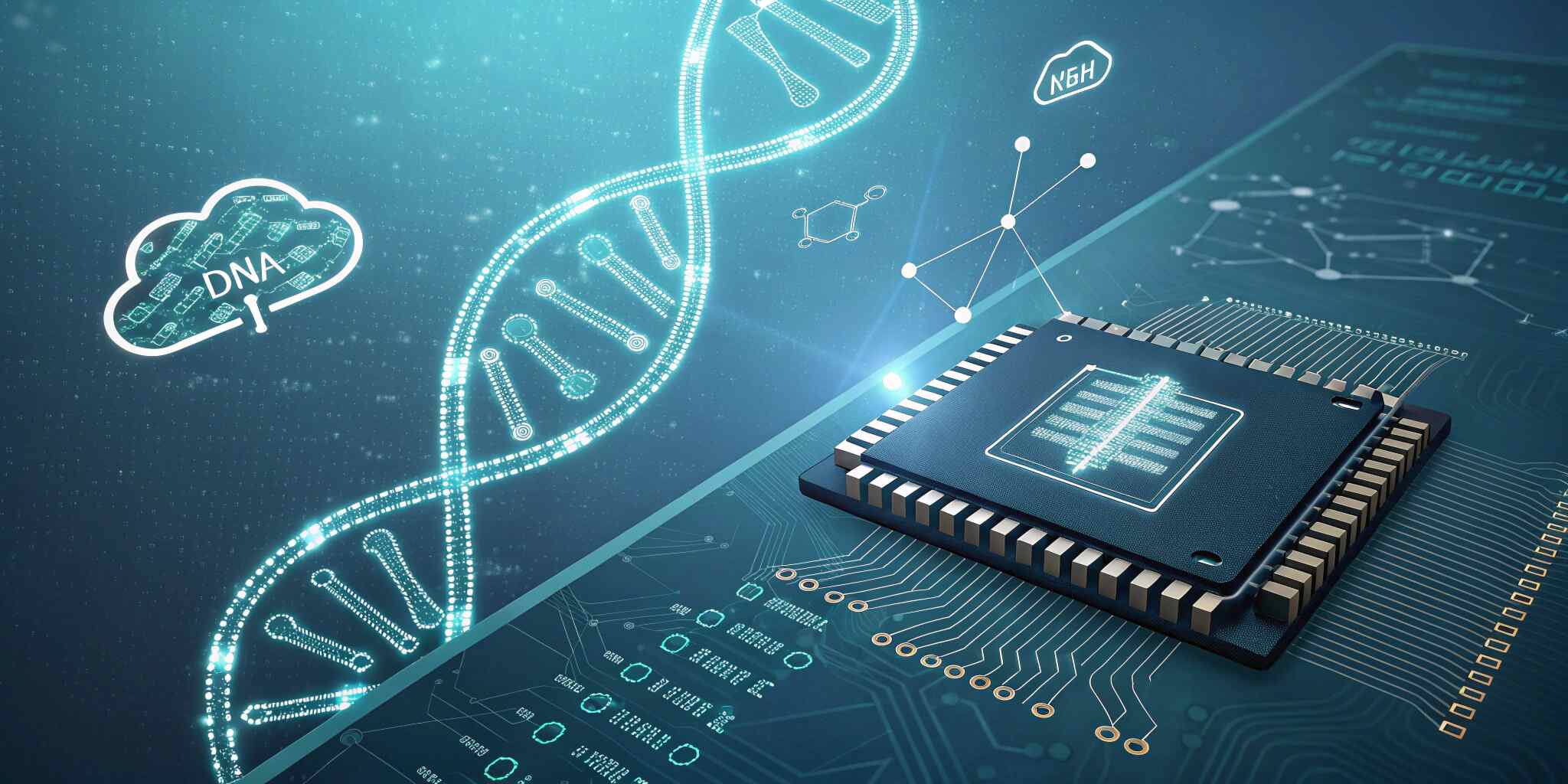
Data is converted into binary (0s and 1s), then translated into the four DNA nucleotides: A, T, C, and G. Synthetic DNA strands are generated in liquid-based storage, preserved in capsules, and decoded using sequencing machines when needed. Companies like Microsoft, Google, IBM, and Illumina are actively developing automated DNA storage and retrieval systems.
Real-World Applications
SectorUse CaseHealthcare & GenomicsHigh-volume genetic sequencing dataAI Training DataLong-term storage for massive datasetsSpace ResearchRadiation-resistant archival storageGovernment &
DefenseClassified data preservationMedia & EntertainmentArchiving films, books, and historical content
Advantages of DNA Computing
- Capable of solving NP-complex problems like optimization and cryptography
- Parallel processing at a molecular scale
- Ultra-low energy consumption
- Minimal physical footprint
Challenges & Limitations
Although revolutionary, DNA computing is still developing and faces significant barriers:
- Extremely high cost of DNA synthesis
- Slow read/write speeds (currently hours vs milliseconds)
- Error-correction complexity
- Limited industrial-scale infrastructure
However, rapid progress in synthetic biology and automated sequencing is reducing barriers quickly.
The Future Outlook
Researchers predict that DNA storage may become commercially viable within the next 5–10 years, beginning with archival storage in cloud-scale data centers. Hybrid computing systems combining biological processors with quantum and neuromorphic hardware may redefine computing beyond silicon.
DNA computing could eventually power:
- Hyper-intelligent AI models
- Self-learning biological machines
- Human-machine biological interfaces
- Ultra-secure encrypted data systems
The shift from electrons to molecules may become the greatest technological leap since the invention of the microchip.
Conclusion
As data generation explodes, traditional computing infrastructure cannot sustain future demands. DNA computing and molecular storage offer a radically different approach that promises massive capacity, ultra-efficiency, and long-term durability. While early in development, this technology is positioned to transform global data handling and become the foundation of the digital universe.