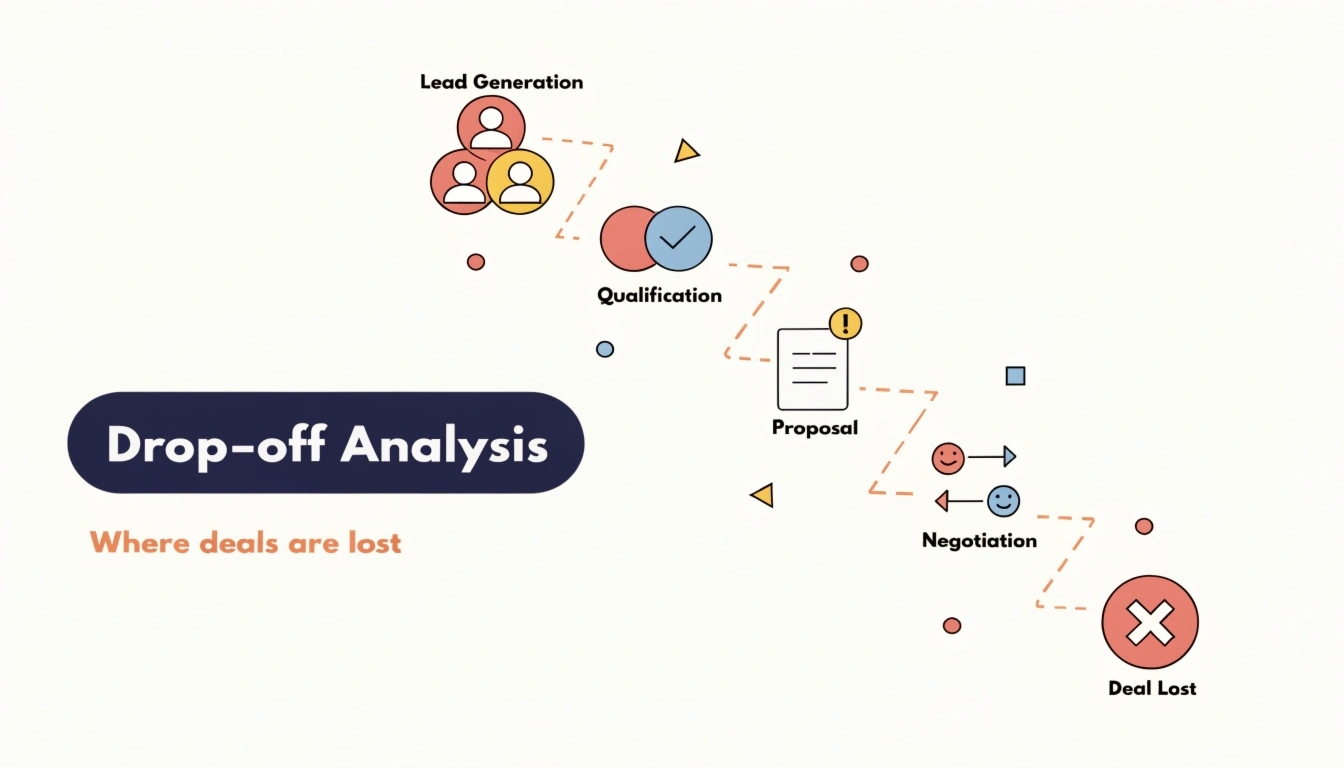
Every sales team celebrates closed deals, but successful organizations also pay close attention to the opportunities they lose. Understanding where and why prospects leave your sales funnel is essential for improving conversion rates and maximizing revenue. This process is known as drop-off analysis.
Drop-off analysis helps businesses identify the stages in their customer journey where potential buyers lose interest, delay decisions, or choose competitors. By uncovering these patterns, organizations can make data-driven improvements to their sales process and achieve better results.
In today's highly competitive digital marketplace, especially in IT services, software development, and B2B sales, analyzing lost deals is just as important as winning new ones.
What is Drop-off Analysis?
Drop-off analysis is the process of tracking prospects through each stage of a sales funnel and identifying where the highest percentage of leads fail to progress.
A typical sales funnel may include:
- Lead Generation
- Initial Contact
- Requirement Gathering
- Proposal Submission
- Negotiation
- Closing
At every stage, some prospects move forward while others drop out. Drop-off analysis helps determine:
- Where prospects are leaving
- How frequently deals are lost
- Why prospects stop engaging
- What improvements can increase conversions
Instead of guessing why deals are lost, businesses use data to identify exact bottlenecks.
Why Drop-off Analysis Matters
Many organizations focus only on generating more leads. However, increasing lead volume alone does not guarantee growth if prospects consistently leave the funnel before converting.
Drop-off analysis helps businesses:
Improve Conversion Rates
By identifying weak points, companies can optimize the customer journey and increase successful conversions.
Reduce Sales Cycle Length
Understanding delays and friction points allows sales teams to streamline processes and close deals faster.
Increase Revenue
Small improvements at critical stages can significantly boost overall sales performance.
Enhance Customer Experience
Analyzing prospect behavior helps create smoother and more engaging interactions.
Improve Resource Allocation
Sales teams can focus efforts on the stages that generate the highest impact.
Common Stages Where Deals Are Lost
1. Initial Contact Stage
Many leads fail to respond after the first outreach.
Common reasons include:
- Generic messaging
- Poor targeting
- Slow response times
- Lack of personalization
Solution:
Use personalized communication and respond quickly to inquiries.
2. Requirement Gathering Stage
Prospects may lose confidence if their needs are not properly understood.
Common reasons:
- Poor communication
- Incomplete discovery sessions
- Misaligned expectations
Solution:
Ask detailed questions and actively listen to customer requirements.
3. Proposal Submission Stage
One of the biggest drop-off points often occurs after sending proposals.
Common causes:
- Pricing concerns
- Unclear scope
- Lack of value demonstration
- Complicated documentation
Solution:
Present clear, customized proposals that emphasize business value rather than just costs.
4. Negotiation Stage
Prospects may hesitate due to budget limitations or internal approvals.
Common reasons:
- Pricing objections
- Competitor comparisons
- Delayed decision-making
Solution:
Address objections proactively and highlight ROI.
5. Final Closing Stage
Even highly qualified opportunities can disappear at the final stage.
Reasons include:
- Budget freezes
- Management changes
- Changing business priorities
- Competitor selection
Solution:
Maintain regular follow-ups and create urgency through value-driven communication.
Key Metrics for Effective Drop-off Analysis
To perform meaningful analysis, track the following metrics:
Stage Conversion Rate
Percentage of prospects moving from one stage to the next.
Drop-off Rate
Percentage of prospects leaving a specific stage.
Average Time in Stage
How long prospects remain in each stage before progressing or exiting.
Win-Loss Ratio
Comparison between won and lost opportunities.
Lead Source Performance
Identify which lead channels generate the highest quality prospects.
Reason for Loss
Categorize losses such as pricing, competition, timing, budget, or lack of fit.
Tools That Support Drop-off Analysis
Modern CRM and analytics platforms provide valuable insights.
Popular tools include:
- Salesforce
- HubSpot CRM
- Zoho CRM
- Pipedrive
- Microsoft Dynamics 365
- Google Analytics
- Power BI
- Tableau
These tools allow businesses to visualize customer journeys and identify conversion bottlenecks.
Best Practices for Reducing Sales Funnel Drop-offs
Maintain Consistent Follow-Ups
Many deals are lost simply because prospects are not contacted regularly.
Personalize Every Interaction
Customized communication builds trust and improves engagement.
Improve Proposal Quality
Focus on outcomes, benefits, and ROI rather than technical details alone.
Analyze Competitor Wins
Understand why prospects choose competitors and adjust your strategy accordingly.
Gather Customer Feedback
Lost prospects can provide valuable insights into weaknesses in your sales process.
Continuously Monitor Funnel Performance
Drop-off analysis should be an ongoing activity rather than a one-time exercise.
Conclusion
Drop-off analysis is one of the most powerful methods for improving sales performance and increasing revenue. By understanding where deals are lost, businesses can eliminate bottlenecks, enhance customer experiences, and create a more efficient sales funnel.
Rather than focusing solely on acquiring more leads, successful organizations continuously analyze prospect behavior throughout the customer journey. Every lost deal contains valuable information. When businesses use that information effectively, they transform missed opportunities into future growth.
Companies that consistently monitor and optimize their drop-off points gain a significant competitive advantage, improve conversion rates, and build a stronger foundation for long-term success.