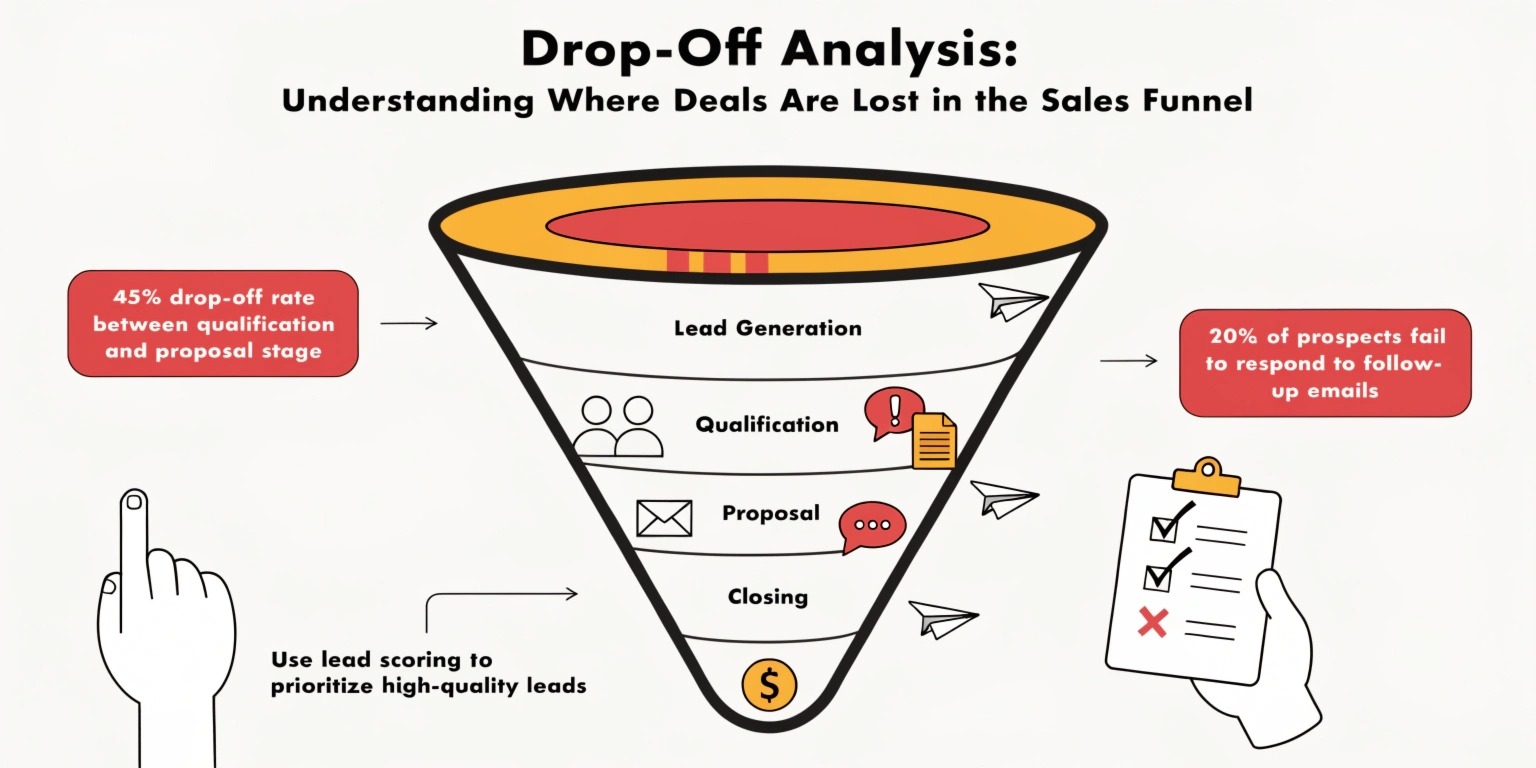
In today’s competitive business environment, generating leads is only part of the challenge. The real success lies in converting those leads into paying customers. Many companies invest heavily in marketing campaigns, sales outreach, and customer acquisition strategies, yet still struggle with declining conversion rates and lost opportunities.
One of the most effective ways to improve sales performance is through drop-off analysis. This process helps businesses identify where potential customers leave the sales funnel and why deals fail before conversion.
Understanding drop-off points allows organizations to optimize their sales process, improve customer experience, and increase revenue. Instead of guessing why prospects disappear, businesses can use data-driven insights to make informed decisions and reduce sales leakage.
What is Drop-Off Analysis?
Drop-off analysis refers to the process of identifying stages in the customer journey or sales funnel where potential customers stop progressing toward conversion.
In a typical sales funnel, customers move through stages such as:
- Awareness
- Interest
- Consideration
- Proposal or negotiation
- Purchase decision
At every stage, some leads naturally exit the funnel. However, excessive drop-offs often indicate operational, communication, or strategic problems.
Drop-off analysis helps organizations answer critical questions such as:
- Where are most deals being lost?
- Why are prospects disengaging?
- Which sales stages have low conversion rates?
- What obstacles prevent customers from purchasing?
These insights enable teams to improve funnel efficiency and customer retention.
Why Drop-Off Analysis Matters
Without proper analysis, businesses may continue investing resources into ineffective strategies.
Drop-off analysis helps organizations:
- Improve conversion rates
- Reduce customer acquisition costs
- Optimize sales pipelines
- Increase revenue predictability
- Improve customer experiences
- Strengthen lead nurturing strategies
Modern businesses rely heavily on analytics-driven decision-making, making drop-off analysis a key component of sales optimization.
Common Drop-Off Points in the Sales Funnel
1. Initial Lead Engagement
Many leads drop off during the first interaction because:
- Messaging is unclear
- Response times are slow
- Targeting is inaccurate
- Value propositions are weak
Customers expect fast and personalized communication. Delayed follow-ups can significantly reduce conversion chances.
2. Product Demonstration or Discovery Calls
Prospects often lose interest during demos if:
- The presentation lacks personalization
- Pain points are not addressed
- Features are overcomplicated
- Pricing is unclear
Effective demonstrations should focus on solving customer problems rather than simply showcasing features.
3. Proposal and Pricing Stage
Pricing is one of the most common stages where deals are lost.
Reasons include:
- Budget limitations
- Hidden costs
- Weak ROI explanation
- Competitor pricing advantages
- Poor negotiation handling
Businesses that fail to communicate value effectively often experience high proposal-stage drop-offs.
4. Contract and Decision-Making Phase
Some prospects disappear even after showing strong interest.
This may happen because:
- Decision processes take too long
- Stakeholder approvals create delays
- Competitors intervene
- Trust is insufficient
- Communication weakens
Complex B2B environments often involve multiple decision-makers, increasing the chances of deal delays or failures.
Key Metrics Used in Drop-Off Analysis
Successful drop-off analysis relies on tracking accurate sales metrics.
Important metrics include:
- Funnel conversion rates
- Lead response time
- Sales cycle duration
- Proposal acceptance rate
- Customer acquisition cost (CAC)
- Customer lifetime value (CLV)
- Stage-to-stage conversion percentages
CRM platforms like Salesforce and HubSpot provide detailed analytics to help organizations identify funnel inefficiencies.
Causes of High Deal Drop-Off Rates
Poor Lead Qualification
When sales teams target unqualified leads, conversion rates naturally decline.
Effective lead qualification ensures that prospects:
- Have genuine interest
- Match the target audience
- Possess purchasing authority
- Fit the budget range
Weak Communication
Lack of clear communication often causes confusion and mistrust.
Customers expect:
- Transparency
- Quick responses
- Personalized interactions
- Professional follow-ups
Poor communication can damage customer confidence quickly.
Lack of Customer Understanding
Businesses sometimes focus too heavily on product features instead of customer needs.
Successful sales strategies prioritize:
- Customer pain points
- Business goals
- Industry challenges
- Desired outcomes
Complex Sales Processes
Long or complicated purchasing journeys can frustrate potential customers.
Simplifying workflows, reducing approval delays, and improving onboarding experiences can significantly improve conversions.
How to Perform Effective Drop-Off Analysis
Map the Entire Customer Journey
The first step is identifying all stages of the sales funnel.
This helps teams visualize:
- Customer interactions
- Conversion paths
- Exit points
- Bottlenecks
Customer journey mapping provides a clear understanding of where friction occurs.
Collect and Analyze Data
Organizations should gather data from:
- CRM systems
- Sales calls
- Customer feedback
- Website analytics
- Email engagement metrics
Data-driven insights provide more accurate conclusions than assumptions.
Segment Customers
Different customer groups may drop off for different reasons.
Segment analysis based on:
- Industry
- Company size
- Geography
- Traffic source
- Buyer intent
can reveal hidden patterns and optimization opportunities.
Conduct Customer Feedback Interviews
Sometimes the best insights come directly from lost prospects.
Businesses can learn:
- Why the customer chose competitors
- Which concerns remained unresolved
- What improvements are needed
Honest feedback helps refine sales strategies effectively.
Using AI and Automation in Drop-Off Analysis
Artificial intelligence is transforming sales analytics.
AI-powered tools can:
- Predict deal risks
- Identify behavioral patterns
- Score leads automatically
- Recommend follow-up actions
- Analyze customer sentiment
Modern AI-driven CRM systems help sales teams respond proactively before deals are lost.
Predictive analytics is becoming increasingly valuable in reducing funnel drop-offs.
Benefits of Reducing Sales Funnel Drop-Offs
Businesses that optimize their funnel experience:
- Higher conversion rates
- Increased revenue
- Better customer retention
- Improved sales efficiency
- Lower acquisition costs
- Stronger customer relationships
Small improvements at key stages can produce significant long-term business growth.
Conclusion
Drop-off analysis is essential for understanding where and why deals are lost in the sales funnel. In today’s data-driven business environment, organizations can no longer rely on assumptions or generic sales strategies.
By analyzing customer behavior, tracking funnel metrics, improving communication, and optimizing sales workflows, businesses can significantly reduce drop-offs and improve conversion performance.
Companies that continuously monitor and refine their sales process gain a competitive advantage by creating smoother customer journeys and maximizing revenue opportunities.