Large Language Models (LLMs) have transformed natural language processing by enabling machines to generate coherent, context-aware, and human-like text. From chatbots and virtual assistants to content generation and code completion, LLMs are powering countless AI applications. However, generating text is only part of the challenge. Ensuring that the generated responses are accurate, relevant, fluent, and useful requires robust evaluation methods.
Unlike traditional classification models that can be measured using straightforward metrics such as accuracy or precision, evaluating text generation is more complex because there may be multiple valid responses to the same prompt. This is why researchers and developers rely on both automated metrics and human judgment to assess LLM performance.
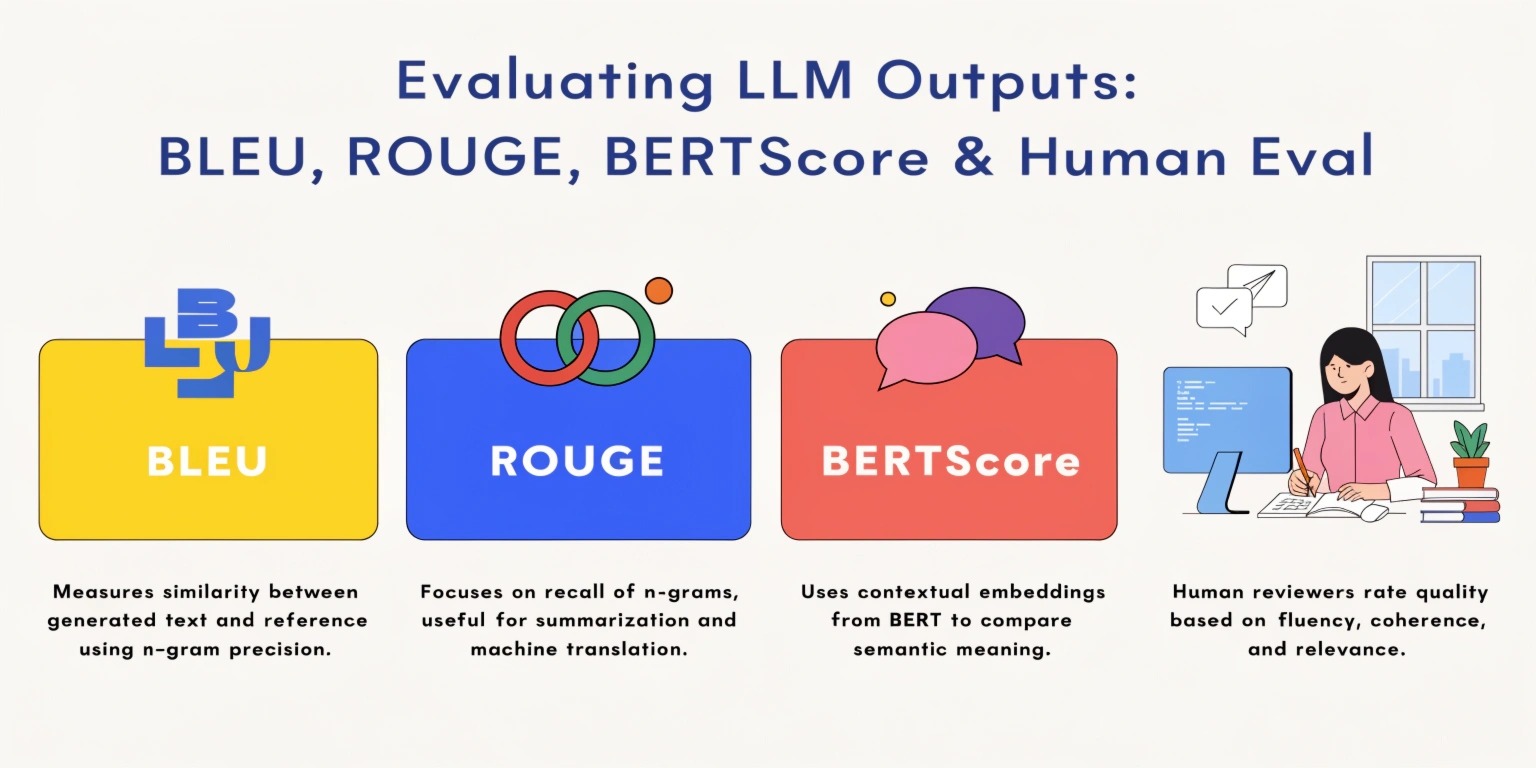
In this article, we'll explore four widely used evaluation methods: BLEU, ROUGE, BERTScore, and Human Evaluation.
Why LLM Evaluation Matters
Reliable evaluation helps developers:
- Compare different language models
- Improve prompt engineering
- Measure model quality
- Detect hallucinations
- Monitor production performance
- Improve user satisfaction
- Benchmark new model versions
- Validate fine-tuned models
Without proper evaluation, it becomes difficult to determine whether a model is truly improving.
BLEU (Bilingual Evaluation Understudy)
BLEU is one of the earliest and most widely used automated metrics for evaluating generated text. Originally developed for machine translation, it measures how closely generated text matches one or more reference texts.
BLEU works by calculating the overlap of word sequences (n-grams) between the generated output and reference text.
Advantages
- Fast computation
- Easy comparison across models
- Standard benchmark for translation
- Works well with multiple references
Limitations
- Focuses on exact word matching
- Does not capture semantic meaning
- Penalizes valid paraphrases
- Less suitable for open-ended text generation
For creative writing or conversational AI, BLEU alone often fails to reflect actual response quality.
ROUGE (Recall-Oriented Understudy for Gisting Evaluation)
ROUGE is commonly used for evaluating summarization models. Instead of emphasizing precision like BLEU, ROUGE measures how much of the reference content appears in the generated summary.
Common ROUGE variants include:
- ROUGE-1 (single-word overlap)
- ROUGE-2 (two-word sequences)
- ROUGE-L (longest common subsequence)
Advantages
- Effective for summarization tasks
- Simple to calculate
- Widely adopted in NLP research
- Measures content coverage
Limitations
- Depends heavily on reference wording
- Ignores deeper semantic similarity
- Cannot evaluate factual correctness
- Limited for conversational AI
ROUGE remains valuable for comparing summaries but should not be the sole evaluation metric.
BERTScore
BERTScore addresses many limitations of BLEU and ROUGE by comparing semantic similarity instead of exact word overlap.
It uses contextual embeddings generated by transformer-based models to evaluate whether two texts convey similar meanings, even if different words are used.
For example:
Reference:
"The weather is pleasant today."
Generated:
"It's a beautiful day outside."
Although there are few exact word matches, BERTScore recognizes that both sentences express similar meanings.
Advantages
- Captures semantic similarity
- Handles paraphrasing effectively
- Better aligned with human judgment
- Suitable for modern LLM evaluation
Limitations
- Higher computational cost
- Requires pretrained language models
- More complex implementation
- Still cannot fully measure factual accuracy
BERTScore has become a preferred automated metric for evaluating modern language models.
Human Evaluation
Despite advances in automated metrics, human evaluation remains the gold standard for assessing LLM outputs.
Human reviewers assess responses based on criteria such as:
- Accuracy
- Relevance
- Fluency
- Coherence
- Helpfulness
- Safety
- Creativity
- Factual correctness
Reviewers may assign numerical ratings or compare multiple model responses to determine which performs better.
Advantages
- Captures nuances missed by automated metrics
- Evaluates user experience
- Measures practical usefulness
- Detects hallucinations and unsafe outputs
Limitations
- Time-consuming
- Expensive
- Subjective
- Difficult to scale
Most organizations combine human evaluation with automated metrics to achieve balanced assessments.
Comparing the Metrics
MetricBest ForStrengthLimitationBLEUMachine TranslationFast and standardizedRelies on exact word overlapROUGEText SummarizationMeasures content recallLimited semantic understandingBERTScoreGeneral Text GenerationSemantic similarityHigher computational costHuman EvaluationAll NLP TasksMost comprehensiveCostly and time-intensive
Each metric serves a different purpose, and choosing the right one depends on the application.
Best Practices for LLM Evaluation
To obtain reliable results:
- Combine automated metrics with human evaluation.
- Evaluate across diverse datasets and prompts.
- Measure factual accuracy separately from fluency.
- Test edge cases and adversarial inputs.
- Monitor performance after deployment.
- Compare multiple model versions consistently.
- Track latency and cost alongside quality.
- Continuously refine evaluation criteria based on user feedback.
A comprehensive evaluation strategy provides a more accurate picture of real-world performance.
Emerging Trends
LLM evaluation continues to evolve rapidly.
New approaches include:
- LLM-as-a-Judge evaluation
- Pairwise response ranking
- Task-specific benchmarks
- Retrieval-aware evaluation
- Hallucination detection metrics
- Safety and bias assessments
- Agent performance evaluation
- Multimodal evaluation for text, images, and audio
These methods aim to provide more holistic measurements of AI system quality.
Conclusion
Evaluating Large Language Models requires more than a single metric. While BLEU and ROUGE remain useful for translation and summarization, they struggle to assess semantic meaning and conversational quality. BERTScore offers a more sophisticated understanding of text similarity, making it better suited for modern LLMs. However, human evaluation remains indispensable for judging accuracy, usefulness, and overall user experience.
By combining automated metrics with structured human assessments, developers can build AI systems that are not only technically strong but also reliable, safe, and genuinely valuable to end users.