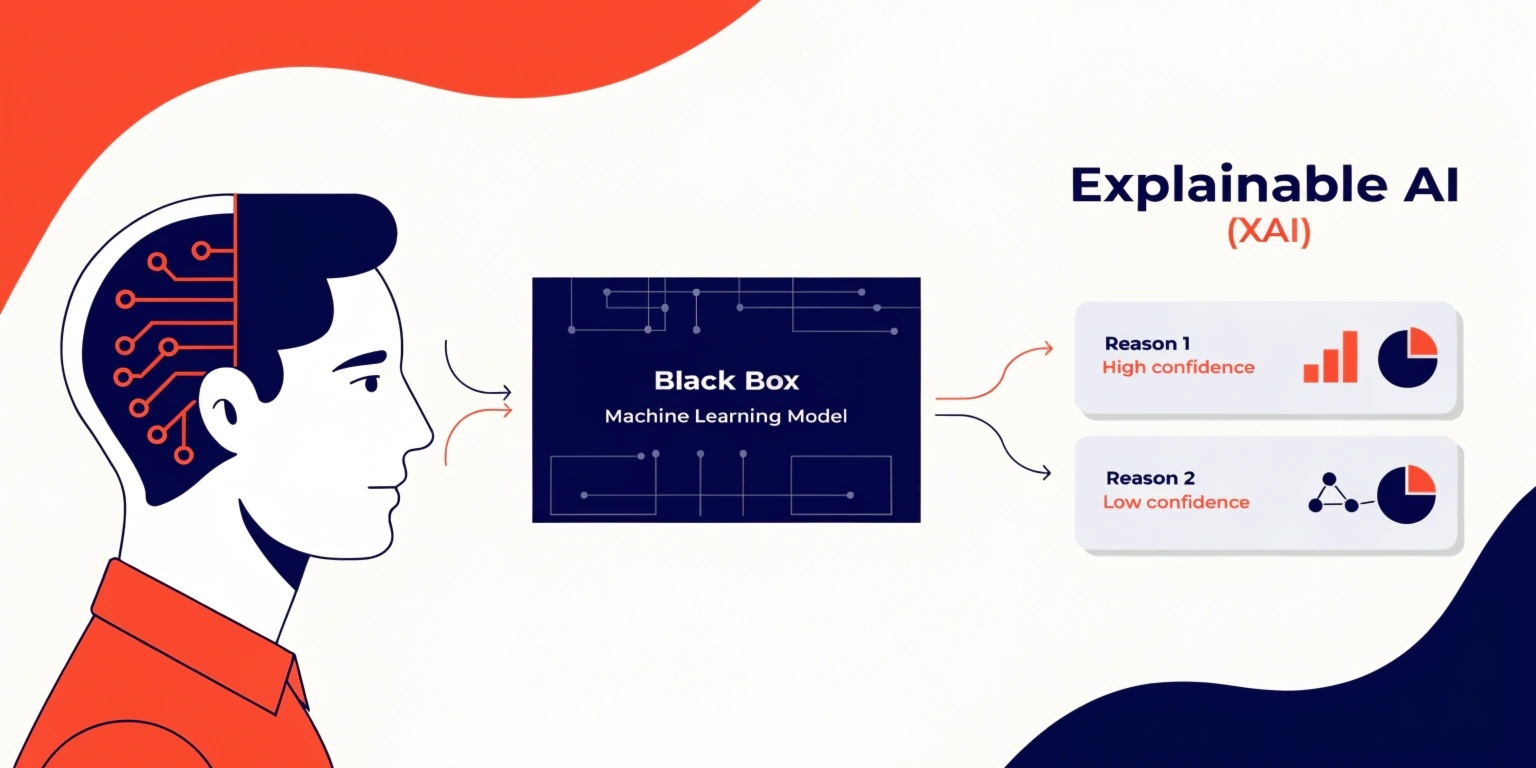
Artificial Intelligence has become an integral part of modern business operations, powering applications such as fraud detection, medical diagnosis, recommendation engines, autonomous vehicles, predictive maintenance, and financial forecasting. Many of these solutions rely on highly sophisticated machine learning models, including deep neural networks, ensemble methods, and large language models. While these models often deliver exceptional predictive accuracy, they are commonly referred to as black-box models because their internal decision-making processes are difficult for humans to understand.
As AI increasingly influences high-impact decisions, organizations face growing demands for transparency, accountability, and fairness. Customers, regulators, and business stakeholders want to understand why an AI system made a specific prediction or recommendation. This is where Explainable AI (XAI) plays a critical role.
Explainable AI provides methods and tools that help developers, analysts, and decision-makers interpret model behavior without significantly sacrificing performance. By making AI systems more understandable, XAI improves trust, supports regulatory compliance, and enables responsible AI adoption. This article explores the principles, techniques, benefits, challenges, and future of Explainable AI for black-box models.
What Is Explainable AI (XAI)?
Explainable AI refers to a collection of techniques that make machine learning models easier for humans to understand and interpret.
Instead of treating predictions as mysterious outputs, XAI explains:
- Why a prediction was made
- Which features influenced the decision
- How confident the model is
- Alternative outcomes under different inputs
- Potential biases within the model
These explanations help stakeholders evaluate whether an AI system is reliable and appropriate for its intended use.
Understanding Black-Box Models
Black-box models are algorithms whose internal reasoning is difficult to interpret due to their complexity.
Examples include:
- Deep Neural Networks
- Gradient Boosting Machines
- Random Forests
- Large Language Models (LLMs)
- Transformer architectures
Although these models often achieve excellent accuracy, understanding exactly how they arrive at specific predictions can be challenging.
Why Explainability Matters
Explainability is becoming increasingly important as AI is adopted across industries.
Key benefits include:
- Building user trust
- Supporting regulatory compliance
- Detecting model bias
- Improving debugging
- Enhancing model validation
- Assisting decision-makers
- Increasing AI adoption
Transparent AI systems are easier to evaluate and improve over time.
Types of Explainability
Explainability can be categorized into different levels.
Global Explainability
Provides insight into how the entire model behaves.
Examples include:
- Overall feature importance
- Model architecture analysis
- Decision boundaries
- Training behavior
Global explanations help developers understand the model as a whole.
Local Explainability
Focuses on explaining individual predictions.
For example:
Why was a particular loan approved?
Why was a medical condition classified as high risk?
Local explanations help users understand specific decisions affecting individuals.
Popular XAI Techniques
Several methods have become industry standards for explaining black-box models.
SHAP (SHapley Additive exPlanations)
SHAP assigns contribution values to each input feature based on cooperative game theory.
Benefits include:
- Consistent explanations
- Model-agnostic compatibility
- Local and global insights
- Visual interpretation tools
SHAP is widely used in finance, healthcare, and enterprise AI.
LIME (Local Interpretable Model-Agnostic Explanations)
LIME explains individual predictions by creating a simpler surrogate model around a specific data point.
Advantages include:
- Easy implementation
- Model independence
- Local prediction explanations
LIME is particularly useful for debugging classification models.
Feature Importance
Many machine learning algorithms can estimate how much each feature contributes to predictions.
Examples include:
- Permutation importance
- Tree-based feature importance
- Gradient analysis
These techniques help identify the variables driving model performance.
Partial Dependence Plots (PDP)
PDPs visualize how changes in a feature influence model predictions while keeping other variables constant.
They provide valuable insights into feature relationships and model behavior.
Applications of Explainable AI
XAI supports decision-making across many industries.
Common use cases include:
- Healthcare diagnosis
- Financial risk assessment
- Fraud detection
- Insurance underwriting
- Autonomous driving
- Cybersecurity
- Human resource analytics
- Manufacturing quality control
In each case, explainability increases confidence in AI-assisted decisions.
Challenges of Explainable AI
Despite its advantages, XAI presents several challenges.
Common limitations include:
- Trade-offs between accuracy and interpretability
- Computational overhead
- Difficulty explaining highly complex models
- Potentially inconsistent explanations
- User misunderstanding of technical outputs
- Limited standardization across tools
Organizations must balance model performance with transparency requirements.
Best Practices
To successfully implement Explainable AI:
- Choose explanation techniques suited to your model type.
- Combine global and local explanations.
- Validate explanations with domain experts.
- Monitor models for bias and fairness.
- Document AI decision processes.
- Use visualizations to improve stakeholder understanding.
- Test explanations regularly as models evolve.
- Integrate explainability into the complete AI lifecycle.
These practices improve trust and support responsible AI deployment.
Regulatory and Ethical Considerations
Many industries now require greater transparency in automated decision-making.
Explainable AI supports:
- Responsible AI governance
- Ethical decision-making
- Risk management
- Audit readiness
- Regulatory compliance
- Customer transparency
Organizations adopting AI should consider explainability an essential part of their governance strategy rather than an optional feature.
Future Trends
Explainable AI continues to evolve alongside advances in machine learning.
Emerging innovations include:
- Explainable Large Language Models
- Real-time explanation systems
- AI governance platforms
- Causal AI analysis
- Counterfactual explanations
- Human-centered AI interfaces
- Automated bias detection
- Explainability integrated into AI development platforms
These developments will make AI systems more transparent, accountable, and accessible.
Conclusion
As black-box machine learning models become increasingly powerful, the need for transparency has never been greater. Explainable AI bridges the gap between model performance and human understanding by providing meaningful insights into how AI systems generate predictions and recommendations.
By leveraging techniques such as SHAP, LIME, feature importance analysis, and partial dependence plots, organizations can improve trust, identify bias, support regulatory compliance, and make AI-driven decisions more understandable for both technical teams and business stakeholders. As responsible AI becomes a strategic priority across industries, Explainable AI will remain a cornerstone of building ethical, reliable, and trustworthy intelligent systems.