The rise of Large Language Models (LLMs) has transformed how businesses build AI-powered applications. From intelligent chatbots and virtual assistants to automated content generation and customer support, organizations now have multiple ways to customize AI behavior without always training a model from scratch.
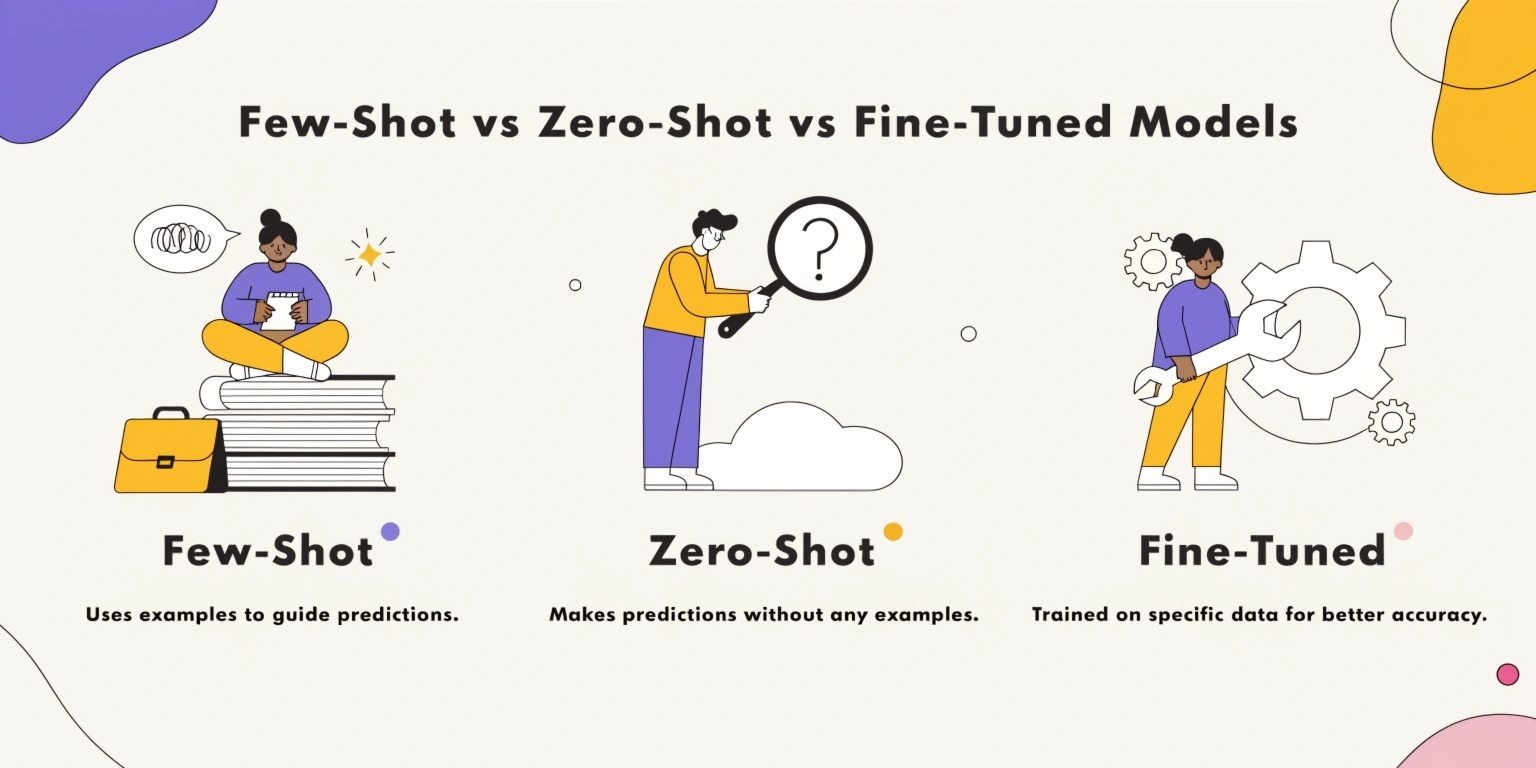
Three of the most common approaches are Zero-Shot Learning, Few-Shot Learning, and Fine-Tuning. While all three enable AI models to solve tasks, they differ significantly in terms of setup, cost, flexibility, accuracy, and maintenance.
Understanding these differences helps developers and businesses select the most suitable strategy for their specific AI projects.
What is Zero-Shot Learning?
Zero-shot learning enables an AI model to perform a task without having seen any task-specific examples. Instead, the model relies entirely on its pre-trained knowledge and the instructions provided in the prompt.
For example, you could ask:
"Summarize this research paper into five bullet points."
Even if the model has never been specifically trained for that exact task, it can often produce high-quality results because of its broad pre-training.
Advantages
- No training data required
- Fast implementation
- Low development cost
- Ideal for rapid prototyping
- Highly flexible across multiple tasks
Limitations
- Less consistent for complex workflows
- Output quality depends heavily on prompt clarity
- May struggle with domain-specific terminology
Common Use Cases
- General question answering
- Content summarization
- Translation
- Brainstorming ideas
- Basic customer support
What is Few-Shot Learning?
Few-shot learning improves performance by providing the model with a small number of examples within the prompt before asking it to complete the task.
For example:
Input Example 1
Customer: "I received the wrong order."
Category: Shipping Issue
Input Example 2
Customer: "The product stopped working."
Category: Product Defect
Then provide a new customer message, and the AI understands the expected response format much better.
Rather than retraining the model, you're teaching it through examples in the prompt.
Advantages
- Higher accuracy than zero-shot
- No model retraining
- Easy to experiment
- Better consistency
- Works well for structured outputs
Limitations
- Limited by prompt length
- Large prompts increase token usage and costs
- Examples must be carefully designed
Common Use Cases
- Email classification
- Sentiment analysis
- Data extraction
- Product categorization
- Support ticket routing
What is Fine-Tuning?
Fine-tuning involves training a pre-trained AI model using your own labeled dataset. Instead of relying solely on prompts, the model learns your organization's specific terminology, style, workflows, and domain knowledge.
For example, a healthcare company may fine-tune a model using thousands of anonymized medical conversations to improve responses for clinicians. Similarly, a legal firm can fine-tune an AI model using legal contracts and case documents to generate more relevant outputs.
Fine-tuning creates a specialized model optimized for specific business requirements.
Advantages
- Highest task-specific accuracy
- Consistent outputs
- Learns industry-specific language
- Faster inference for repetitive tasks
- Reduced need for lengthy prompts
Limitations
- Requires high-quality training data
- Higher implementation cost
- Longer development cycle
- Ongoing maintenance and updates
Common Use Cases
- Medical AI assistants
- Legal document generation
- Financial analysis
- Enterprise knowledge systems
- Industry-specific chatbots
Comparing the Three Approaches
FeatureZero-ShotFew-ShotFine-TunedTraining RequiredNoNoYesSample ExamplesNoneFewThousandsDevelopment SpeedVery FastFastSlowerInitial CostLowLowHighAccuracyModerateHighVery HighCustomizationLimitedModerateExtensiveMaintenanceMinimalMinimalOngoingBest ForGeneral tasksStructured workflowsSpecialized AI solutions
Which Approach Should You Choose?
The ideal choice depends on your business objectives, available data, and budget.
Choose Zero-Shot When:
- Building an MVP quickly
- Testing AI capabilities
- Performing general-purpose tasks
- Working with limited resources
Choose Few-Shot When:
- Better consistency is required
- Output format matters
- You have example-based workflows
- Prompt engineering can solve the problem
Choose Fine-Tuning When:
- Industry-specific knowledge is essential
- Large-scale production systems are involved
- Brand voice consistency is critical
- High accuracy directly impacts business outcomes
Real-World Example
Imagine an e-commerce company developing an AI customer support assistant.
Zero-Shot
The chatbot answers general customer questions based solely on the prompt. It's quick to deploy but may provide inconsistent responses for company-specific policies.
Few-Shot
Developers include examples of common customer interactions, refund requests, and shipping inquiries within the prompt. The chatbot produces more accurate and consistent answers without modifying the model.
Fine-Tuned
The company trains the AI using thousands of historical support tickets, FAQs, and policy documents. The chatbot learns brand-specific language and consistently provides accurate, policy-compliant responses at scale.
Factors to Consider Before Deciding
Before selecting an approach, evaluate:
- Project complexity
- Data availability
- Budget constraints
- Required accuracy
- Scalability needs
- Response latency
- Maintenance requirements
- Regulatory compliance
- Security considerations
Many organizations begin with zero-shot or few-shot prompting and move to fine-tuning only after validating the business case.
Best Practices
To maximize AI performance:
- Start with clear prompt engineering.
- Test zero-shot performance first.
- Use few-shot examples for repetitive tasks.
- Fine-tune only when measurable improvements justify the investment.
- Continuously monitor model outputs.
- Keep datasets clean and representative.
- Evaluate performance using real-world scenarios.
- Regularly update prompts or training data as business needs evolve.
Conclusion
Zero-shot, few-shot, and fine-tuned models each play an important role in modern AI development. Zero-shot learning offers speed and simplicity, making it ideal for general-purpose applications. Few-shot learning enhances reliability through carefully crafted examples without requiring model retraining. Fine-tuned models provide the highest level of specialization and accuracy, making them the preferred choice for enterprise-grade, domain-specific AI solutions.
Rather than viewing these approaches as competitors, businesses should see them as complementary tools. By understanding their strengths and limitations, organizations can build AI systems that balance performance, cost, scalability, and user experience, ensuring long-term success in an increasingly AI-driven world.