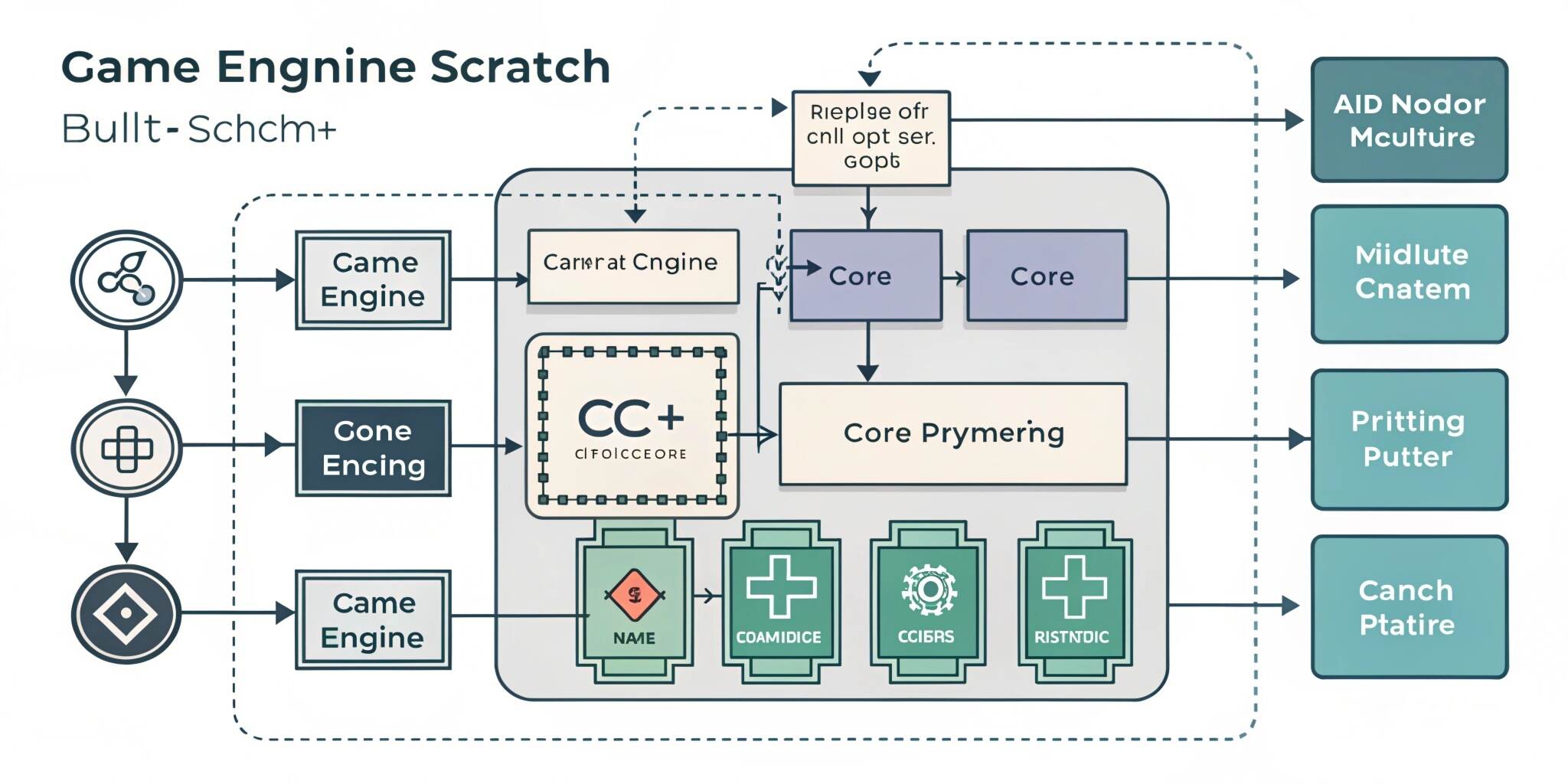
Building a game engine from scratch is one of the most challenging and rewarding tasks in software engineering. It requires a deep understanding of systems design, performance optimization, and real-time computing. While modern engines like Unreal Engine 5 and Unity abstract much of this complexity, creating your own engine provides unmatched control and insight into how games truly work.
This article explores the architectural foundations of a game engine built in C++.
What Is a Game Engine?
A game engine is a collection of systems that handle rendering, physics, input, audio, and more. It provides the infrastructure required to build and run games efficiently.
At its core, a game engine must:
- Process user input
- Update game logic
- Render frames in real time
All of this happens within a structured loop known as the game loop.
The Game Loop
The game loop is the heart of any engine. It continuously runs while the game is active.
Basic structure:
- Handle input
- Update game state
- Render output
In C++, a simplified loop looks like:
while (running) {
processInput();
update(deltaTime);
render();
}
A fixed timestep or variable timestep approach can be used depending on the design.
Core Engine Architecture
A well-designed engine is modular. Each system operates independently but communicates through well-defined interfaces.
Key subsystems include:
1. Rendering Engine
Handles drawing objects on the screen.
Responsibilities:
- Shader management
- Lighting calculations
- Mesh rendering
- Camera transformations
Modern engines use APIs like DirectX or Vulkan for GPU communication.
2. Entity Component System (ECS)
ECS is a popular architecture for managing game objects.
Instead of traditional inheritance-based design:
- Entities = unique IDs
- Components = data (position, velocity, health)
- Systems = logic operating on components
This improves:
- Performance (cache-friendly memory layout)
- Scalability
- Flexibility
3. Memory Management
C++ gives low-level control over memory, which is critical for performance.
Common techniques:
- Custom allocators
- Object pooling
- Stack vs heap allocation strategies
Efficient memory usage reduces fragmentation and improves runtime performance.
4. Input System
Handles keyboard, mouse, and controller input.
Key goals:
- Low latency
- Cross-platform compatibility
- Event-driven or polling systems
5. Physics Engine
Manages collisions and physical interactions.
Basic features:
- Rigid body simulation
- Collision detection (AABB, SAT)
- Gravity and forces
Many custom engines implement simplified physics for performance reasons.
6. Audio System
Handles sound playback and effects.
Includes:
- 2D/3D audio
- Spatial positioning
- Sound mixing
7. Asset Management System
Responsible for loading and managing resources like:
- Textures
- Models
- Audio files
Efficient asset streaming is crucial for large games.
Multithreading and Job Systems
Modern game engines use multithreading to utilize multi-core CPUs.
Common approaches:
- Task-based job systems
- Thread pools
- Parallel processing for rendering and physics
This significantly improves performance, especially in complex scenes.
Rendering Pipeline Overview
A typical rendering pipeline includes:
- Scene setup
- Culling (remove unseen objects)
- Draw calls submission
- GPU execution
- Frame presentation
Optimizations include:
- Frustum culling
- Occlusion culling
- Batching draw calls
Performance Optimization Strategies
Game engines must maintain real-time performance (usually 60 FPS or higher).
Key strategies:
- Minimize memory allocations
- Use data-oriented design
- Reduce draw calls
- Optimize cache usage
- Profile continuously
Tools like profilers help identify bottlenecks in CPU and GPU usage.
Challenges of Building from Scratch
Creating an engine is complex and time-consuming.
Common challenges:
- Debugging low-level systems
- Cross-platform compatibility
- GPU programming complexity
- Maintaining performance under load
This is why many studios prefer established engines unless they need custom solutions.
Why Build Your Own Engine?
Despite the challenges, building a custom engine offers:
- Full control over architecture
- Tailored optimization for specific games
- Deep understanding of game systems
- Competitive advantage for specialized use cases
Studios developing unique gameplay mechanics or proprietary technology often choose this route.
Final Thoughts
Designing a game engine from scratch in C++ is a deep technical endeavor that combines systems programming, graphics, and real-time architecture. While tools like Unreal Engine 5 simplify development, understanding what happens under the hood is invaluable.
Whether you are building a small experimental engine or a production-ready system, the principles of modular design, performance optimization, and clean architecture remain essential.
Mastering these concepts not only improves your engineering skills but also enables you to push the boundaries of what games can achieve.