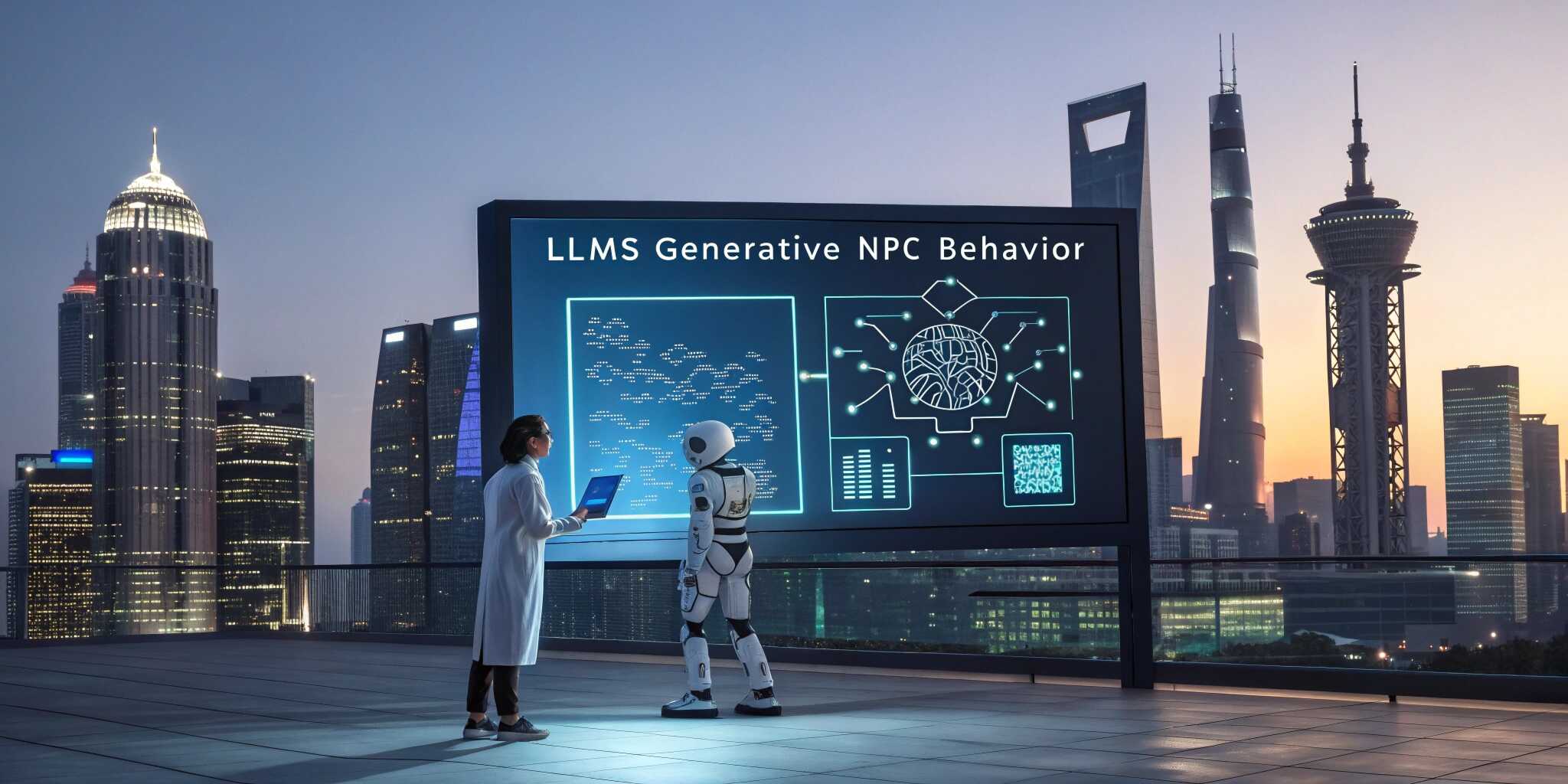
For decades, NPCs (Non-Player Characters) have served as a backbone for interaction, storytelling, and world-building in video games. Yet traditional NPC systems rely heavily on predetermined scripts and dialog trees, making interactions repetitive and predictable. The emergence of Large Language Models (LLMs) is redefining this paradigm, enabling NPCs to behave like autonomous beings with dynamic personalities, persistent memory, and context-aware responses that adapt to player behavior.
Generative AI unlocks the possibility of NPCs who can communicate in natural language, make decisions based on environmental cues, and evolve their behavior over time. Instead of selecting from fixed lines of dialogue, NPCs powered by LLMs can generate unique responses based on player actions, emotional tone, historical memory, and narrative direction. This enables games to move beyond static storytelling into truly interactive narrative ecosystems.
One of the most transformative capabilities of LLM-driven NPCs is dynamic decision-making. Rather than following predefined action patterns, NPCs can evaluate scenarios using reasoning models, considering consequences and goals. For instance, in a sandbox RPG, a guard NPC might change patrol routes based on previous attacks, request reinforcements, or negotiate instead of fighting depending on the player’s reputation. NPCs feel alive not because they are scripted to respond but because they are capable of real-time judgement.
LLM-based NPCs can also utilize persistent memory, allowing them to remember player choices, alliances, betrayals, or past conversations. This opens the door to deeply personal gameplay experiences. A trader who remembers being cheated may increase prices; a rescued villager may become a loyal follower later in the story. Unlike typical reputation meters, memory-driven interactions feel organic and emotionally meaningful.
Another powerful application is emotionally intelligent interaction. LLMs can analyze tone, sentiment, objectives, and social context, enabling NPCs to respond empathetically or strategically. In narrative-heavy games, emotional AI can radically enhance immersion by allowing players to build real relationships with characters that grow over time.
Generative NPC behavior also supports open-ended emergent storytelling. Instead of pre-planned quests, LLMs can generate scenarios and conflicts based on world state and player actions. NPCs can create goals, form factions, build alliances, or start conflicts autonomously. The game becomes less of a predetermined experience and more of a living simulation where storylines emerge naturally.
The combination of LLMs with traditional AI technologies strengthens generative NPC systems even further. Pathfinding, animation systems, and behavior trees continue to manage physical actions, while LLMs manage cognitive reasoning, communication, and emotional layers. This hybrid approach balances freedom with control, ensuring consistency, performance, and stability.
However, the transition to generative NPC systems introduces significant challenges. LLMs require robust guardrails to maintain lore accuracy, prevent immersion-breaking randomness, and ensure appropriateness. Developers need tools that define character backgrounds, values, knowledge boundaries, and narrative constraints. Without this, NPCs may generate unrealistic or erratic behavior.
Performance is another critical concern. Running complex LLM processing for hundreds of NPCs simultaneously is computationally demanding. Techniques such as local caching, priority-based inference, and memory routing systems are essential to achieve scalability—especially in multiplayer or open-world games.
Looking to the future, generative NPC technology represents one of the biggest leaps in immersive game design. We may soon see worlds where every NPC has a unique personality, dynamic goals, individual histories, and the ability to collaborate, compete, or evolve based on player actions and world conditions. AI companions, quest-givers, merchants, and enemies could all share consistent world awareness, creating narrative experiences that feel handcrafted—yet occur autonomously.
The next generation of game AI will not simply simulate intelligence—it will learn, adapt, and interact as if truly alive. With LLMs, NPCs become partners in storytelling rather than tools that deliver content. This marks the beginning of a new era where gameplay is shaped not by scripted events, but by intelligent collaboration between players and AI-driven characters.