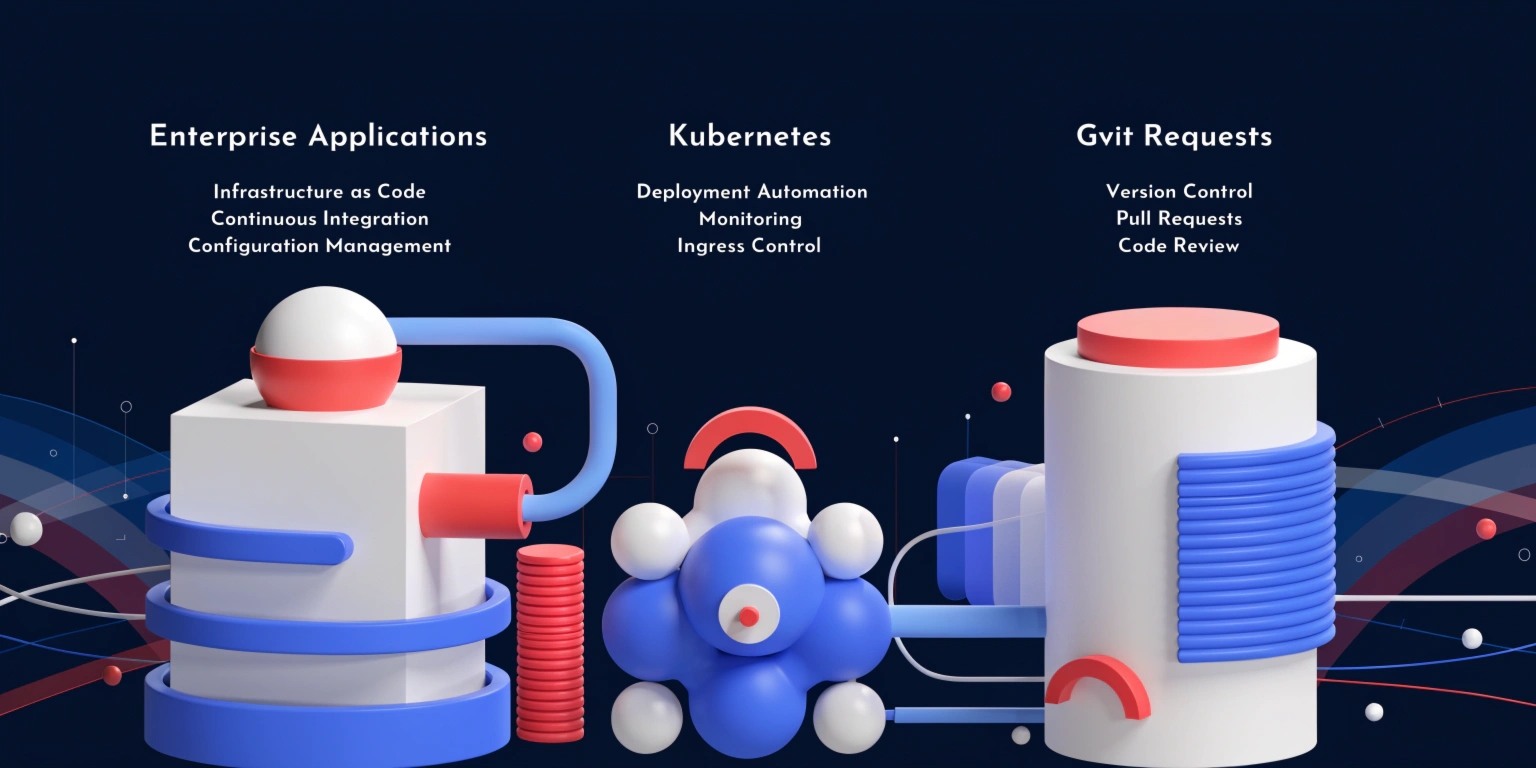
As enterprises scale their applications and infrastructure, managing deployments efficiently becomes increasingly complex. Traditional DevOps practices, while effective, often lack the transparency and control needed for large-scale environments. This is where GitOps emerges as a powerful paradigm—bringing consistency, automation, and reliability to infrastructure management.
What Is GitOps?
GitOps is an operational framework that uses Git repositories as the single source of truth for both application code and infrastructure configurations. All changes are made through Git workflows, and automated systems ensure that the live environment matches the desired state defined in the repository.
In simple terms, GitOps extends Infrastructure as Code (IaC) by adding continuous reconciliation and automated deployment.
Why GitOps Matters in Enterprises
Enterprise environments typically involve:
- Multiple teams and services
- Complex cloud and hybrid infrastructures
- Strict security and compliance requirements
GitOps addresses these challenges by providing:
- Version Control: Every change is tracked and auditable
- Consistency: Environments are reproducible
- Automation: Reduces manual intervention and errors
- Security: Controlled access via Git permissions
Core Principles of GitOps
1. Declarative Infrastructure
Systems are defined declaratively using configuration files (e.g., YAML). These files describe the desired state rather than the steps to achieve it.
2. Versioned and Immutable
All configurations are stored in Git, enabling versioning, rollback, and change tracking.
3. Automated Synchronization
Agents continuously monitor the Git repository and automatically apply changes to the infrastructure.
4. Continuous Reconciliation
If the system deviates from the desired state, GitOps tools automatically correct it.
GitOps Workflow in Enterprises
A typical GitOps workflow looks like this:
- Developer updates configuration or code in a Git repository
- Changes are reviewed via pull requests
- Once approved, changes are merged into the main branch
- GitOps tools detect the update
- Infrastructure or application is automatically updated
This workflow ensures that deployments are predictable, auditable, and repeatable.
Key Tools for GitOps
Several tools enable GitOps practices in enterprise environments:
- Argo CD – Kubernetes-native continuous delivery tool
- Flux – Automates deployment and synchronization
- Jenkins X – CI/CD solution with GitOps integration
- Terraform – Often used alongside GitOps for infrastructure provisioning
These tools integrate seamlessly with Kubernetes, making GitOps particularly effective for containerized applications.
Benefits of GitOps in Enterprise Settings
1. Enhanced Security and Compliance
All changes go through Git, ensuring:
- Audit trails
- Role-based access control
- Easy compliance reporting
2. Faster Deployments
Automation reduces deployment time and eliminates manual steps.
3. Improved Reliability
Continuous reconciliation ensures systems remain in the desired state.
4. Easy Rollbacks
Reverting to a previous version is as simple as rolling back a Git commit.
Challenges in Adopting GitOps
Despite its advantages, enterprises may face challenges:
1. Cultural Shift
Teams must adopt Git-centric workflows, which may require training.
2. Tooling Complexity
Integrating multiple tools can be overwhelming initially.
3. Repository Management
Managing large-scale repositories with multiple environments requires proper structuring.
Best Practices for Enterprise GitOps
- Use separate repositories for infrastructure and applications
- Implement strict code review policies
- Structure repositories by environment (dev, staging, production)
- Secure sensitive data using secrets management tools
- Monitor deployments and system state continuously
Real-World Use Cases
- Multi-Cloud Deployments: Manage infrastructure across AWS, Azure, and GCP
- Microservices Architecture: Deploy and manage independent services efficiently
- Disaster Recovery: Quickly restore systems using version-controlled configurations
Conclusion
GitOps is transforming how enterprises manage infrastructure and deployments. By leveraging Git as the single source of truth and automating system reconciliation, organizations can achieve greater consistency, security, and scalability.
While adopting GitOps requires an initial investment in tools and training, the long-term benefits make it a critical strategy for modern enterprise DevOps.