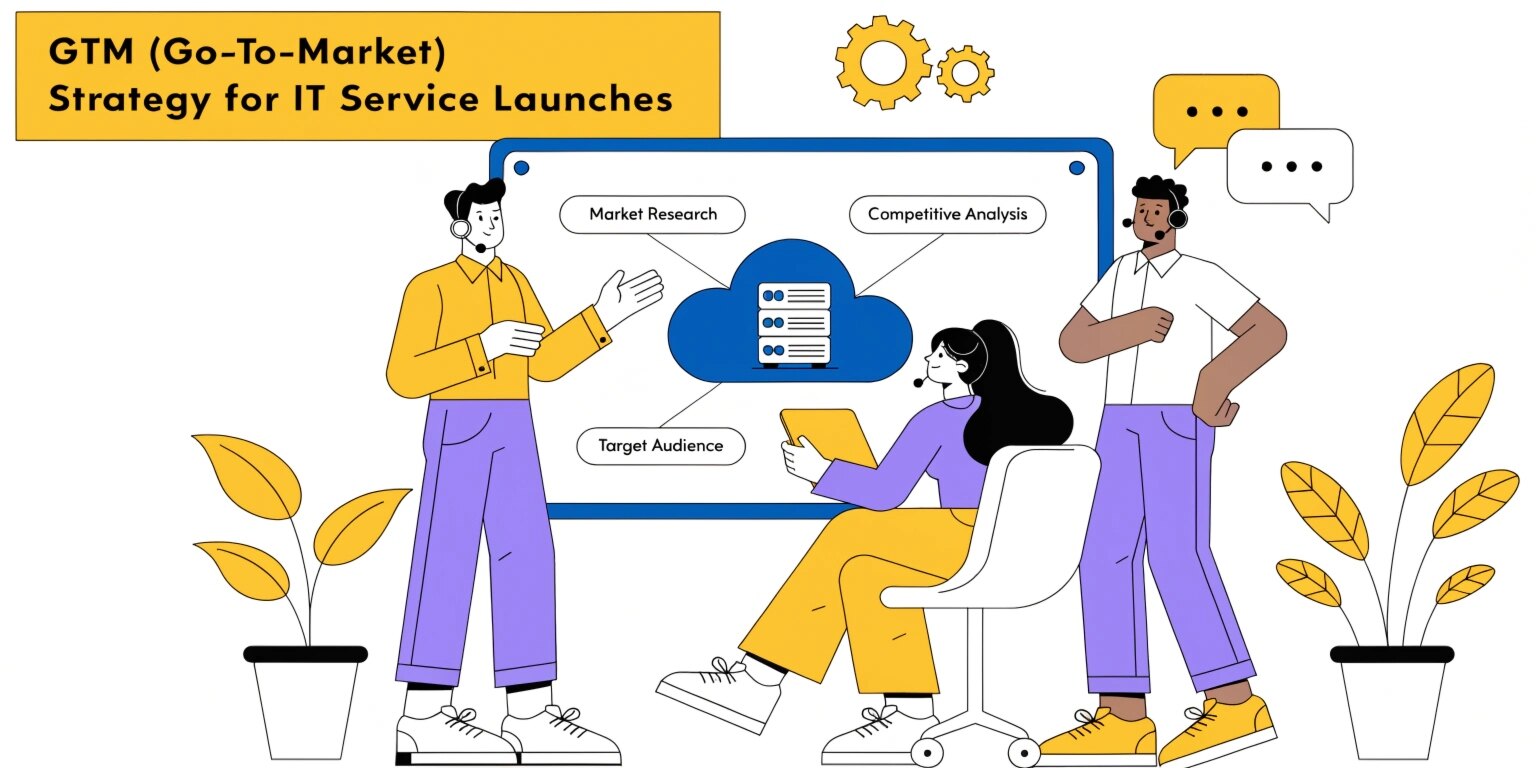
Launching a new IT service is an exciting milestone, but even the most innovative offering can fail if customers are unaware of its value. Many technology companies invest heavily in developing software solutions, cloud services, AI platforms, cybersecurity offerings, or consulting services, only to struggle with acquiring clients after launch.
The missing piece is often a well-defined Go-To-Market (GTM) Strategy. A GTM strategy provides a structured roadmap for introducing a service to the market, identifying the right audience, communicating value, and generating sustainable revenue.
For IT service providers, a strong GTM strategy can mean the difference between rapid growth and a stalled launch. Let's explore how to build an effective Go-To-Market strategy for IT service launches.
What Is a Go-To-Market Strategy?
A Go-To-Market (GTM) strategy is a comprehensive plan that outlines how a company will deliver its services to target customers and achieve a competitive advantage.
A GTM strategy answers critical questions such as:
- Who are our ideal customers?
- What problems do we solve?
- Why should clients choose us?
- Which marketing channels should we use?
- How will we generate leads and sales?
Instead of relying on guesswork, a GTM strategy creates a clear path to market success.
Why GTM Is Important for IT Services
IT services are often complex and highly competitive. Clients evaluate multiple vendors before making decisions, especially for high-value projects.
Without a GTM strategy, companies may face:
- Poor market visibility
- Weak lead generation
- Ineffective messaging
- Low conversion rates
- Difficulty differentiating from competitors
A structured GTM approach helps organizations target the right audience with the right message at the right time.
Step 1: Define Your Ideal Customer Profile (ICP)
The first step in any GTM strategy is identifying who will benefit most from your service.
Consider factors such as:
Industry
- Healthcare
- Finance
- Retail
- Manufacturing
- Education
Company Size
- Startups
- Small businesses
- Mid-sized companies
- Enterprises
Decision Makers
- CEOs
- CTOs
- IT Managers
- Product Owners
- Operations Directors
Creating a detailed Ideal Customer Profile (ICP) helps focus marketing and sales efforts on the most promising opportunities.
Step 2: Identify the Problem You Solve
Clients don't buy services—they buy solutions to business problems.
For example:
Weak Positioning
"We provide cloud migration services."
Strong Positioning
"We help businesses reduce infrastructure costs and improve scalability through secure cloud transformation."
Clearly defining the problem and outcome makes your service more compelling.
Step 3: Develop a Unique Value Proposition
Your value proposition should explain why clients should choose your company over competitors.
A strong value proposition answers:
- What makes your service unique?
- What measurable results can clients expect?
- How do you reduce risk or improve efficiency?
Examples include:
- Faster project delivery
- Industry-specific expertise
- Proven implementation frameworks
- Cost-effective engagement models
Differentiation is essential in crowded IT markets.
Step 4: Create Service Packaging and Pricing
Pricing plays a major role in market acceptance.
Common pricing models include:
Fixed Price
Best for clearly defined projects.
Time and Material
Suitable for evolving project requirements.
Dedicated Team
Ideal for long-term development partnerships.
Subscription-Based Services
Popular for managed services and SaaS solutions.
Clearly defined packages simplify decision-making for prospects.
Step 5: Build Your Marketing Foundation
Before launch, ensure your marketing assets are ready.
Key elements include:
Website Landing Pages
Create dedicated pages highlighting:
- Service benefits
- Case studies
- Client testimonials
- Call-to-action forms
Content Marketing
Publish valuable content such as:
- Blogs
- Whitepapers
- Case studies
- Industry reports
Educational content builds authority and trust.
Search Engine Optimization (SEO)
Optimize content for relevant keywords to attract organic traffic.
Step 6: Choose the Right Marketing Channels
Different audiences respond to different channels.
Popular GTM channels for IT services include:
Excellent for B2B lead generation and thought leadership.
Email Marketing
Effective for nurturing prospects and maintaining engagement.
Google Search
Captures high-intent buyers actively seeking solutions.
Industry Events
Conferences, webinars, and networking events help establish credibility.
Partnerships
Collaborating with technology vendors can expand market reach.
A multi-channel strategy often produces the best results.
Step 7: Align Sales and Marketing
Many GTM failures occur because marketing and sales teams operate independently.
Marketing should focus on:
- Awareness
- Lead generation
- Lead nurturing
Sales should focus on:
- Discovery calls
- Solution presentation
- Proposal development
- Closing deals
Shared goals and communication improve conversion rates.
Step 8: Build a Lead Generation Process
Successful launches require a predictable lead pipeline.
Common lead generation methods include:
- LinkedIn outreach
- SEO-driven content
- Email campaigns
- Paid advertising
- Referral programs
- Webinar marketing
The objective is to consistently attract qualified prospects.
Step 9: Establish a Sales Process
A structured sales process improves efficiency and forecasting.
Typical stages include:
- Lead Qualification
- Discovery Meeting
- Requirement Analysis
- Solution Presentation
- Proposal Submission
- Negotiation
- Contract Signing
Standardizing the process helps scale revenue growth.
Step 10: Measure Performance Metrics
Tracking performance is essential for optimizing your GTM strategy.
Key metrics include:
Marketing Metrics
- Website traffic
- Lead generation volume
- Content engagement
- Cost per lead
Sales Metrics
- Conversion rate
- Proposal acceptance rate
- Sales cycle length
- Revenue generated
Data-driven decision-making enables continuous improvement.
Common Mistakes to Avoid
Many IT companies make avoidable GTM mistakes such as:
- Targeting everyone instead of a niche audience
- Focusing on features instead of business outcomes
- Weak differentiation
- Inconsistent messaging
- Ignoring customer feedback
- Lack of sales and marketing alignment
Avoiding these pitfalls significantly increases launch success.
Future Trends in IT Service GTM Strategies
The future of GTM is becoming increasingly data-driven.
Emerging trends include:
- AI-powered lead scoring
- Account-Based Marketing (ABM)
- Hyper-personalized outreach
- Predictive analytics
- Automated sales workflows
- Customer success-led growth
Organizations that adopt these approaches will gain a competitive advantage in client acquisition and retention.
Conclusion
A successful IT service launch requires far more than technical expertise. Without a clear Go-To-Market strategy, even the most innovative service can struggle to gain traction. By defining an ideal customer profile, creating a compelling value proposition, selecting the right channels, aligning sales and marketing, and continuously measuring performance, IT companies can maximize their chances of market success.
Whether launching software development services, cloud solutions, cybersecurity offerings, AI consulting, or managed IT services, a well-executed GTM strategy provides the framework needed to attract clients, generate revenue, and build sustainable growth. In today's competitive technology landscape, a strong Go-To-Market plan is not just beneficial—it is essential.