Many IT companies struggle with an unpredictable sales pipeline.
Some months bring multiple projects. Other months bring none.
The problem is not lead generation — it is the absence of a sales system.
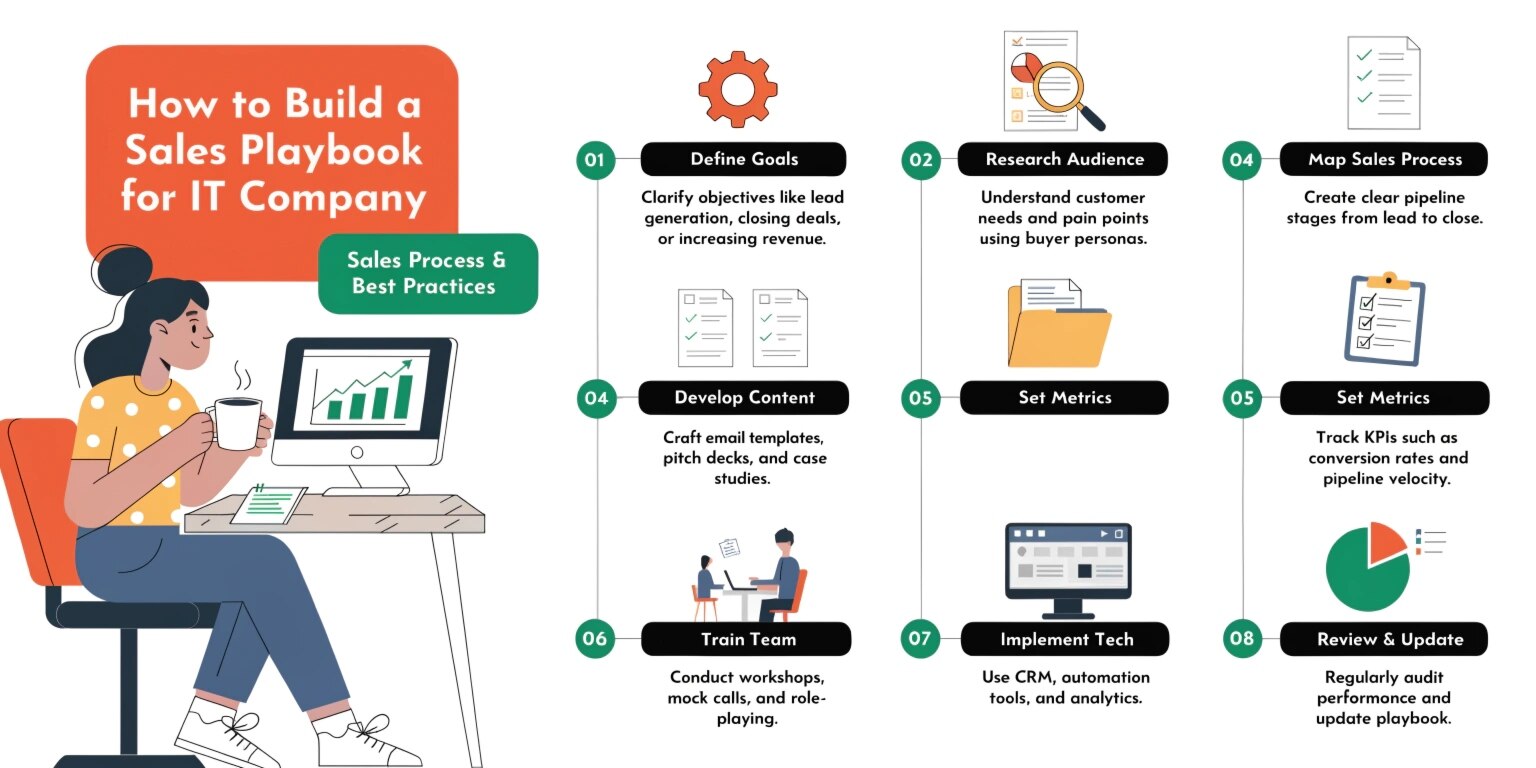
This is where a sales playbook becomes essential.
A sales playbook is a documented, repeatable process that shows exactly how your company finds prospects, communicates with them, qualifies them, presents solutions, and closes deals. It transforms sales from a person-dependent activity into a company-controlled process.
If your agency depends on one salesperson or founder to close deals, you don’t have a scalable business yet — you have a relationship-based business.
Let’s understand how to build a proper sales playbook.
What is a Sales Playbook?
A sales playbook is a structured document containing:
- Ideal customer profile
- Outreach methods
- Messaging scripts
- Qualification process
- Sales meeting flow
- Proposal format
- Negotiation strategy
- Closing techniques
- Follow-up system
It becomes the operating manual for your business development team.
New employees can start selling faster, and performance becomes measurable.
Step 1: Define Your Ideal Customer Profile (ICP)
Before selling, you must know who you should NOT sell to.
Most IT companies fail because they target everyone: startups, small businesses, e-commerce, healthcare, fintech, education — all together.
This creates weak messaging.
Instead, clearly define:
- Industry (e.g., fintech, logistics, healthcare)
- Company size (startup / SME / enterprise)
- Budget range
- Decision maker (CTO, Founder, Product Manager)
- Geography (US, UK, Middle East, Australia)
Example:
A company building SaaS dashboards should target B2B SaaS startups with funding — not local small shops.
Your playbook must start with a written ICP.
Step 2: Create a Lead Generation System
Your playbook should explain exactly how leads are generated.
Common Channels for IT Companies:
- LinkedIn outreach
- Cold email campaigns
- Upwork/Clutch
- SEO blog traffic
- Referrals
- Partnerships
Document:
- Where leads come from
- Who collects data
- Which tools are used (Apollo, LinkedIn Sales Navigator, CRM)
This removes confusion inside the team.
Step 3: Write Outreach Scripts
Never allow each salesperson to write random messages.
Your playbook must include approved outreach templates.
Cold Email Structure:
- Personalization
- Problem identification
- Relevant experience
- Clear CTA (call booking)
Example Flow:
- Mention their product or company
- Identify a technical gap or opportunity
- Show proof (case study)
- Ask for 15-minute discussion
Consistency increases response rates and brand professionalism.
Step 4: Lead Qualification Framework
Not every lead is a client.
Unqualified leads waste developer time and reduce profitability.
Use a qualification model like BANT:
- Budget – Can they afford your services?
- Authority – Are you speaking to decision maker?
- Need – Do they actually need development?
- Timeline – When will they start?
Create a checklist in your playbook.
If a lead fails 2+ criteria → Do not send proposal yet.
Step 5: Standardize Discovery Call
The discovery call is the most important sales stage.
Your playbook should include a fixed call structure.
Discovery Call Flow:
- Introduction and agenda
- Understand business goals
- Identify pain points
- Technical discussion
- Budget alignment
- Next steps
Do not start by pitching your company.
Start by understanding the client’s business.
The best IT salespeople act like consultants, not sellers.
Step 6: Proposal Framework
Many IT companies lose deals because their proposals are confusing.
Your playbook should define a universal proposal format:
- Client problem summary
- Proposed solution
- Technical architecture
- Project timeline
- Team structure
- Cost breakdown
- Support & maintenance
- Case studies
Clients should clearly understand what they are paying for.
Avoid only sending hourly rates — enterprise clients want solutions, not developer CVs.
Step 7: Objection Handling
Common objections:
- “Too expensive”
- “We need to think”
- “We are comparing vendors”
- “Send more details”
Your playbook should include prepared responses.
Example:
If client says expensive → explain ROI, not discount immediately.
Discounting early reduces brand value.
Step 8: Closing Strategy
Define how deals are closed.
Methods:
- Pilot project
- Paid discovery phase
- Limited scope MVP
- Milestone-based contract
Never wait silently after proposal.
Your playbook must include follow-up schedule:
- Day 2 follow-up
- Day 5 reminder
- Day 10 decision push
Most deals are lost due to lack of follow-up.
Step 9: CRM and Tracking
Without tracking, sales cannot improve.
Use CRM tools:
- HubSpot
- Zoho CRM
- Pipedrive
Track:
- Lead source
- Stage
- Conversion rate
- Proposal success rate
- Sales cycle duration
This data helps you predict revenue.
Step 10: Continuous Improvement
A sales playbook is not static.
Every month review:
- Which industry closes faster
- Which outreach works
- Which objections repeat
- Average deal size
Update scripts and processes accordingly.
Over time, your company moves from random selling → predictable selling.
Final Thoughts
A sales playbook converts your IT company from a freelancer-style operation into a scalable organization.
Without a playbook:
Sales depends on individuals.
With a playbook:
Sales depends on systems.
The agencies that grow consistently are not the ones with the best developers — they are the ones with the clearest sales process.
Document your process, train your team, track results, and refine continuously.
Predictable sales create predictable revenue — and predictable revenue creates a stable IT business.