Many app ideas fail not because of poor execution, but because there was no real demand in the first place. Building an app without validation is like launching a product blindly—risky and often costly.
Validating your app idea before development helps you confirm whether users actually need your solution. It reduces risk, saves money, and increases your chances of building a successful product.
What is App Idea Validation?
App idea validation is the process of testing whether your idea solves a real problem and has market demand—before investing in full development.
The goal is simple:
Ensure people are willing to use (or pay for) your app.
Why Validation is Important
1. Saves Time and Money
Development can be expensive. Validation helps avoid building something users don’t want.
2. Reduces Risk
You make informed decisions based on real data, not assumptions.
3. Improves Product Quality
User feedback helps refine your idea before development begins.
4. Increases Success Rate
Validated ideas are more likely to succeed in the market.
Step 1: Identify the Problem Clearly
Start by defining:
- What problem are you solving?
- Who is facing this problem?
- How are they solving it today?
A strong problem statement is the foundation of validation.
Step 2: Conduct Market Research
Analyze your target market:
- Industry trends
- Demand for similar solutions
- Target audience behavior
Look at existing apps on platforms like Google Play Store and Apple App Store to understand what already exists.
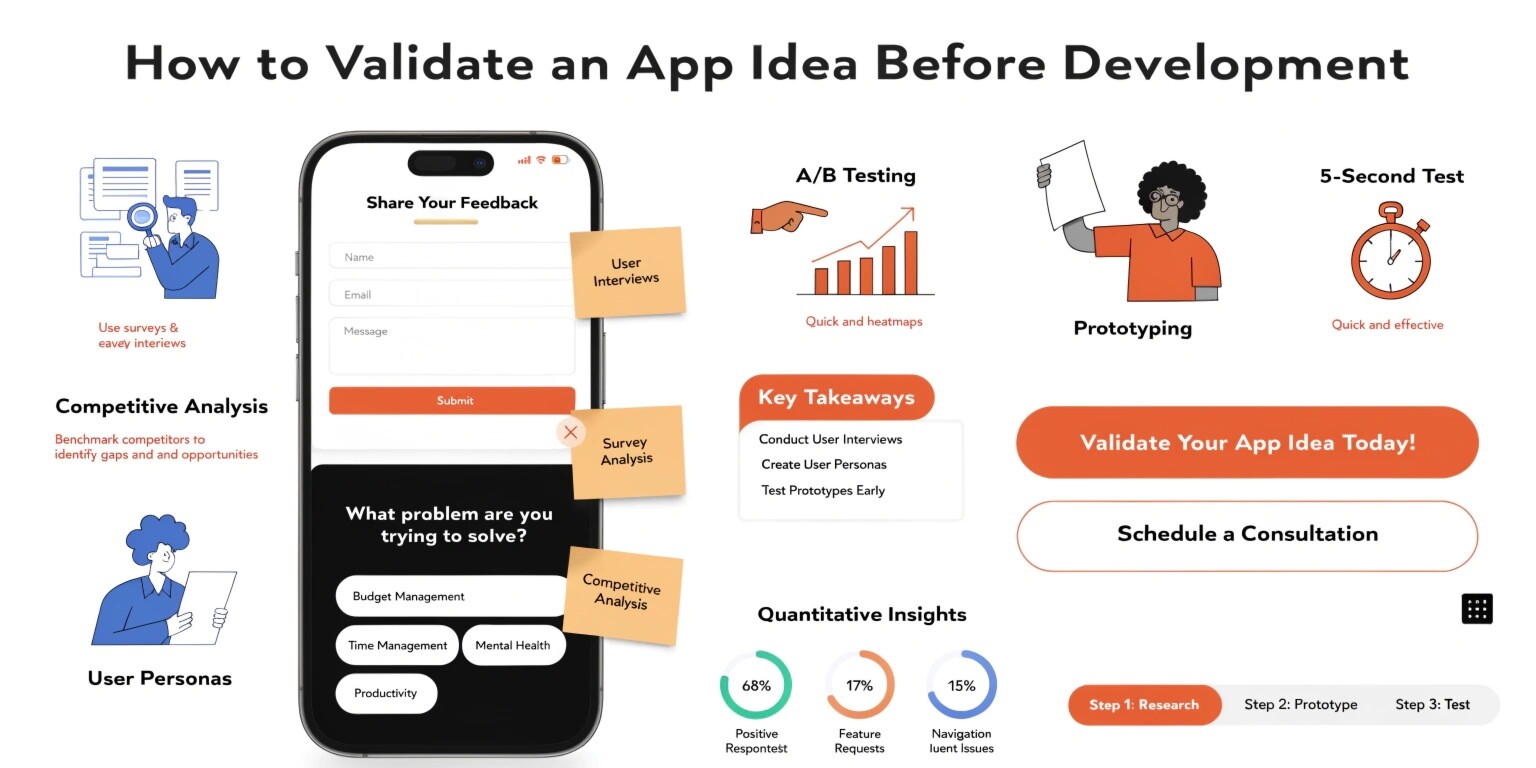
Step 3: Competitor Analysis
Study your competitors:
- What features do they offer?
- What do users like or dislike?
- What gaps can you fill?
Read reviews to identify common complaints—these are opportunities.
Step 4: Define Your Unique Value Proposition (UVP)
Ask yourself:
Why should users choose your app over others?
Your UVP should clearly explain:
- What makes your app different
- What value it delivers
- Why it matters to users
Step 5: Create a Landing Page
Build a simple landing page describing your app idea.
Include:
- Problem statement
- Proposed solution
- Key features
- Call-to-action (signup or waitlist)
Tools like WordPress or Webflow can help you create one quickly.
Step 6: Run Small Marketing Tests
Drive traffic to your landing page using:
- Social media ads
- Google Ads
- Organic posts
Measure:
- Click-through rate (CTR)
- Sign-ups or interest
- Engagement levels
This helps gauge real demand.
Step 7: Collect User Feedback
Talk directly to potential users:
- Conduct surveys
- Run interviews
- Ask open-ended questions
Focus on understanding their needs, not selling your idea.
Step 8: Build a Minimum Viable Product (MVP)
Instead of a full app, create a basic version with core features.
An MVP allows you to:
- Test functionality
- Gather real user feedback
- Improve before scaling
Step 9: Analyze Results
Evaluate your validation efforts:
- Are users interested?
- Are they willing to pay?
- Is there consistent demand?
If results are positive, move forward. If not, refine or pivot your idea.
Step 10: Iterate and Improve
Validation is not a one-time process.
- Continuously gather feedback
- Improve features
- Adjust your strategy
Successful apps evolve based on user needs.
Common Mistakes to Avoid
- Skipping validation entirely
- Relying only on personal assumptions
- Ignoring negative feedback
- Building too many features too early
- Not testing with real users
Avoiding these mistakes can save significant time and cost.
Best Practices for Effective Validation
- Start small and test quickly
- Focus on solving one problem well
- Use real data, not opinions
- Be open to pivoting
- Validate before scaling
Real-World Example Approach
Suppose you have a fitness app idea:
- Create a landing page
- Run ads targeting fitness enthusiasts
- Collect emails for early access
- Build a simple MVP
- Gather feedback and improve
This approach minimizes risk while maximizing learning.
Conclusion
Validating your app idea before development is one of the smartest steps you can take as a founder or developer. It ensures that you’re building something people actually want, reducing risk and increasing your chances of success.
Instead of jumping straight into development, take the time to research, test, and refine your idea. Because in the world of apps, the best ideas aren’t just built—they’re validated.