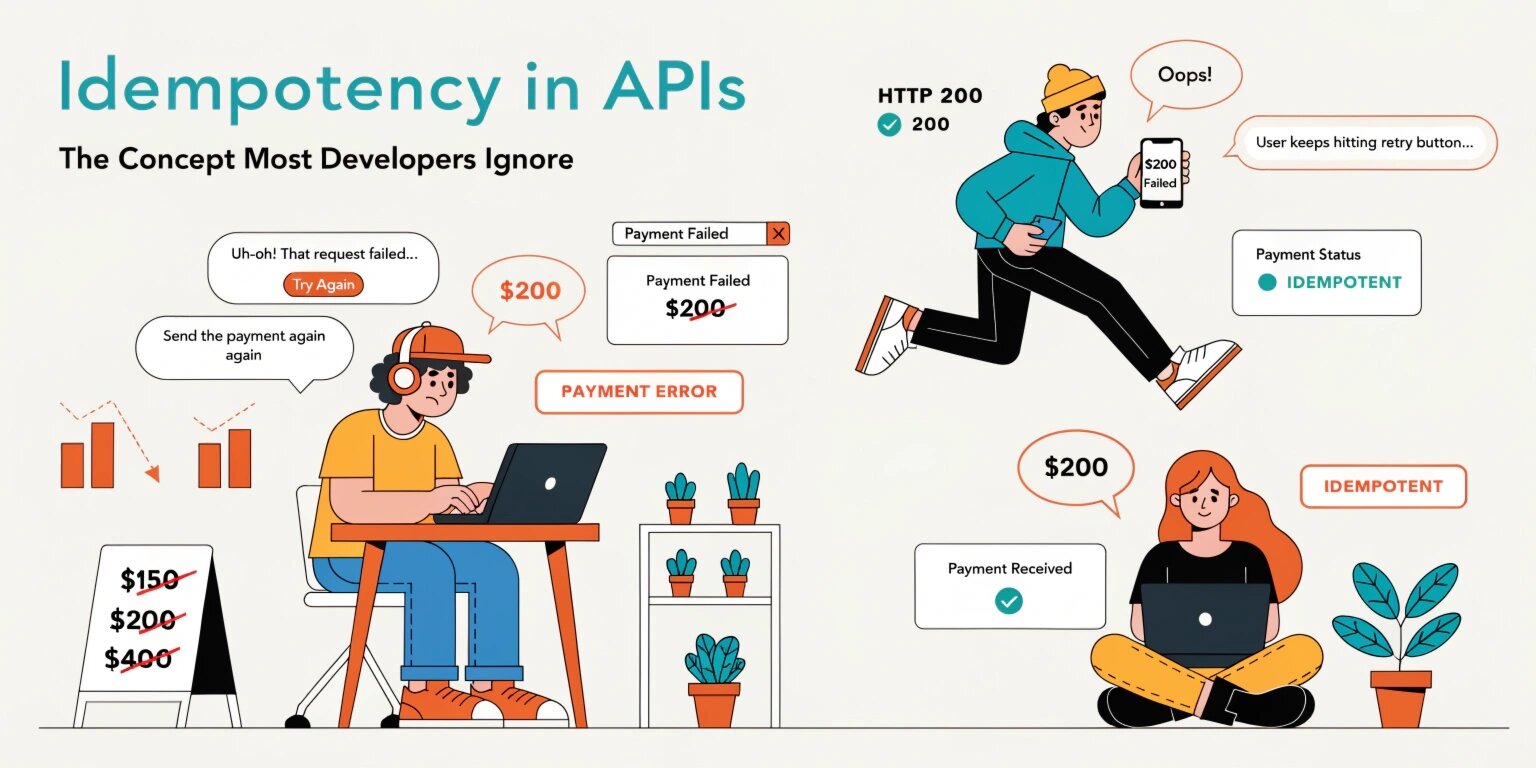
In modern distributed systems, APIs must handle unreliable networks, retries, and unexpected failures. One of the most overlooked yet critical concepts in building robust APIs is idempotency.
Many developers ignore idempotency until they face issues like duplicate payments, repeated orders, or inconsistent data. Understanding and implementing idempotency can significantly improve system reliability and user experience.
What is Idempotency?
Idempotency means that making the same request multiple times produces the same result as making it once.
In API terms, an idempotent operation ensures that repeated requests do not create duplicate side effects.
Why Idempotency Matters
1. Network Reliability
In real-world systems, network failures can cause clients to retry requests. Without idempotency, retries can lead to duplicate operations.
2. Preventing Duplicate Actions
Imagine a payment API:
- Without idempotency → Multiple charges
- With idempotency → Only one successful transaction
3. Improved User Experience
Users won’t face issues like duplicate orders or inconsistent states.
4. Safer Distributed Systems
Idempotency is essential in microservices where communication failures are common.
Idempotency in HTTP Methods
HTTP defines certain methods as idempotent:
MethodIdempotent?DescriptionGETYesFetch data without side effectsPUTYesUpdate resource consistentlyDELETEYesDeleting multiple times has same resultPOSTNo (by default)Creates new resources
However, POST requests can be made idempotent using special techniques.
Real-World Example: Payment APIs
Payment systems like Stripe use idempotency keys to prevent duplicate transactions.
How It Works:
- Client sends a unique idempotency key with the request
- Server stores the result associated with that key
- If the same request is repeated, the server returns the same response
This ensures that even if a request is retried, it won’t process multiple payments.
How to Implement Idempotency
1. Use Idempotency Keys
Generate a unique key for each request (e.g., UUID).
- Store request and response mapping
- Return the same response for repeated keys
2. Database Constraints
Use unique constraints to prevent duplicate entries.
Example:
- Unique order ID
- Unique transaction ID
3. Conditional Updates
Use versioning or timestamps to ensure updates are applied only once.
4. Safe Retry Mechanisms
Design APIs to handle retries gracefully without side effects.
Common Use Cases
- Payment processing
- Order creation systems
- Booking systems (flights, hotels)
- File uploads
- Webhooks and event processing
Challenges in Implementing Idempotency
1. Storage Overhead
Storing idempotency keys and responses requires additional storage.
2. Expiry Management
Keys should expire after a certain time to avoid unnecessary data buildup.
3. Complexity
Implementing idempotency adds complexity to API design.
4. Consistency Issues
Ensuring consistent responses across distributed systems can be challenging.
Best Practices
- Always use idempotency for critical operations (payments, orders)
- Generate truly unique keys
- Store responses for a limited time (TTL)
- Combine idempotency with logging and monitoring
- Document idempotency behavior clearly in API docs
Idempotency in Microservices Architecture
In microservices, idempotency becomes even more important because:
- Services communicate over unreliable networks
- Events may be processed multiple times
- Failures can occur at any stage
Using idempotent APIs ensures system stability and consistency.
Common Mistakes Developers Make
- Ignoring idempotency in POST requests
- Not handling retries properly
- Failing to store request-response mappings
- Overlooking duplicate event processing
Avoiding these mistakes can prevent serious production issues.
Future of Reliable API Design
As systems become more distributed and event-driven, idempotency will play a key role in:
- Event streaming systems
- Serverless architectures
- High-scale microservices
It is becoming a standard practice in modern backend development.
Conclusion
Idempotency is not just a technical concept—it’s a fundamental principle for building reliable and scalable APIs. By ensuring that repeated requests do not cause unintended side effects, developers can prevent critical issues like duplicate transactions and inconsistent data.
Ignoring idempotency may not cause immediate problems, but in high-scale systems, it can lead to serious failures. For any developer building modern APIs, mastering idempotency is essential.