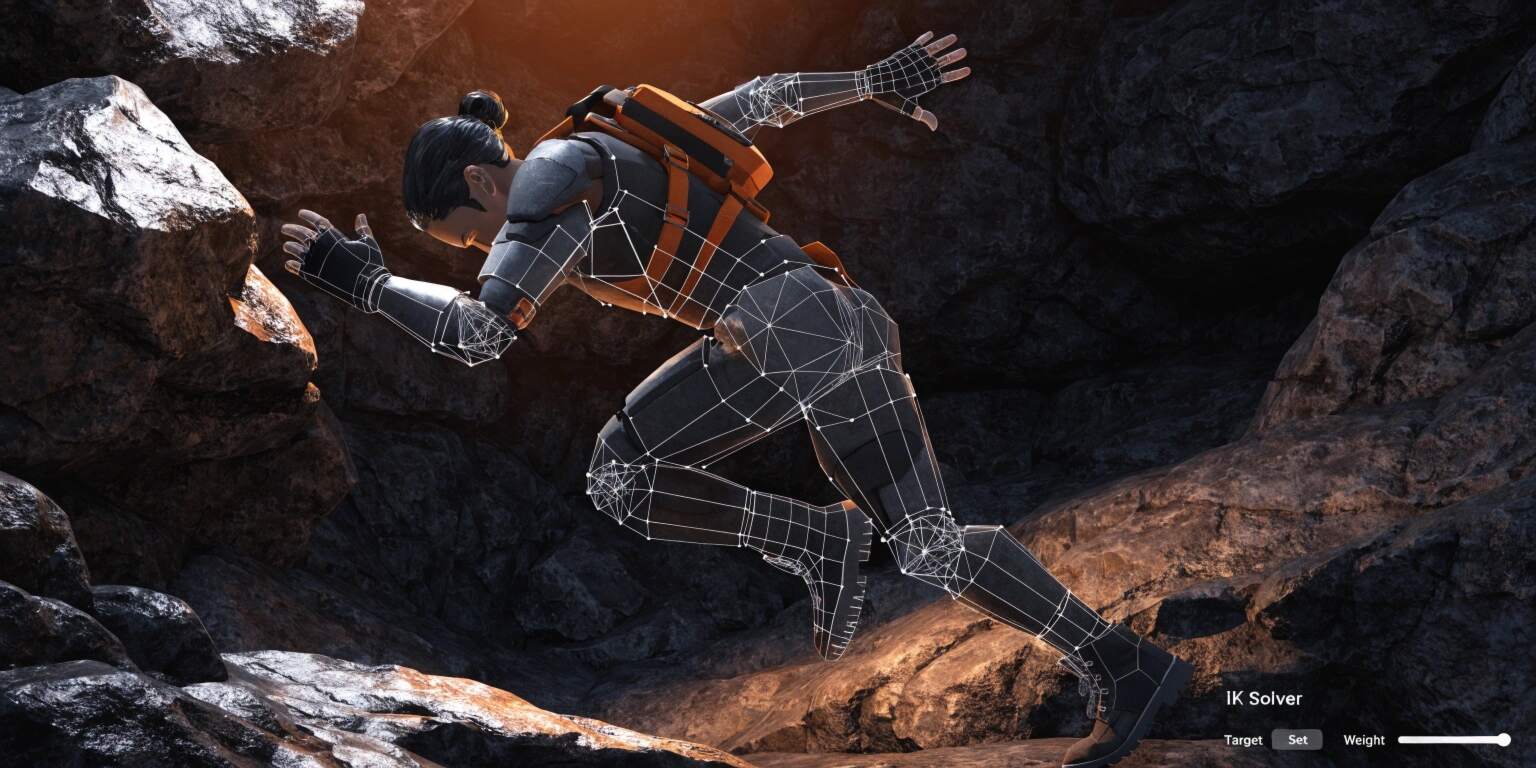
Character animation has evolved far beyond predefined keyframe sequences. Modern games demand responsive, adaptive, and realistic movement that reacts dynamically to changing environments, player input, and gameplay situations. Whether a character places a foot naturally on uneven terrain, reaches for an object, climbs a ladder, or interacts with environmental elements, these animations are often powered by Inverse Kinematics (IK).
Unlike Forward Kinematics (FK), where joint rotations are manually controlled from the root outward, Inverse Kinematics determines the necessary joint rotations automatically by defining the desired position of an end effector, such as a hand or foot. Advanced IK systems extend this concept with sophisticated solvers, procedural animation, and full-body coordination to create natural movement in real time.
This article explores advanced IK techniques, common algorithms, practical applications, optimization strategies, and best practices for building modern animation systems.
What Is Inverse Kinematics?
Inverse Kinematics is an animation technique that calculates joint rotations needed to position an end effector at a target location.
For example:
- A hand reaching a door handle
- A foot adapting to uneven ground
- A character climbing stairs
- Eyes tracking moving objects
- Fingers interacting with equipment
Instead of manually animating every joint, developers specify the target position while the IK solver determines the required joint transformations.
Forward Kinematics vs Inverse Kinematics
Understanding the difference helps determine when each approach is appropriate.
Forward Kinematics (FK)
Characteristics include:
- Manual joint rotation
- Predictable motion
- Ideal for predefined animations
- Easier artistic control
Inverse Kinematics (IK)
Characteristics include:
- Target-driven positioning
- Dynamic environmental interaction
- Procedural animation support
- Real-time adaptability
Modern animation systems often combine FK and IK for maximum flexibility.
Common IK Solvers
Several algorithms solve IK problems with different strengths.
Two-Bone IK
One of the simplest and most widely used methods.
Applications include:
- Arms
- Legs
- Mechanical joints
Advantages:
- Fast computation
- Stable solutions
- Ideal for real-time games
Cyclic Coordinate Descent (CCD)
CCD adjusts joints one at a time until the end effector reaches the target.
Benefits:
- Easy implementation
- Flexible chain length
- Good convergence for many scenarios
Limitations include occasional unnatural joint motion in complex rigs.
FABRIK (Forward and Backward Reaching Inverse Kinematics)
FABRIK positions joints through iterative forward and backward adjustments rather than rotating them directly.
Advantages include:
- Smooth motion
- Fast convergence
- Stable animation
- Natural limb movement
Many modern game engines use FABRIK because of its efficiency and realism.
Full-Body IK (FBIK)
Full-Body IK coordinates the entire skeleton instead of isolated limbs.
It allows:
- Balanced body posture
- Natural weight shifting
- Multi-limb coordination
- Realistic climbing
- Dynamic interactions
- Environmental adaptation
FBIK significantly improves realism in character movement.
Procedural Animation with IK
Procedural animation combines IK with real-time calculations instead of relying solely on handcrafted animations.
Applications include:
- Foot placement
- Weapon aiming
- Hand positioning
- Object interaction
- Dynamic climbing
- Terrain adaptation
Procedural techniques reduce animation asset requirements while increasing responsiveness.
Constraint Systems
Realistic IK requires joint constraints to prevent impossible movements.
Common constraints include:
- Rotation limits
- Angle restrictions
- Joint locking
- Stretch prevention
- Pole vector control
Constraints ensure anatomically plausible animation while maintaining stability.
Motion Blending
Modern engines rarely rely exclusively on IK or keyframe animation.
Instead, animation blending combines:
- Motion capture
- FK animation
- IK corrections
- Physics simulation
- Procedural adjustments
This hybrid approach delivers both artistic quality and real-time adaptability.
Performance Optimization
Real-time IK calculations can become expensive when many characters are active simultaneously.
Optimization strategies include:
- Limiting IK updates to visible characters
- Reducing solver iterations
- Using simplified rigs for distant characters
- Parallelizing calculations
- Updating IK selectively based on gameplay needs
- Caching repeated calculations
Efficient optimization maintains smooth frame rates without sacrificing animation quality.
Common Use Cases
Advanced IK enhances many gameplay systems.
Examples include:
- Third-person action games
- First-person weapon handling
- VR hand tracking
- NPC interactions
- Sports simulations
- Robotics simulation
- Character customization
- Cinematic animation
These applications create more immersive and believable experiences.
Challenges in IK Implementation
Developers often encounter several technical challenges.
Common issues include:
- Joint flipping
- Solver instability
- Performance overhead
- Unrealistic limb stretching
- Target ambiguity
- Complex multi-contact scenarios
- Blending conflicts
Addressing these challenges requires careful rig design and solver tuning.
Best Practices
To build effective IK systems:
- Use IK only where dynamic adaptation is necessary.
- Combine IK with traditional animation workflows.
- Apply realistic joint constraints.
- Optimize solver iterations for performance.
- Blend smoothly between FK and IK.
- Test across a variety of character poses.
- Profile animation performance regularly.
- Design rigs specifically for procedural animation.
Following these practices ensures responsive and visually convincing character movement.
Future Trends in IK
Character animation continues to advance through AI and procedural technologies.
Emerging innovations include:
- Machine learning-based animation generation
- AI-assisted pose prediction
- Physics-driven Full-Body IK
- Neural animation systems
- Motion matching integration
- Procedural crowd animation
- Real-time motion synthesis
- Cloud-assisted animation processing
These developments will enable increasingly lifelike and adaptive character behavior.
Conclusion
Advanced Inverse Kinematics has become an essential component of modern game development, enabling characters to interact naturally with dynamic environments while reducing reliance on manually authored animations. From simple Two-Bone IK solvers to sophisticated Full-Body IK systems, these techniques improve realism, responsiveness, and immersion across a wide range of gameplay scenarios.
By combining efficient IK algorithms, procedural animation, motion blending, constraint systems, and performance optimization, developers can create believable character movement that adapts seamlessly to player actions and environmental changes. As AI-driven animation and real-time simulation continue to evolve, advanced IK techniques will play an increasingly important role in shaping the future of interactive character animation.