The rise of connected devices has transformed how we interact with technology. From smart homes to industrial automation, the Internet of Things (IoT) is reshaping industries. Mobile applications play a crucial role in this ecosystem by acting as the interface between users and smart devices.
Integrating IoT with mobile apps enables real-time control, monitoring, and automation, creating seamless and intelligent user experiences.
What is IoT Integration in Mobile Apps?
IoT integration involves connecting physical devices—such as sensors, wearables, or appliances—to mobile applications. These devices collect and transmit data, which the app processes and presents to users.
For example:
- A smart home app controlling lights and thermostats
- A fitness app tracking wearable device data
- An industrial app monitoring machinery in real time
Key Components of IoT-Mobile Integration
1. Devices and Sensors
IoT devices collect data such as temperature, motion, or location.
2. Connectivity
Devices communicate with mobile apps using protocols like:
- Wi-Fi
- Bluetooth
- MQTT
- HTTP/HTTPS
3. Cloud Platforms
Cloud services store, process, and analyze IoT data. Platforms like Amazon Web Services provide scalable infrastructure for IoT solutions.
4. Mobile Application
The mobile app acts as the user interface, allowing users to control devices and view data.
How IoT Integration Works
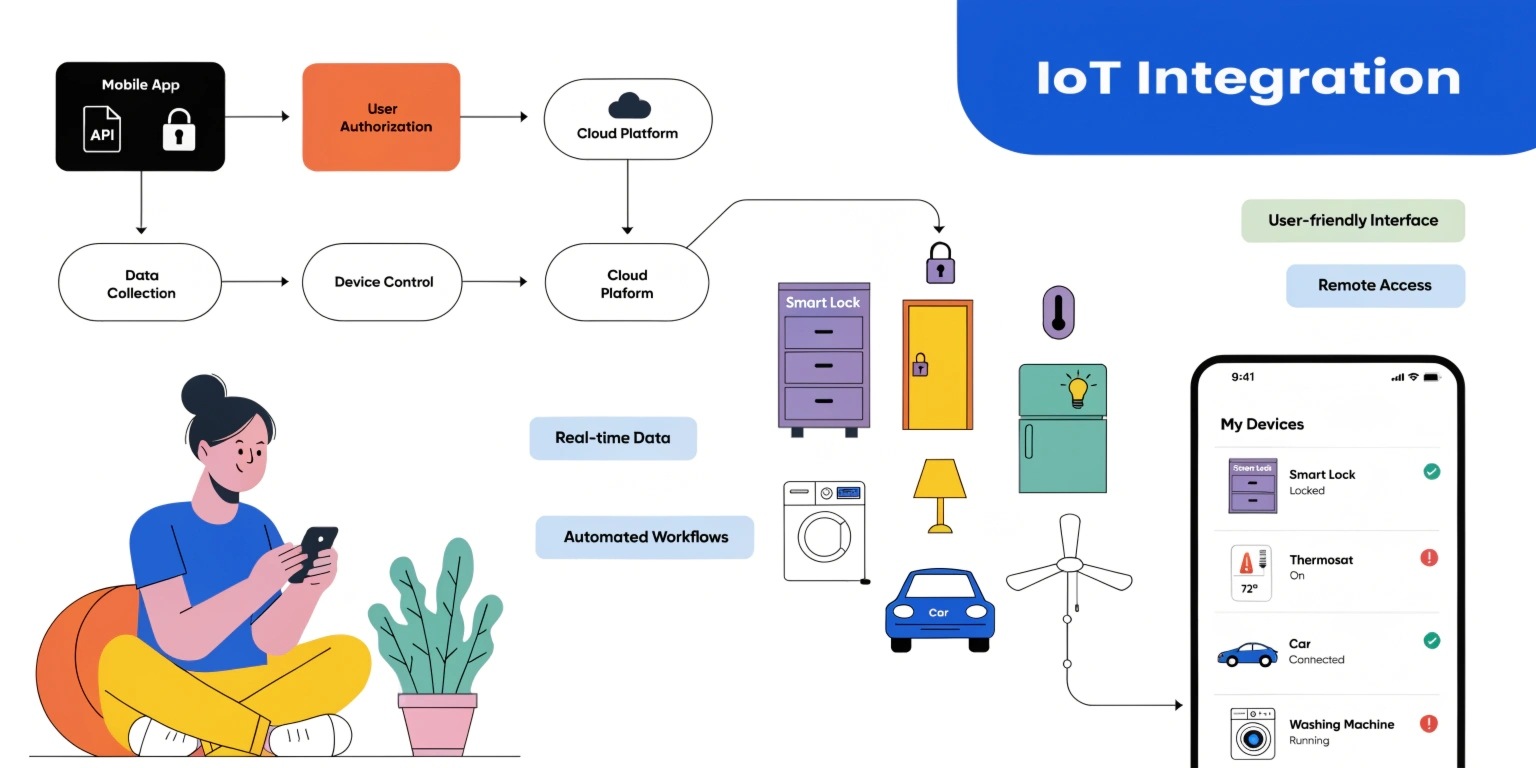
A typical workflow looks like this:
- IoT device collects data
- Data is sent to the cloud
- Cloud processes and stores the data
- Mobile app retrieves and displays information
- User sends commands via the app
- Commands are sent back to the device
This continuous loop enables real-time interaction and automation.
Benefits of IoT Integration with Mobile Apps
1. Real-Time Monitoring
Users can track device data instantly, improving decision-making.
2. Remote Control
Devices can be controlled from anywhere using mobile apps.
3. Automation
Systems can automate tasks based on predefined rules.
4. Enhanced User Experience
Seamless connectivity creates intuitive and engaging applications.
Popular Use Cases
Smart Homes
Mobile apps control lighting, security systems, and appliances.
Healthcare
Wearable devices monitor health metrics and sync with mobile apps.
Industrial IoT
Factories use mobile apps to monitor equipment and optimize operations.
Smart Cities
IoT-enabled apps manage traffic, energy, and public services.
Companies like Google are активно developing IoT ecosystems that integrate seamlessly with mobile platforms.
Challenges in IoT Integration
Despite its advantages, IoT integration comes with challenges:
- Security Risks: Protecting data and devices from cyber threats
- Connectivity Issues: Ensuring stable communication between devices
- Data Management: Handling large volumes of real-time data
- Device Compatibility: Supporting multiple hardware types
Addressing these challenges is essential for building reliable systems.
Best Practices for IoT-Mobile Integration
To build successful IoT applications:
- Use secure communication protocols
- Implement strong authentication and encryption
- Optimize data transmission to reduce latency
- Design scalable architectures
- Regularly update and maintain devices and apps
Following these practices ensures performance, security, and scalability.
Tools and Technologies
Developers use various tools to streamline IoT integration:
- Cloud platforms (AWS IoT, Azure IoT)
- Communication protocols (MQTT, HTTP)
- Mobile frameworks like Flutter
- Backend services and APIs
These tools help simplify development and improve efficiency.
Future of IoT and Mobile Apps
The future of IoT integration looks promising with advancements in:
- 5G connectivity for faster communication
- Edge computing for real-time processing
- AI-powered IoT applications
- Increased device interoperability
These innovations will further enhance the capabilities of IoT-powered mobile apps.
Conclusion
IoT integration with mobile apps is transforming how users interact with technology. By enabling real-time monitoring, remote control, and automation, it creates smarter and more efficient systems.
For developers and businesses, embracing IoT integration opens up new opportunities for innovation and growth. With the right architecture, tools, and security measures, building scalable and intelligent IoT applications is more achievable than ever.