As artificial intelligence systems continue growing in scale and complexity, performance optimization has become one of the most critical challenges in AI engineering. Modern AI applications must process enormous volumes of data while delivering accurate results within acceptable response times.
Two key performance metrics dominate AI infrastructure design: latency and throughput.
Although both are essential, optimizing one often impacts the other. This creates a fundamental trade-off that AI engineers must carefully manage depending on the application’s goals and operational requirements.
Understanding latency vs throughput trade-offs is crucial for designing scalable, efficient, and responsive AI systems across industries such as healthcare, finance, autonomous vehicles, gaming, and cloud computing.
What is Latency in AI Systems?
Latency refers to the time it takes for an AI system to process a request and produce a response.
In simple terms, latency measures responsiveness.
For example:
- How quickly a chatbot replies
- How fast a recommendation engine updates
- How rapidly a self-driving car detects obstacles
Low latency is especially important in real-time AI applications where delays can negatively affect user experience or operational safety.
Examples of Latency-Sensitive Applications
- Autonomous driving
- Voice assistants
- Real-time fraud detection
- Online gaming AI
- Live translation systems
- Medical diagnostics
In these systems, milliseconds can make a significant difference.
What is Throughput in AI Systems?
Throughput measures how many tasks or requests an AI system can process within a specific period.
It focuses on overall processing capacity rather than individual response speed.
For example:
- Number of AI inferences per second
- Number of images processed per minute
- Number of API requests handled simultaneously
High throughput is critical for large-scale systems handling massive workloads.
Examples of Throughput-Oriented Systems
- Recommendation platforms
- Data analytics pipelines
- Search engines
- Batch image processing
- Enterprise AI platforms
- Large-scale cloud inference systems
These systems prioritize handling large volumes efficiently.
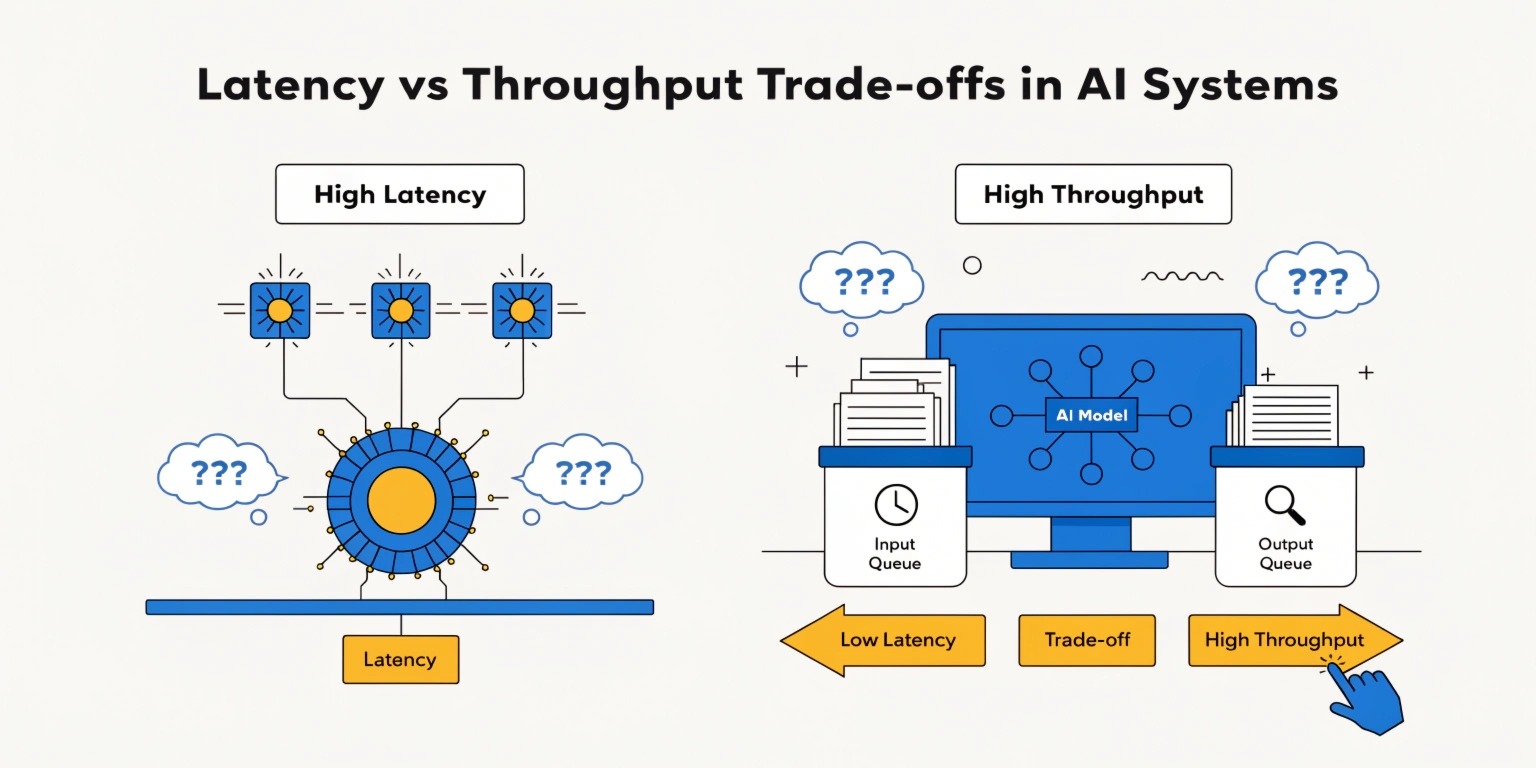
Understanding the Trade-off
Latency and throughput often compete with each other.
Improving throughput usually involves batching multiple requests together for efficient processing. However, batching introduces waiting time, which increases latency.
Conversely, minimizing latency often requires processing requests immediately, reducing batching efficiency and lowering throughput.
This trade-off forces organizations to balance:
- Speed
- Scalability
- Resource utilization
- Infrastructure cost
Real-World Example: AI Chatbots
AI chat systems provide a clear example of this trade-off.
A chatbot serving millions of users must balance:
- Fast responses (low latency)
- High request handling capacity (high throughput)
If the system processes every request individually:
- Response time improves
- GPU utilization decreases
- Operational costs increase
If requests are heavily batched:
- GPU efficiency improves
- More users are served
- Individual response times become slower
Companies like OpenAI and Google continuously optimize these trade-offs in large-scale AI deployments.
Factors Affecting Latency and Throughput
Several technical factors influence AI system performance.
1. Model Size
Large neural networks require more computation.
Bigger models:
- Increase latency
- Reduce throughput
- Consume more memory
Optimization techniques like quantization and pruning help address these issues.
2. Hardware Infrastructure
AI performance heavily depends on hardware capabilities.
Common AI hardware includes:
- GPUs
- TPUs
- AI accelerators
- Edge processors
Companies like NVIDIA and Intel develop specialized AI hardware optimized for performance efficiency.
3. Batch Processing
Batching multiple requests together improves hardware utilization and throughput.
However:
- Small batches improve latency
- Large batches improve throughput
Selecting optimal batch size is one of the most important AI infrastructure decisions.
4. Network Communication
Distributed AI systems introduce communication overhead.
Factors include:
- API latency
- Cloud network delays
- Data transfer speeds
- Multi-node synchronization
Edge AI reduces latency by processing data closer to users.
5. Model Optimization Techniques
Several optimization methods improve both latency and throughput.
Common Techniques
Quantization
Reduces numerical precision for faster inference.
Pruning
Removes unnecessary neural network weights.
Knowledge Distillation
Creates smaller, efficient models.
Caching
Stores repeated inference results.
These approaches reduce computational overhead significantly.
Edge AI and Latency Optimization
Edge AI focuses heavily on minimizing latency.
Instead of sending data to cloud servers, processing happens directly on local devices.
Benefits of Edge AI
- Faster responses
- Reduced network dependency
- Improved privacy
- Lower bandwidth costs
Applications include:
- Smart cameras
- Industrial automation
- IoT systems
- Autonomous drones
Companies like Qualcomm actively invest in edge AI processors.
Throughput Optimization in Cloud AI
Cloud-based AI systems often prioritize throughput.
Massive distributed infrastructures process millions of requests efficiently through:
- Parallel computing
- Distributed GPUs
- Load balancing
- Auto-scaling systems
Cloud providers such as Amazon Web Services, Microsoft, and Google Cloud optimize AI infrastructure for scalable throughput.
Balancing Latency and Throughput
The ideal balance depends entirely on application requirements.
Low Latency Priority
Best for:
- Real-time decision-making
- Interactive AI systems
- Safety-critical applications
High Throughput Priority
Best for:
- Batch analytics
- Enterprise AI workloads
- Large-scale recommendation systems
Modern AI architectures often use hybrid approaches combining:
- Real-time inference
- Batch processing
- Edge computing
- Cloud acceleration
Emerging Trends in AI Performance Optimization
AI infrastructure continues evolving rapidly.
Future Trends
- AI-specific hardware accelerators
- Adaptive batching algorithms
- Sparse neural networks
- Federated AI systems
- Energy-efficient AI computing
- Distributed edge-cloud architectures
These innovations aim to improve both latency and throughput simultaneously.
Challenges in AI Performance Engineering
Optimizing AI systems remains highly complex.
Common Challenges
- Resource limitations
- Energy consumption
- Infrastructure costs
- Model complexity
- Scalability bottlenecks
- Real-time processing requirements
AI engineers must constantly evaluate trade-offs based on business priorities and technical constraints.
Conclusion
Latency and throughput are two of the most important performance metrics in artificial intelligence systems. While low latency ensures fast responsiveness, high throughput enables scalable processing for massive workloads.
Balancing these competing priorities is essential for designing efficient AI architectures across industries and applications. From edge AI devices and autonomous systems to cloud-scale machine learning platforms, understanding these trade-offs helps organizations optimize performance, infrastructure costs, and user experience.
As AI models continue becoming larger and more sophisticated, innovations in hardware, optimization techniques, and distributed computing will play a critical role in improving both latency and throughput simultaneously.