Artificial Intelligence (AI) applications are now powering everything from virtual assistants and recommendation engines to autonomous vehicles, fraud detection platforms, and medical imaging systems. As organizations deploy AI models into production, performance becomes just as important as model accuracy. Two of the most critical performance metrics are latency and throughput.
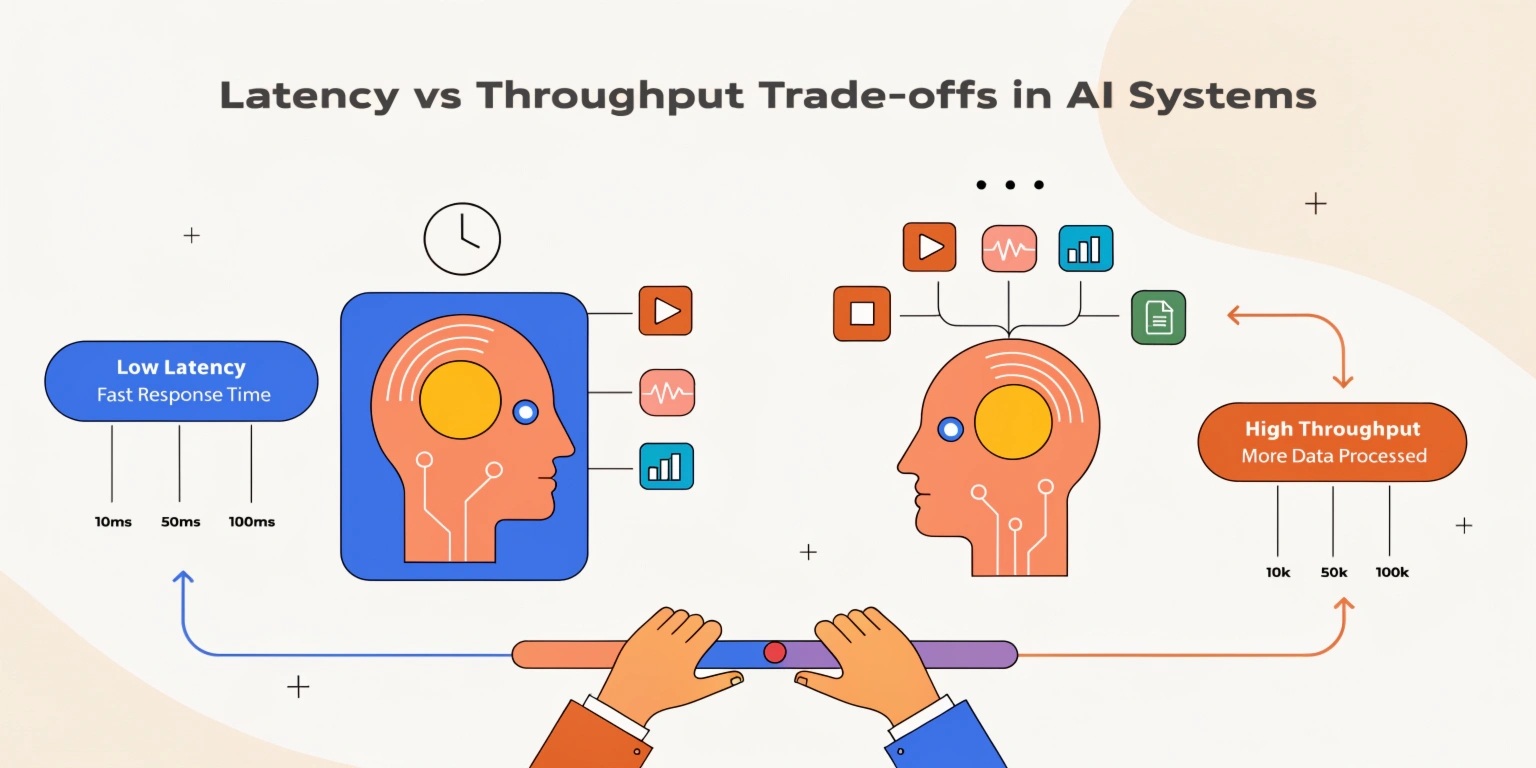
Latency measures how quickly an AI system responds to a single request, while throughput measures how many requests the system can process within a given period. Optimizing one often affects the other, making it essential for developers and system architects to understand the trade-offs involved.
A chatbot requires low latency to deliver near-instant responses, whereas a large-scale analytics platform may prioritize throughput to process millions of predictions efficiently. Designing AI systems requires balancing these competing goals based on application requirements, available hardware, and operational constraints.
This article explores latency and throughput, why they matter, common optimization strategies, and best practices for building efficient AI systems.
What Is Latency?
Latency refers to the time it takes for an AI system to process a request and return a response.
For an inference request, latency typically includes:
- Request transmission
- Data preprocessing
- Model execution
- Post-processing
- Response delivery
Lower latency results in faster interactions and a better user experience.
Applications where latency is critical include:
- Voice assistants
- Autonomous driving
- Fraud detection
- Medical diagnostics
- Real-time translation
- Interactive chatbots
In these scenarios, even small delays can affect usability or decision-making.
What Is Throughput?
Throughput measures the number of AI inference requests processed over a specific time interval.
Examples include:
- Requests per second (RPS)
- Predictions per minute
- Images processed per hour
- Documents analyzed daily
High throughput enables systems to serve many users or process large datasets efficiently.
Applications prioritizing throughput include:
- Batch document processing
- Recommendation generation
- Large-scale analytics
- Video processing
- Data labeling
- Search indexing
These workloads emphasize maximizing computational efficiency.
Understanding the Trade-off
Latency and throughput are closely related but often compete with each other.
For example:
- Processing requests individually minimizes latency but may underutilize hardware resources.
- Grouping requests into batches improves throughput but introduces waiting time before processing begins.
The ideal balance depends on the application's objectives.
Factors Affecting Latency and Throughput
Several factors influence AI system performance.
Model Complexity
Larger models generally require more computation, increasing latency while potentially reducing throughput.
Optimization techniques such as pruning, quantization, and knowledge distillation can reduce computational demands.
Hardware Acceleration
Specialized hardware improves both latency and throughput.
Common accelerators include:
- GPUs
- TPUs
- NPUs
- AI inference chips
- High-performance CPUs
Selecting appropriate hardware depends on workload characteristics and deployment environments.
Batch Processing
Batch inference combines multiple requests into a single execution.
Benefits include:
- Better GPU utilization
- Higher throughput
- Lower cost per inference
However, larger batches may increase response times for individual users.
Network Performance
In cloud-based deployments, network latency contributes significantly to total response time.
Reducing unnecessary communication and deploying models closer to users can improve responsiveness.
Strategies for Reducing Latency
Organizations aiming for real-time AI should consider:
- Model quantization
- Model pruning
- Hardware acceleration
- Edge deployment
- Efficient preprocessing
- Optimized inference engines
- Low-latency networking
These techniques reduce processing delays while maintaining acceptable accuracy.
Strategies for Increasing Throughput
For high-volume workloads, developers can improve throughput through:
- Dynamic batching
- Parallel inference
- Distributed serving
- Load balancing
- Asynchronous request handling
- Efficient resource scheduling
- Horizontal scaling
These approaches maximize infrastructure utilization and support larger workloads.
AI Model Serving Architectures
Deployment architecture significantly affects both latency and throughput.
Real-Time Inference
Characteristics:
- Single-request processing
- Low latency
- Interactive applications
- Immediate responses
Suitable for customer-facing services.
Batch Inference
Characteristics:
- Large groups of requests
- Higher throughput
- Lower infrastructure costs
- Scheduled processing
Commonly used for offline analytics and reporting.
Streaming Inference
Streaming systems continuously process incoming data.
Examples include:
- Fraud detection
- Sensor monitoring
- Video analytics
- Financial trading
These systems require balancing both latency and sustained throughput.
Monitoring Performance
Continuous monitoring helps identify bottlenecks before they affect users.
Important metrics include:
- Average latency
- P95 and P99 latency
- Requests per second
- GPU utilization
- CPU utilization
- Memory usage
- Queue length
- Error rates
Performance dashboards enable proactive optimization.
Common Challenges
Balancing latency and throughput involves several challenges.
These include:
- Hardware limitations
- Resource contention
- Variable workloads
- Queue congestion
- Large model sizes
- Network delays
- Cost optimization
Careful system design helps address these constraints.
Best Practices
When designing AI systems:
- Define clear latency and throughput objectives.
- Select infrastructure based on workload characteristics.
- Benchmark multiple deployment strategies.
- Use batching where response time allows.
- Optimize models before scaling hardware.
- Monitor production performance continuously.
- Scale horizontally to handle demand spikes.
- Test under realistic workloads before deployment.
A balanced approach delivers both responsiveness and scalability.
Future Trends
Advancements in AI infrastructure continue to improve performance optimization.
Emerging innovations include:
- AI-specific accelerator hardware
- Adaptive batching algorithms
- Intelligent workload scheduling
- Serverless AI inference
- Edge AI deployments
- Model sparsity optimization
- Automated performance tuning
- Energy-efficient inference architectures
These developments will help organizations deploy increasingly sophisticated AI applications with lower costs and better user experiences.
Conclusion
Latency and throughput are two fundamental performance metrics that shape the effectiveness of AI systems. While low latency ensures responsive user interactions, high throughput enables organizations to process large volumes of data efficiently. Finding the right balance depends on application requirements, infrastructure capabilities, and business objectives.
By combining optimized models, intelligent batching, hardware acceleration, scalable architectures, and continuous monitoring, organizations can build AI systems that deliver both speed and scalability. As AI adoption continues to expand across industries, mastering the trade-offs between latency and throughput will remain essential for developing reliable, high-performing, and future-ready intelligent