In the competitive IT services industry, winning a new client is only the beginning. Software development companies, IT consultancies, SaaS providers, and digital agencies need to continuously engage customers throughout their relationship. This is where lifecycle marketing becomes valuable.
Lifecycle marketing focuses on delivering the right message, content, offer, and communication at the right stage of a customer's journey. Instead of treating every prospect or client the same way, businesses create targeted experiences based on where each person is in the buying and relationship cycle.
For IT companies, this approach can transform one-time projects into long-term client relationships.
What Is Lifecycle Marketing?
Lifecycle marketing is a strategy that manages communication with prospects and customers throughout their entire relationship with a business.
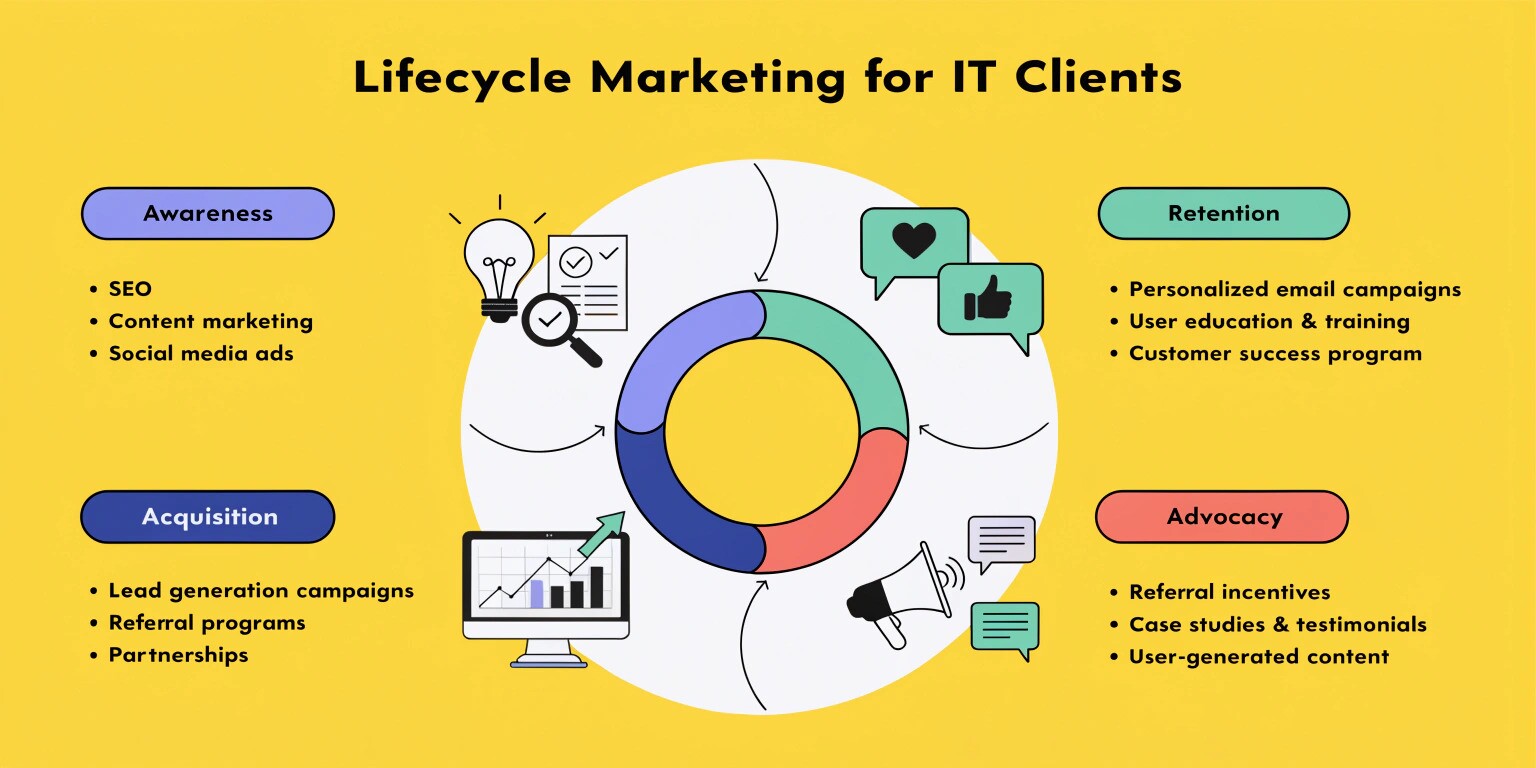
For an IT company, the lifecycle may look like:
Awareness → Lead → Qualified Prospect → Client → Onboarding → Retention → Expansion → Advocacy
Each stage requires a different marketing approach.
For example, a new prospect may need educational content explaining custom software development, while an existing client may be interested in cloud migration, AI integration, or application maintenance services.
Why Lifecycle Marketing Matters for IT Companies
IT services often involve complex buying decisions, long sales cycles, and significant investments. Clients may need weeks or months to evaluate vendors before signing a contract.
Lifecycle marketing helps companies remain relevant throughout this process.
Key benefits include:
- Better lead nurturing
- Higher conversion rates
- Stronger client relationships
- Improved customer retention
- Increased repeat business
- More upselling opportunities
- Better customer experience
- Higher customer lifetime value
Instead of constantly searching for new customers, IT companies can generate more revenue from their existing relationships.
Stage 1: Awareness
At the awareness stage, potential clients may not know your company or may not have fully defined their technology requirements.
The goal is to educate rather than aggressively sell.
Useful content includes:
- Industry blogs
- Technology guides
- Research reports
- Educational videos
- Webinars
- Technology comparison articles
- Industry trend reports
For example, an IT company offering AI development could publish content explaining how businesses can use AI to automate repetitive operations.
This establishes expertise and attracts relevant prospects.
Stage 2: Lead Generation
Once prospects become interested, the next goal is to capture their information and begin a relationship.
IT companies can use:
- Website forms
- Consultation requests
- LinkedIn campaigns
- Downloadable guides
- Webinars
- Newsletter subscriptions
- Free assessments
At this stage, avoid asking for excessive information. Collect essential details and gradually build a more complete understanding of the prospect.
Stage 3: Lead Nurturing
Most IT leads are not immediately ready to purchase.
Lead nurturing keeps prospects engaged until they are ready to make a decision.
Email campaigns can provide:
- Case studies
- Technical insights
- Client success stories
- Service explanations
- Industry-specific solutions
- ROI information
- Frequently asked questions
For example, a prospect interested in mobile app development might receive a sequence covering app planning, development costs, technology selection, security, and post-launch maintenance.
Stage 4: Conversion
Once a prospect demonstrates buying intent, marketing and sales teams should work together.
Signals may include:
- Requesting a proposal
- Booking a consultation
- Visiting pricing pages
- Downloading service documents
- Repeated website visits
- Responding to sales emails
At this point, communication should become more personalized.
Sales teams can provide customized proposals, project estimates, technical recommendations, and relevant case studies.
Stage 5: Client Onboarding
Winning the contract does not end lifecycle marketing.
The onboarding experience strongly influences the client's perception of the company.
IT companies should establish:
- Clear communication channels
- Project timelines
- Roles and responsibilities
- Documentation
- Meeting schedules
- Reporting processes
- Support procedures
Automated onboarding emails can help clients understand what happens next and reduce uncertainty.
Stage 6: Retention
Retaining IT clients is often more valuable than constantly acquiring new ones.
Regular communication can include:
- Project updates
- Performance reports
- Product recommendations
- Maintenance reminders
- Technology updates
- Client satisfaction surveys
- Educational content
Proactive communication demonstrates that the company is interested in the client's long-term success rather than simply completing a project.
Stage 7: Upselling and Cross-Selling
Existing clients already understand your capabilities, making them strong candidates for additional services.
For example, a client who purchased web development services might later require:
- Mobile app development
- Cloud migration
- UI/UX improvements
- AI integration
- Cybersecurity
- Performance optimization
- Maintenance and support
However, upselling should be based on genuine business needs.
Instead of saying, "You should buy another service," explain how the additional solution can solve an existing challenge.
Stage 8: Advocacy
Satisfied clients can become powerful marketing assets.
Encourage happy customers to provide:
- Testimonials
- Reviews
- Case studies
- Referrals
- LinkedIn recommendations
- Video testimonials
Client advocacy creates social proof and can help generate new qualified opportunities.
Using CRM and Automation
A CRM system can help IT companies track every stage of the customer lifecycle.
Marketing automation can trigger personalized campaigns based on customer behavior.
For example:
New lead: Send educational content.
Proposal requested: Send relevant case studies.
New client: Start onboarding communication.
Inactive client: Launch a re-engagement campaign.
Existing client: Recommend relevant complementary services.
Automation allows teams to manage large client databases without sacrificing personalization.
Measuring Lifecycle Marketing Success
IT companies should track metrics across every lifecycle stage.
Important metrics include:
- Lead-to-client conversion rate
- Customer acquisition cost
- Sales cycle length
- Client retention rate
- Churn rate
- Customer lifetime value
- Upsell revenue
- Cross-sell revenue
- Email engagement
- Referral rate
These metrics reveal where prospects or clients are dropping out of the lifecycle.
Common Mistakes to Avoid
Several mistakes can reduce the effectiveness of lifecycle marketing.
Avoid:
- Sending identical messages to every client
- Focusing only on lead generation
- Ignoring existing customers
- Overusing promotional emails
- Failing to segment audiences
- Not tracking customer behavior
- Selling irrelevant services
- Ignoring post-project engagement
Lifecycle marketing works best when communication is useful, timely, and personalized.
The Future of IT Lifecycle Marketing
Artificial intelligence is making lifecycle marketing increasingly intelligent.
AI can help companies analyze customer behavior, identify buying signals, predict churn, personalize campaigns, and recommend relevant services.
For IT companies, this could enable systems that automatically identify when an existing client may need cloud migration, application modernization, cybersecurity services, or AI integration.
Combining AI with CRM and marketing automation can create highly personalized client journeys at scale.
Conclusion
Lifecycle marketing provides IT companies with a structured way to manage relationships from the first interaction to long-term advocacy. By understanding each client's stage, delivering relevant content, nurturing prospects, improving onboarding, maintaining engagement, and identifying genuine expansion opportunities, IT businesses can create stronger relationships and more predictable revenue.
The most successful IT companies will not simply focus on acquiring new clients. They will build systems that continuously create value throughout the entire client lifecycle. With the right combination of CRM data, automation, personalization, and customer success, lifecycle marketing can turn individual software projects into long-lasting business partnerships.