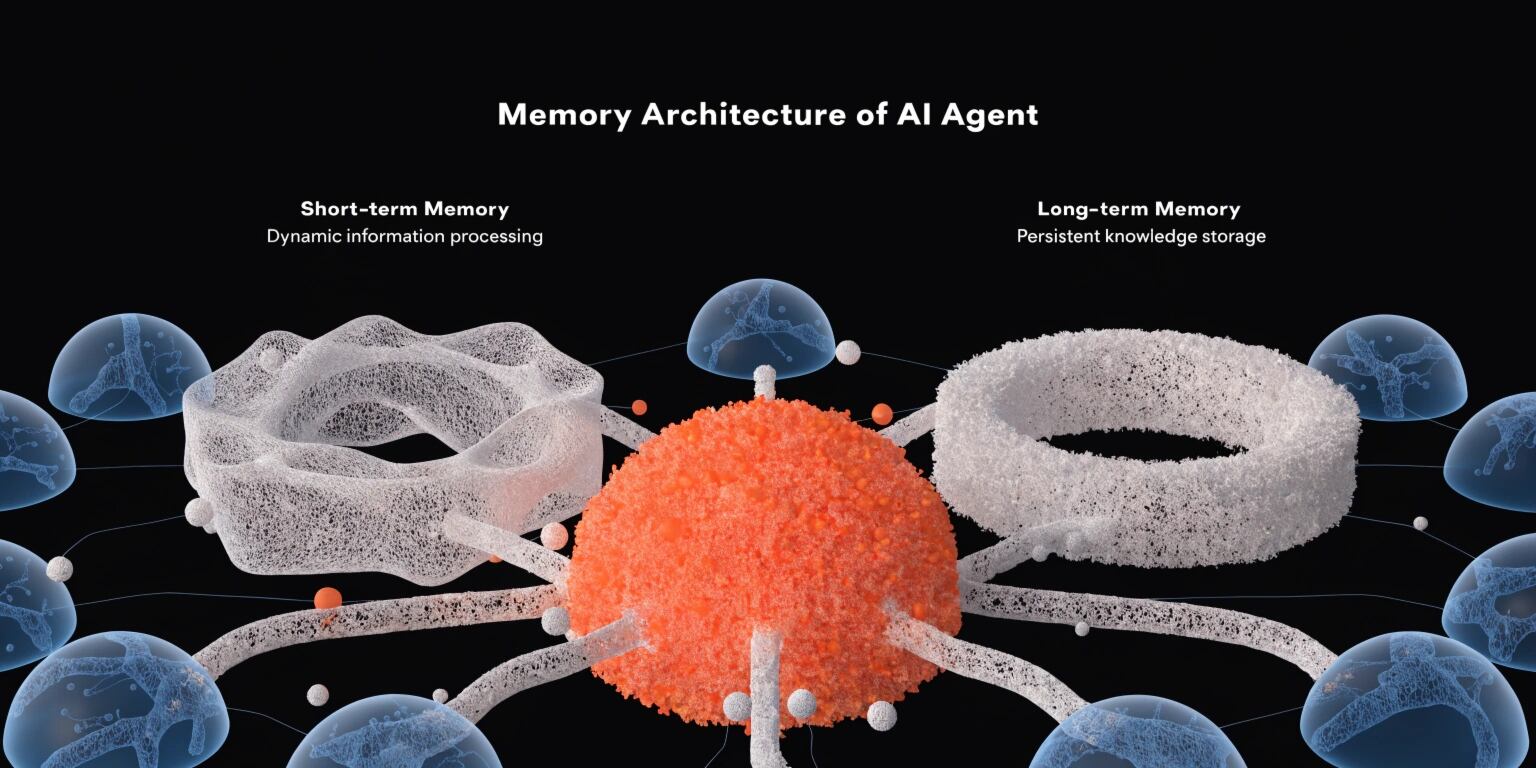
Modern AI agents are evolving beyond simple question-answer systems. They now plan, reason, retrieve knowledge, and maintain context across multiple interactions. The key component enabling this intelligence is memory architecture.
Without memory, an AI agent behaves like a stateless chatbot. With structured memory, it becomes context-aware, adaptive, and capable of long-term reasoning.
Understanding the difference between short-term memory and long-term memory is essential when designing production-ready AI systems.
What is Memory in AI Agents?
Memory in AI agents refers to the mechanism used to store, retrieve, and manage contextual or historical information to improve decision-making and response quality.
Unlike biological memory, AI memory is engineered. It must be intentionally designed, stored, retrieved, and maintained.
There are two primary types:
- Short-Term Memory (Contextual Memory)
- Long-Term Memory (Persistent Knowledge)
Each serves a distinct architectural purpose.
Short-Term Memory (Working Context)
Short-term memory represents temporary context within an ongoing interaction.
What It Includes:
- Recent conversation history
- Current task instructions
- Temporary variables
- Intermediate reasoning steps
In large language models, short-term memory typically exists inside the context window. The model only remembers what is passed into its prompt at runtime.
Characteristics:
- Limited capacity
- Session-based
- Reset after interaction
- Fast access
Example:
If a user says:
"Plan a 3-day trip to Goa."
Then later:
"Make it budget-friendly."
The AI uses short-term memory to understand that "it" refers to the Goa trip.
However, once the session ends, this context disappears unless stored elsewhere.
Long-Term Memory (Persistent Knowledge)
Long-term memory allows AI agents to remember information across sessions and over time.
What It Includes:
- User preferences
- Historical interactions
- Company documents
- Knowledge bases
- Structured databases
Long-term memory is typically implemented using:
- Vector databases
- Relational databases
- Knowledge graphs
- Document stores
Unlike short-term memory, long-term memory persists beyond a single session.
How Long-Term Memory Works in AI Systems
Long-term memory often uses Retrieval-Augmented Generation (RAG) architecture.
The flow looks like this:
- User sends query.
- Query is converted into embeddings.
- System searches vector database.
- Relevant documents are retrieved.
- Retrieved content is injected into prompt.
- Model generates informed response.
This process simulates memory recall.
Why Memory Architecture Matters
1. Context Continuity
Without memory, AI responses become generic. Memory enables personalization and coherent conversations.
2. Reduced Hallucinations
When AI retrieves factual data from structured storage, it relies less on probabilistic guessing.
3. Personalization
Long-term memory enables remembering:
- User preferences
- Tone
- Business context
- Past decisions
This makes AI agents feel intelligent rather than reactive.
4. Task Completion
Complex tasks require intermediate reasoning. Short-term memory stores these temporary steps.
Memory Design Patterns in AI Agents
Pattern 1: Stateless Agent
No memory stored. Every request is independent.
Use case: Simple FAQ bots.
Pattern 2: Session-Based Memory
Conversation history stored temporarily.
Use case: Customer support chats.
Pattern 3: Persistent Memory Agent
Stores long-term user data and knowledge base.
Use case: Enterprise AI assistants.
Pattern 4: Hybrid Memory System
Combines:
- Short-term working context
- Long-term persistent storage
- External tools
- Structured databases
This is the architecture used in advanced autonomous AI agents.
Technical Components of Memory Architecture
- Embedding models
- Vector databases
- Metadata tagging
- Memory pruning strategies
- Token management
- Retrieval ranking algorithms
- Caching layers
Each component ensures relevant, scalable memory usage.
Challenges in Designing AI Memory
1. Context Window Limits
Large language models have token limits. Too much short-term memory increases cost and latency.
2. Memory Retrieval Accuracy
Poor embeddings or indexing reduce relevance.
3. Data Privacy
Enterprise memory systems must protect:
- Confidential data
- User history
- Regulatory compliance
4. Memory Bloat
Unfiltered memory storage leads to inefficiency. Systems require:
- Summarization
- Archiving
- Expiration policies
Short-Term vs Long-Term Memory: Key Differences
FeatureShort-Term MemoryLong-Term MemoryDurationSession-basedPersistentStoragePrompt contextExternal databaseCapacityLimitedScalableSpeedImmediateRetrieval-basedUse CaseConversation flowKnowledge recall
Both are necessary for intelligent AI systems.
Future of AI Memory Architecture
Emerging trends include:
- Hierarchical memory layers
- Self-updating memory
- Memory compression techniques
- Event-driven memory triggers
- Agent-to-agent shared memory
Future AI systems will behave less like chatbots and more like autonomous digital workers with memory continuity.
Conclusion
Memory architecture defines how intelligent an AI agent can truly become. Short-term memory ensures contextual awareness within a conversation. Long-term memory enables personalization, learning, and enterprise-grade intelligence.
To build scalable AI agents, developers must design both layers thoughtfully.
Without memory, AI is reactive.
With structured memory, AI becomes adaptive.
The future of AI agents depends not only on model size—but on how well they remember.