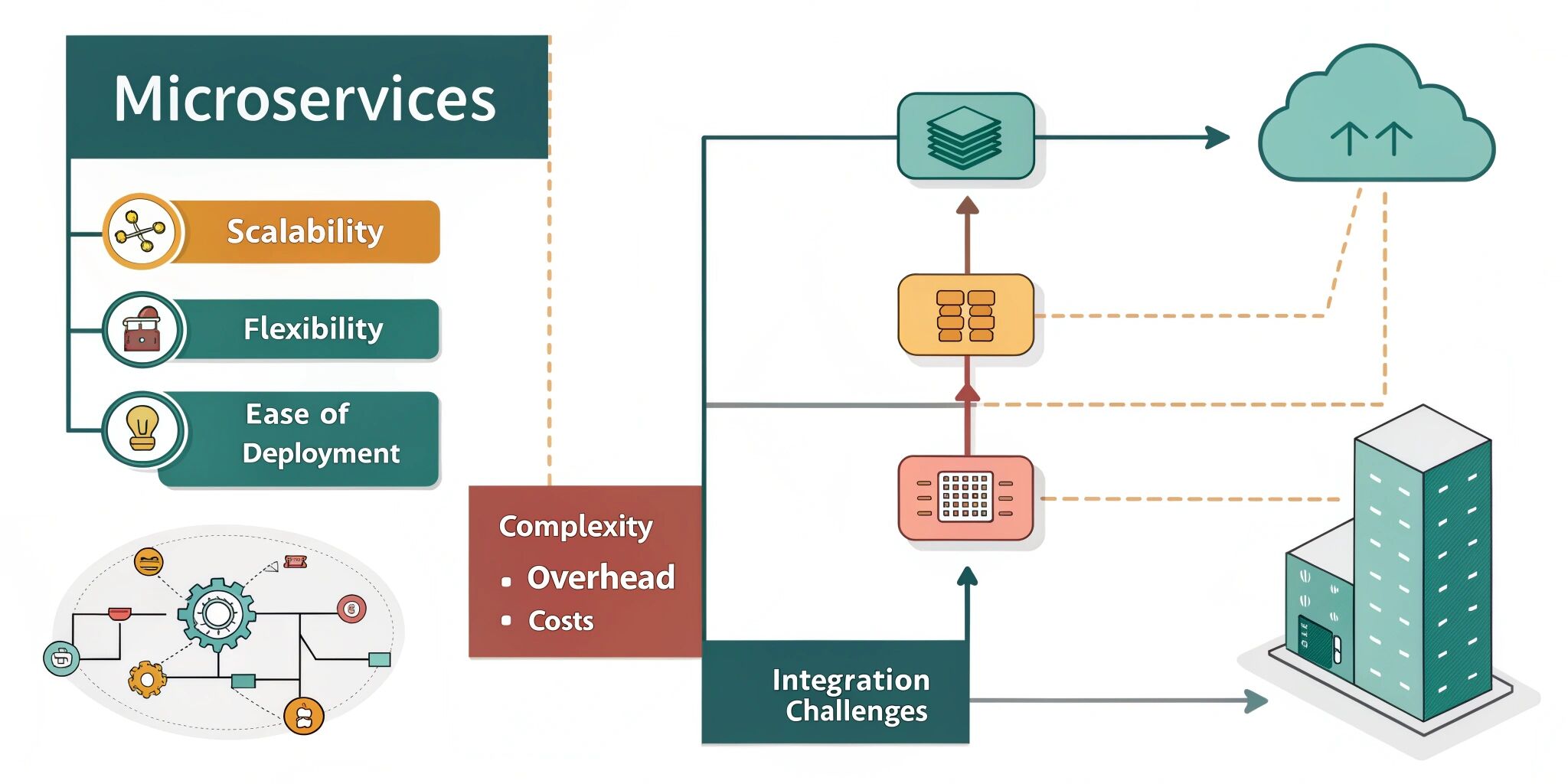
In today’s fast-evolving digital world, software systems must adapt quickly to changing market needs. Traditional application models often struggle to keep up with the pace of innovation. This is where microservices architecture steps in—a design approach that structures an application as a collection of small, independent services. Each service performs a specific function, enabling faster updates, greater scalability, and continuous delivery.
As organizations move toward cloud-native development, microservices have become a vital component of digital transformation strategies. However, while this architecture brings undeniable benefits, it also presents certain operational and management challenges that businesses must navigate carefully.
Understanding Microservices Architecture
Microservices architecture involves building applications as a suite of loosely coupled services. Each service is developed, deployed, and scaled independently, communicating with others through APIs. This modular approach allows development teams to innovate and deliver updates without disrupting the entire system.
Unlike rigid systems that depend on centralized databases or shared components, microservices encourage decentralization. This means every service can choose its own programming language, data storage, and deployment method—making systems more adaptable and resilient.
Key Benefits of Microservices Architecture
1. Agility and Faster Development
Microservices promote parallel development, allowing multiple teams to work on separate services simultaneously. This accelerates release cycles and supports continuous delivery—essential in a competitive tech environment.
2. Scalability and Performance Optimization
Each microservice can be scaled independently based on its workload. For example, an e-commerce application can scale only the checkout or search service during high traffic periods, ensuring optimal resource utilization.
3. Enhanced Fault Isolation
Because services are decoupled, failures in one do not necessarily affect others. This containment improves system reliability and reduces downtime.
4. Technology Diversity and Flexibility
Teams can use different programming languages or frameworks for each service, enabling them to adopt the most efficient tools for the task at hand.
5. Easier Maintenance and Continuous Improvement
Microservices enable incremental upgrades—teams can modify, test, and deploy a single service without affecting the rest of the application.
6. Improved Alignment with DevOps and CI/CD
Microservices naturally complement DevOps practices, encouraging automation, testing, and rapid deployment through CI/CD pipelines.
Pitfalls and Challenges of Microservices
1. Increased System Complexity
Managing dozens or even hundreds of services can become complex. Proper orchestration, service discovery, and version control are critical for success.
2. Data Consistency Issues
Since each microservice often maintains its own database, ensuring data synchronization across services becomes a challenge. Implementing distributed transactions and eventual consistency models is crucial.
3. Monitoring and Debugging Difficulties
Troubleshooting issues in a distributed environment is harder than in a single system. Organizations must invest in centralized monitoring tools and observability solutions.
4. Higher Operational Overhead
Microservices may require additional infrastructure, deployment pipelines, and container management tools, which increase operational costs.
5. Communication and Security Risks
APIs are the lifeline of microservices communication. Unsecured APIs can expose vulnerabilities, making strong authentication, encryption, and rate-limiting mechanisms vital.
Best Practices for Successful Microservices Implementation
1. Start Small and Scale Gradually
Begin by breaking a single, high-impact function into microservices. Expand only after the initial implementation is stable and well-understood.
2. Adopt Containerization and Orchestration
Tools like Docker and Kubernetes simplify deployment and scaling, ensuring consistent environments across development and production.
3. Centralize Monitoring and Logging
Use tools like Prometheus, Grafana, or ELK Stack to gain visibility into performance and identify issues before they escalate.
4. Focus on API Governance
Standardize communication with secure, well-documented APIs. This ensures consistency and reduces integration complexity.
5. Build a DevOps Culture
Encourage collaboration between development and operations teams. Automation through CI/CD pipelines enhances reliability and deployment speed.
6. Implement Security from the Start
Integrate authentication, authorization, and encryption mechanisms early in the development cycle to protect data across services.
Conclusion
Microservices architecture represents a powerful evolution in how software is designed, developed, and delivered. Its modular and independent nature makes it ideal for organizations seeking agility, scalability, and resilience in their IT infrastructure.
However, to reap the full rewards, businesses must balance innovation with structure—focusing on monitoring, governance, and team collaboration. By adopting best practices and leveraging modern tools, enterprises can transform microservices from a technical concept into a foundation for sustainable digital success in 2025 and beyond.