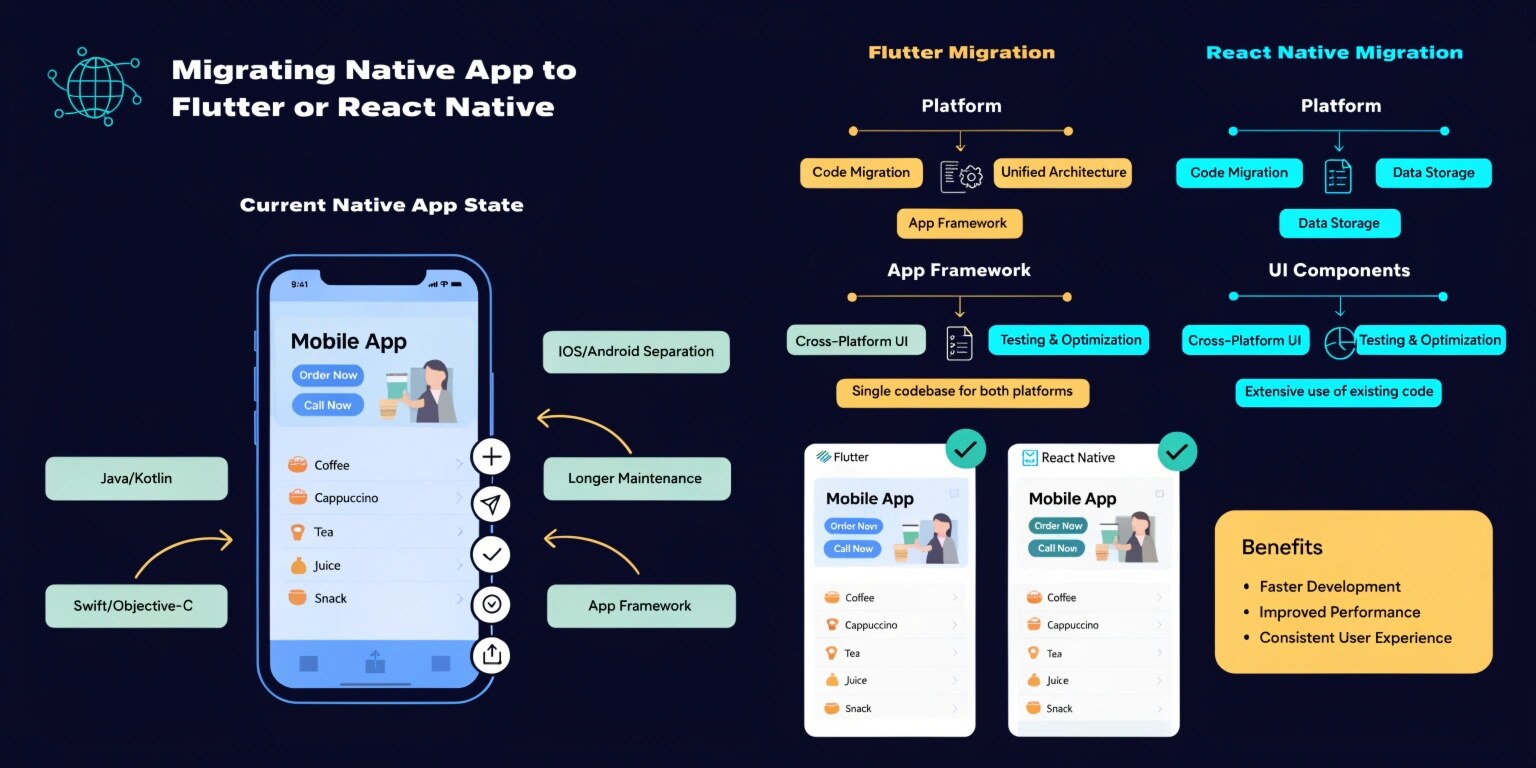
As mobile applications grow in complexity and user expectations increase, maintaining separate codebases for iOS and Android becomes expensive and time-consuming. This is why many businesses are now considering migrating their native applications to cross-platform frameworks like Flutter and React Native.
But migration is not just a technical shift—it’s a strategic decision that impacts performance, scalability, and long-term maintenance.
Why Migrate from Native to Cross-Platform?
Native development (Swift for iOS, Kotlin/Java for Android) offers high performance but comes with challenges:
- Maintaining two separate codebases
- Higher development and maintenance costs
- Slower feature releases
- Resource duplication across teams
Cross-platform frameworks solve these issues by allowing developers to write a single codebase that runs on multiple platforms.
Flutter vs React Native: Quick Overview
Before migrating, it’s important to understand the difference:
- Flutter uses Dart and renders UI using its own engine, offering high performance and consistent design
- React Native uses JavaScript and relies on native components, making it easier for web developers to adapt
Choosing between them depends on your team’s expertise, app complexity, and performance requirements.
Migration Strategies
There is no one-size-fits-all approach. Here are the most common strategies:
1. Full Rewrite
Rebuilding the entire app in Flutter or React Native.
Pros:
- Clean architecture
- Optimized performance
- No legacy issues
Cons:
- Time-consuming
- Higher upfront cost
2. Incremental Migration
Gradually replacing native screens with cross-platform modules.
Pros:
- Lower risk
- Continuous delivery
- Easier testing
Cons:
- Temporary complexity
- Hybrid architecture challenges
3. Module-Based Integration
Embedding Flutter or React Native modules into an existing native app.
This is ideal for large apps where a complete rewrite isn’t feasible.
Key Challenges in Migration
Migrating apps is not without obstacles:
1. Performance Concerns
While both frameworks are fast, poorly optimized code can lead to lag, especially in animation-heavy apps.
2. Third-Party Dependencies
Some native libraries may not have direct equivalents, requiring custom bridges or plugins.
3. Platform-Specific Features
Features like GPS, camera, or Bluetooth may need native integration.
4. UI/UX Consistency
Maintaining a native feel while using a cross-platform framework can be tricky.
Step-by-Step Migration Process
Here’s a practical roadmap:
Step 1: Analyze Your Existing App
Identify core features, dependencies, and performance-critical modules.
Step 2: Choose the Right Framework
- Pick Flutter for performance and UI consistency
- Choose React Native for faster onboarding if your team knows JavaScript
Step 3: Define Migration Scope
Decide whether to migrate fully or incrementally.
Step 4: Set Up Architecture
Adopt scalable patterns like MVVM or Clean Architecture to ensure maintainability.
Step 5: Start with Non-Critical Features
Migrate less complex modules first to minimize risk.
Step 6: Integrate Native Modules
Use platform channels (Flutter) or native modules (React Native) where needed.
Step 7: Testing and Optimization
Perform rigorous testing across devices to ensure performance and stability.
Real-World Scenario
Consider a fintech app with separate iOS and Android teams. By migrating to Flutter, the company reduced development time by 40% and achieved consistent UI across platforms.
However, they retained native modules for sensitive operations like biometric authentication, demonstrating a hybrid approach.
Best Practices for Successful Migration
- Audit your app thoroughly before starting
- Avoid migrating everything at once unless necessary
- Optimize performance-critical screens carefully
- Use analytics to monitor performance post-migration
- Train your team on the chosen framework
- Maintain proper documentation throughout the process
When NOT to Migrate
Migration may not be ideal if:
- Your app relies heavily on platform-specific APIs
- Performance requirements are extremely high (e.g., high-end gaming)
- Your current native app is already stable and cost-effective
Final Thoughts
Migrating from native to cross-platform frameworks like Flutter or React Native can significantly reduce costs, speed up development, and simplify maintenance. However, success depends on choosing the right strategy and executing it carefully.
A well-planned migration not only improves efficiency but also future-proofs your application in an increasingly competitive mobile landscape.