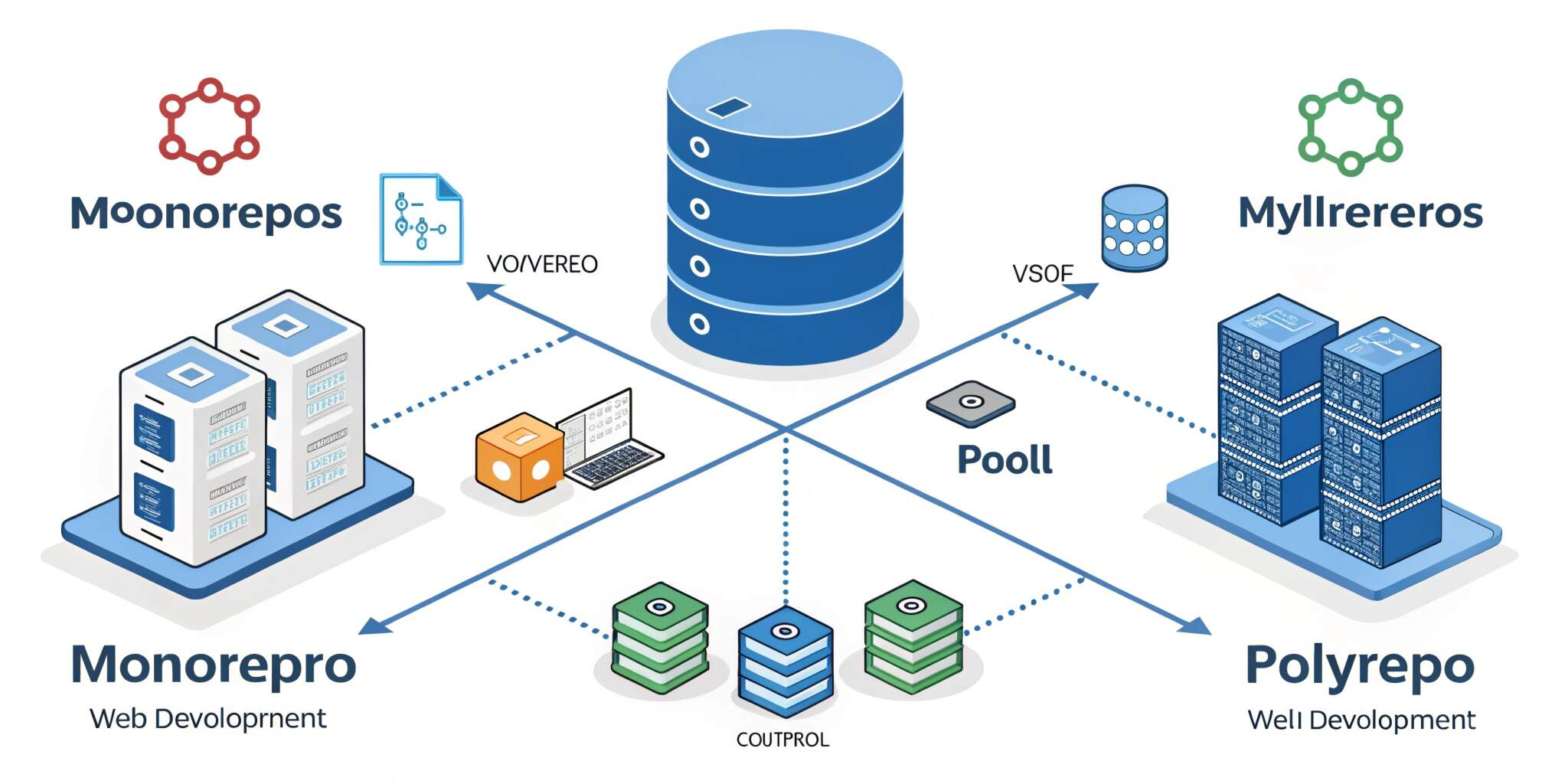
As enterprise web applications grow in size, complexity, and team count, managing source code effectively becomes a critical architectural decision. One of the most debated topics among engineering leaders is Monorepo vs Polyrepo—two fundamentally different approaches to organizing code repositories. Each strategy has its strengths and trade-offs, and the right choice depends on organizational structure, scalability goals, and development workflows.
What Is a Monorepo?
A monorepo (monolithic repository) is a single repository that contains multiple projects, services, or applications. Frontend, backend, shared libraries, utilities, and even infrastructure code may all live under one repository.
Large enterprises such as Google and Facebook have successfully adopted monorepo strategies, supported by powerful internal tooling.
Key Characteristics of Monorepos:
- Single source of truth for all code
- Shared dependencies and libraries
- Unified versioning
- Centralized CI/CD pipelines
What Is a Polyrepo?
A polyrepo (multiple repositories) approach stores each service, application, or component in its own repository. This model aligns naturally with microservices architecture, where each service is independently developed, deployed, and versioned.
Many organizations using GitHub and GitLab adopt polyrepo structures for better isolation and ownership.
Key Characteristics of Polyrepos:
- Independent repositories per service
- Separate versioning and release cycles
- Team-level ownership
- Decentralized CI/CD pipelines
Monorepo Advantages in Enterprise Environments
- Improved Code Sharing
- Shared utilities, UI components, and business logic are easier to reuse without complex dependency management.
- Simplified Refactoring
- Large-scale refactoring across multiple services can be done atomically, reducing compatibility issues.
- Consistency Across Teams
- Standardized linting, testing, and build tools ensure uniform engineering practices.
- Better Visibility
- Developers gain full visibility into the system, improving cross-team collaboration.
Monorepo Challenges
- Scalability of Tooling: Without tools like Nx, Turborepo, or Bazel, build times can become slow.
- Access Control Complexity: Managing permissions for large teams requires strict governance.
- CI/CD Optimization Required: Poorly configured pipelines can lead to inefficiencies.
Polyrepo Advantages in Enterprise Environments
- Independent Deployments
- Teams can deploy services independently without impacting others.
- Clear Ownership
- Each repository has a dedicated team, improving accountability and velocity.
- Simpler CI/CD Pipelines
- Pipelines are easier to configure and maintain per service.
- Microservices-Friendly
- Polyrepos align well with decentralized, domain-driven design.
Polyrepo Challenges
- Code Duplication: Shared logic often gets duplicated across repositories.
- Complex Dependency Management: Version mismatches can cause integration issues.
- Difficult Cross-Service Refactoring: Changes across repositories require careful coordination.
Impact on CI/CD and DevOps
Monorepos require smart CI/CD strategies, such as selective builds and affected-project testing, to avoid rebuilding everything on every change. Modern tools have made this more manageable.
Polyrepos simplify pipelines but increase the operational overhead of managing multiple repositories, especially at enterprise scale.
Which Should Enterprises Choose?
There is no one-size-fits-all answer.
Choose Monorepo if:
- You have tightly coupled services
- You rely heavily on shared code
- You want unified tooling and governance
Choose Polyrepo if:
- Teams are fully autonomous
- Services are loosely coupled
- Independent scaling and deployments are critical
Many enterprises now adopt a hybrid approach, using monorepos for frontend and shared libraries, while maintaining polyrepos for core backend microservices.
Final Thoughts
Monorepo and polyrepo strategies both have a place in enterprise web development. The decision should be driven by organizational maturity, team structure, and long-term scalability goals rather than trends alone. With the right tooling and discipline, either approach can support high-performing, scalable enterprise systems.