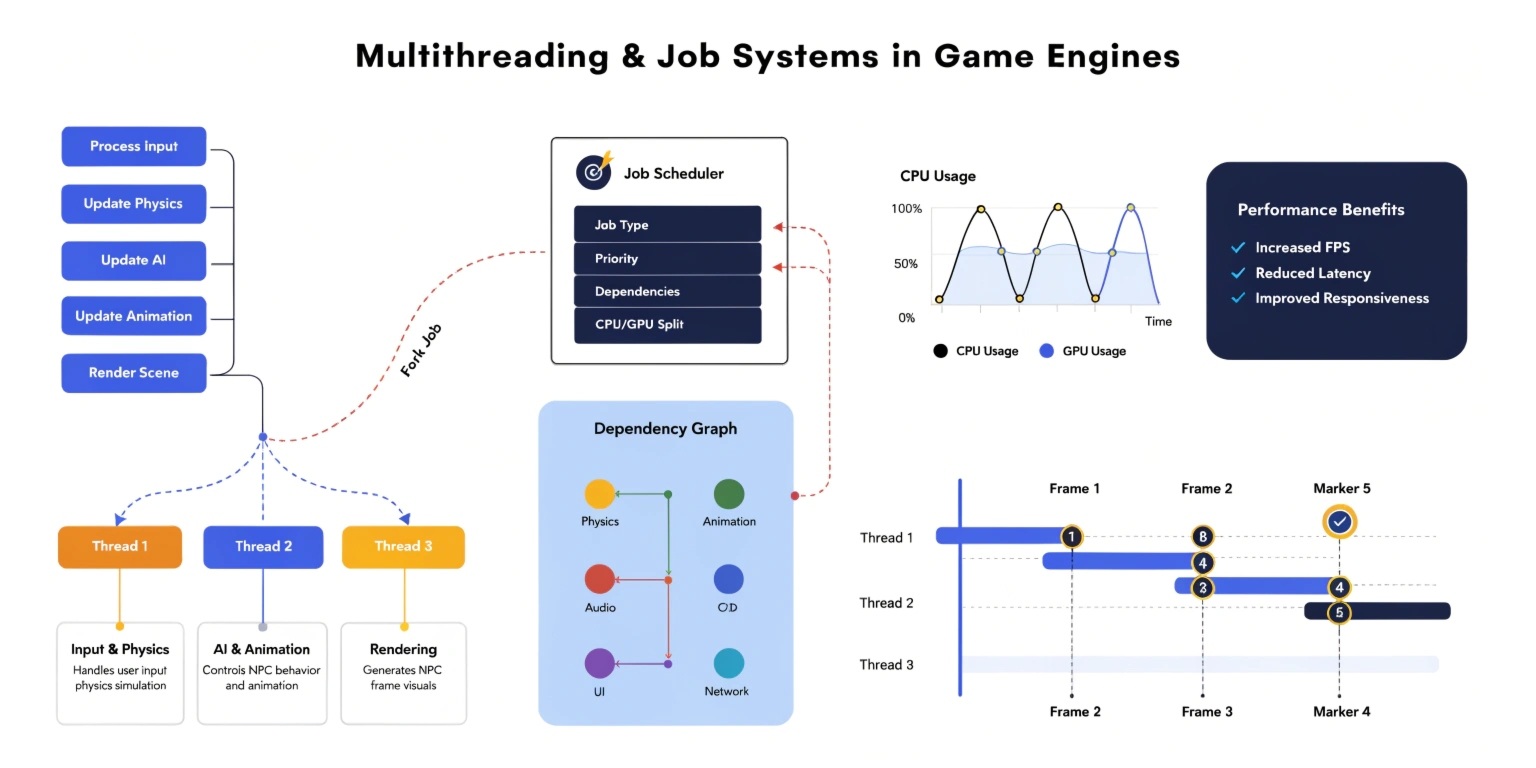
Modern games demand high performance, realistic physics, AI, and seamless rendering—all running in real time. To achieve this, game engines rely heavily on multithreading and job systems.
Let’s understand how these systems work and why they are essential for game development.
1. What is Multithreading in Game Engines?
Multithreading allows a program to execute multiple tasks simultaneously using multiple CPU cores.
Instead of running everything on a single thread (sequential execution), tasks are divided across threads.
Example:
In a game:
- One thread handles rendering
- Another handles physics
- Another handles AI
This improves performance and responsiveness.
2. Why Single-Threading is Not Enough
Earlier games used single-threaded architectures, but modern games require:
- Complex physics calculations
- Advanced AI systems
- Real-time rendering
- Large open worlds
A single thread becomes a bottleneck, causing:
- Frame drops
- Lag
- Poor user experience
3. What is a Job System?
A job system is a higher-level abstraction over multithreading.
Instead of manually managing threads, developers create small tasks called jobs, and the system distributes them across available CPU cores.
👉 Think of it like:
- Multithreading = workers
- Job system = task manager assigning work efficiently
4. How Job Systems Work (Step-by-Step)
Step 1: Break Tasks into Jobs
Large tasks are divided into smaller independent units.
Example:
- Physics simulation → multiple object calculations
- Animation → per-character updates
Step 2: Job Queue Creation
All jobs are placed into a queue.
Step 3: Worker Threads Execute Jobs
Available CPU threads pick jobs from the queue and execute them in parallel.
Step 4: Synchronization
Once jobs are completed, results are combined safely.
5. Real-World Example in Games
Imagine a battlefield game with 100 characters:
Without job system:
- Each character processed sequentially → slow
With job system:
- Each character processed as a separate job → parallel execution
👉 Result: smoother gameplay and higher FPS.
6. Multithreading vs Job Systems
FeatureMultithreadingJob SystemLevelLow-levelHigh-levelComplexityHighLower (managed)Task ManagementManualAutomaticScalabilityLimitedHighly scalable
7. Use Cases in Game Engines
1. Rendering Pipeline
Parallel processing of draw calls and shaders.
2. Physics Simulation
Collision detection and rigid body calculations run in parallel.
3. AI Processing
Multiple NPC behaviors computed simultaneously.
4. Animation Systems
Character animations updated across threads.
8. Popular Game Engines Using Job Systems
1. Unity
- Uses C# Job System + Burst Compiler
- Efficient for ECS (Entity Component System)
2. Unreal Engine
- Uses Task Graph System
- Handles async tasks and threading internally
3. Godot Engine
- Supports multithreading with scripting and engine-level optimizations
9. Challenges in Multithreading
1. Race Conditions
Two threads accessing the same data can cause errors.
2. Deadlocks
Threads waiting on each other indefinitely.
3. Synchronization Overhead
Too much coordination can reduce performance.
4. Debugging Complexity
Multithreaded bugs are harder to detect.
10. Best Practices
1. Use Job Systems Instead of Raw Threads
Reduces complexity and improves scalability.
2. Avoid Shared State
Minimize data sharing between threads.
3. Use Thread-Safe Structures
Prevent race conditions.
4. Profile Performance
Use tools to identify bottlenecks.
11. Future of Game Performance
With increasing CPU core counts, job systems are becoming essential. Combined with technologies like ECS and GPU parallelism, they enable:
- Massive open worlds
- Realistic simulations
- High frame rates
Conclusion
Multithreading and job systems are the backbone of modern game engines. While multithreading provides the power of parallel execution, job systems make it manageable and scalable.
Understanding these concepts is crucial for building high-performance games that run smoothly across platforms.