As mobile applications grow larger, managing code becomes increasingly difficult. Many beginner developers initially build apps where UI code, data handling, and business logic are written in the same file. The app may work for small projects, but once features increase, the code becomes messy, difficult to test, and hard to maintain.
To solve this problem, software engineers introduced architectural patterns. Among them, MVVM (Model-View-ViewModel) has become the industry standard for modern Android and iOS mobile applications.
Today, most production apps — including banking, e-commerce, and social media platforms — rely on MVVM to manage complex features efficiently.
The Problem with Traditional MVC
Earlier mobile apps followed MVC (Model-View-Controller) architecture. In theory, MVC separates data, UI, and logic. However, in mobile development, especially Android, Activities and ViewControllers handled too many responsibilities.
They:
- Fetched API data
- Stored database values
- Managed UI rendering
- Handled user input
This created a situation called Massive View Controller (or Massive Activity). As the app grew, files became thousands of lines long, making debugging extremely difficult.
What is MVVM?
MVVM stands for:
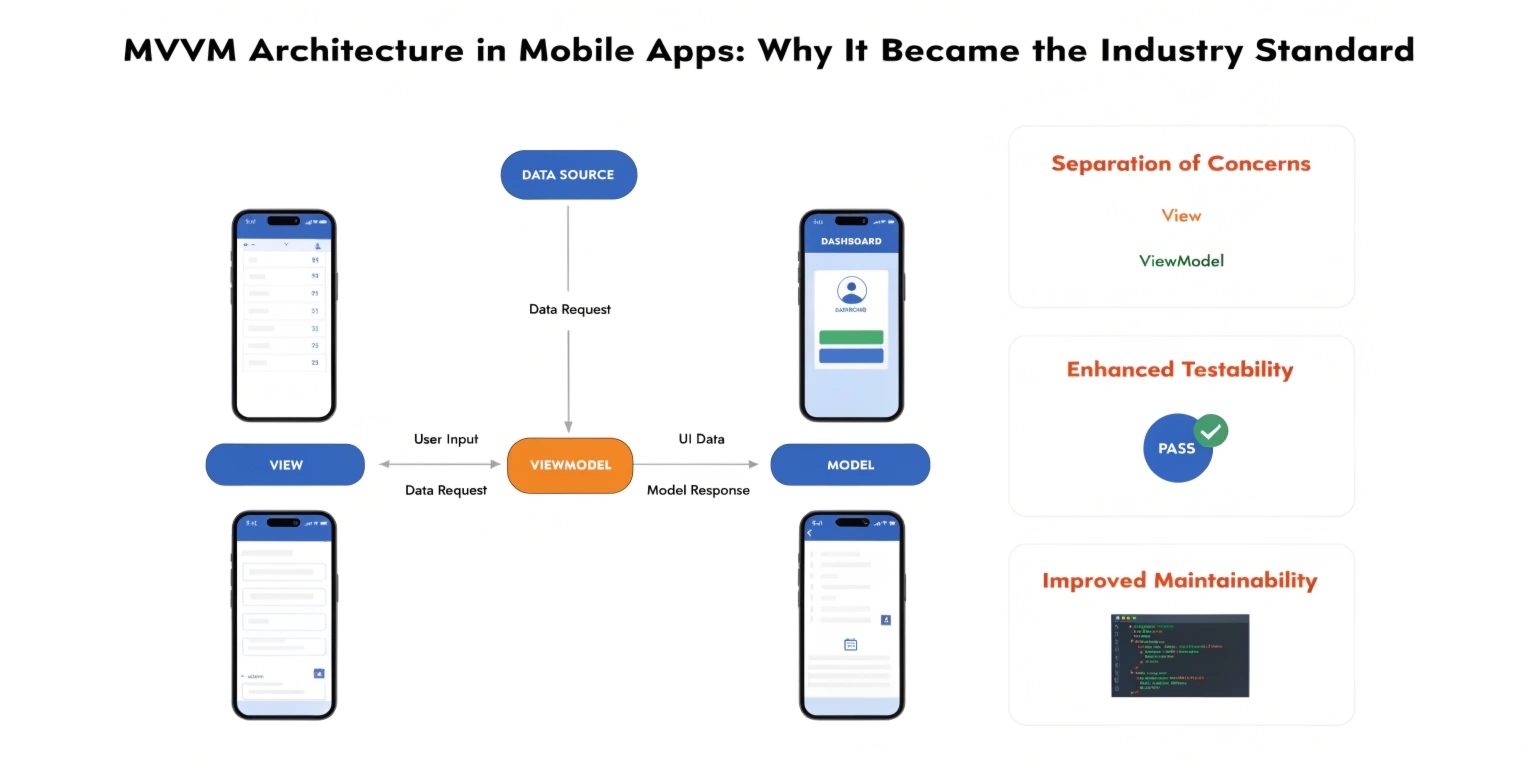
- Model → Data layer (API, database, repository)
- View → UI (Activity, Fragment, SwiftUI View, XML layout)
- ViewModel → Connects Model and View
The ViewModel acts as a bridge. The View does not directly communicate with the Model. Instead, it observes the ViewModel.
This separation is the key reason MVVM became popular.
Components of MVVM
1. Model
The Model handles data sources:
- API responses
- Database storage
- Business rules
It does not know anything about the UI.
2. View
The View displays data to the user. It only:
- Shows information
- Sends user actions (clicks, inputs)
The View never processes business logic.
3. ViewModel
The ViewModel prepares data for the UI. It:
- Requests data from the repository
- Processes and formats data
- Exposes observable state
The View observes the ViewModel and automatically updates.
How Data Flows in MVVM
- User opens the product screen
- View asks ViewModel for data
- ViewModel calls Repository/API
- Data returns to ViewModel
- ViewModel updates observable state
- UI updates automatically
No direct UI-API connection exists. This makes the code organized and predictable.
Real App Example
Consider a shopping app product list screen.
Without MVVM:
The Activity directly calls the API and updates RecyclerView.
With MVVM:
- Activity observes product data
- ViewModel fetches products
- Repository calls Retrofit API
- UI updates automatically when data changes
This approach allows developers to change the API without touching the UI code.
Why Companies Prefer MVVM
1. Separation of Concerns
UI and business logic remain independent. Designers can modify UI without affecting backend logic.
2. Easy Testing
ViewModel can be unit-tested without launching the app or emulator.
3. Lifecycle Awareness
ViewModels survive configuration changes like screen rotation.
4. Scalability
Large teams can work simultaneously on UI and data layers.
5. Maintainability
Future developers can understand and modify the project easily.
MVVM vs MVC vs MVP
ArchitectureProblemMVCControllers become very largeMVPToo many interfaces and boilerplateMVVMBalanced and lifecycle-aware
MVVM provides structure without excessive complexity.
Modern Tools Supporting MVVM
Android:
- ViewModel
- LiveData
- StateFlow
- Data Binding
- Jetpack Compose
iOS:
- SwiftUI
- Combine framework
- Observable objects
These tools automatically update UI when data changes, making MVVM even more powerful.
MVVM and Reactive UI
Modern apps require real-time updates:
- Chat messages
- Notifications
- Live tracking
- Stock prices
MVVM works well with reactive programming. The UI observes state changes rather than manually refreshing screens.
MVVM and Clean Architecture
MVVM is often combined with Clean Architecture:
- Presentation Layer → View + ViewModel
- Domain Layer → Use Cases
- Data Layer → Repository + API + Database
This makes enterprise applications scalable and production-ready.
Conclusion
MVVM architecture has become the industry standard because it solves real development problems: messy code, poor testing, and maintenance difficulty. By separating UI from business logic, MVVM creates organized, scalable, and testable applications.
Modern mobile development focuses not only on making apps work but making them maintainable for years. For this reason, companies strongly prefer developers who understand MVVM and structured architecture patterns.
For any developer aiming to build professional mobile applications, learning MVVM is not optional — it is a fundamental skill required for production-level development.