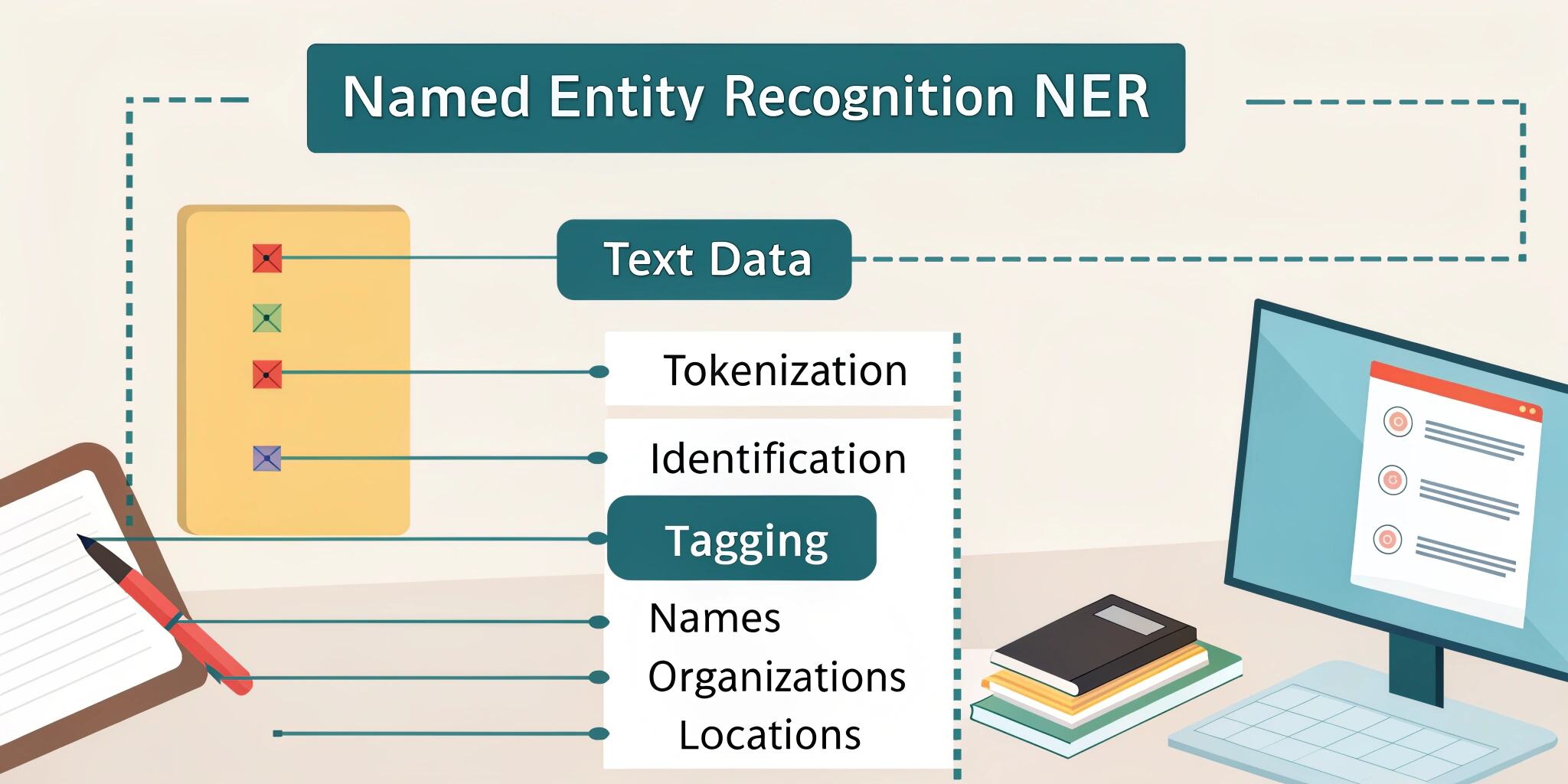
Text data surrounds us—emails, documents, social media, and more. Making sense of this unstructured data requires Natural Language Processing (NLP). One of the most widely used NLP techniques is Named Entity Recognition (NER), which identifies and classifies key entities like people, locations, organizations, and dates.
What is Named Entity Recognition (NER)?
NER is a subtask of NLP that extracts and categorizes important elements from text.
Examples:
- “Google was founded in 1998 in California.”
- Entities: Google (Organization), 1998 (Date), California (Location)
NER helps transform unstructured text into structured, machine-readable information.
Types of Entities Recognized in NER
- Person Names – e.g., Elon Musk, Barack Obama
- Organizations – e.g., Google, United Nations
- Locations – e.g., Paris, New York
- Dates & Time – e.g., January 1, 2025, 5 PM
- Monetary Values – e.g., $500, €1M
- Percentages – e.g., 25% growth
- Miscellaneous Entities – product names, events, nationalities, etc.
How NER Works
NER typically involves:
- Tokenization – Breaking text into words/tokens.
- Part-of-Speech Tagging – Assigning grammatical roles.
- Entity Recognition Algorithms – Detecting and classifying entities using:
- Rule-Based Systems (manual patterns and dictionaries)
- Statistical Models (e.g., Hidden Markov Models, CRFs)
- Deep Learning Models (BiLSTM, Transformers like BERT)
Applications of NER
- Information Retrieval – Search engines use NER to deliver context-aware results.
- Customer Support – Chatbots extract entities (e.g., order numbers, product names).
- Healthcare – Identifying patient details, diseases, and medications from clinical notes.
- Finance – Extracting company names, stock tickers, and monetary values from news.
- Security & Compliance – Identifying sensitive data (PII) in documents.
Challenges in NER
- Ambiguity: “Apple” (company vs. fruit).
- Context Sensitivity: Same word may mean different things in different contexts.
- Multilingual Data: Entity recognition across languages is complex.
- Domain-Specific Entities: Medical or legal jargon may require custom NER models.
Best Practices for NER
- Use pretrained models (like spaCy, Hugging Face Transformers) as a baseline.
- Fine-tune models on domain-specific datasets.
- Regularly update entity dictionaries to adapt to evolving language.
- Apply human-in-the-loop validation for high-stakes applications.
Conclusion
Named Entity Recognition is a cornerstone of NLP, enabling machines to extract structured insights from unstructured text. By leveraging NER, businesses can enhance search engines, improve chatbots, analyze customer feedback, and automate document processing—all while making AI more intelligent and context-aware.