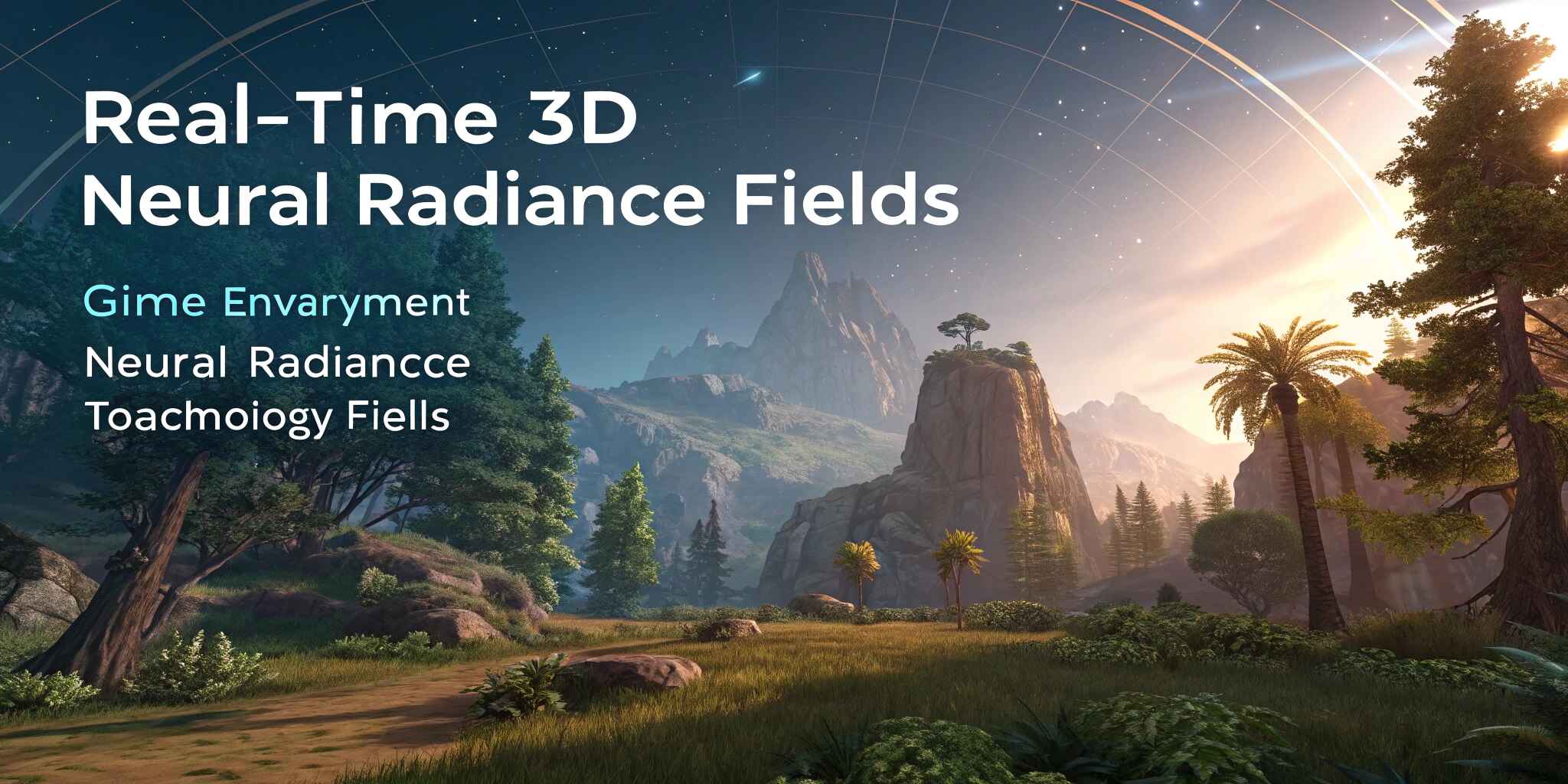
Neural Radiance Fields (NeRFs) are rapidly emerging as one of the most transformative technologies in 3D graphics, especially in the gaming industry. Designed to reconstruct photorealistic scenes from a handful of images, NeRFs use machine learning to capture light behavior, geometry, and texture as a continuous volumetric function. Unlike traditional 3D modeling pipelines, which rely on polygons, UVs, and manual texture creation, NeRFs provide a new paradigm where a neural network becomes the scene itself. This shift represents a major evolution in how developers create, render, and optimize environments in real time.
At the core of NeRF technology is the concept of implicit neural representation. Instead of storing geometry as meshes, NeRFs encode spatial information inside a neural network that predicts density and color at any 3D coordinate. When rendered, rays are marched through the virtual space, querying the network to calculate how light interacts with the environment. The result is an astonishingly realistic reconstruction of complex scenes—captured with soft shadows, global illumination, and fine texture detail. This makes NeRFs particularly valuable for photorealistic game environments and immersive simulation experiences.
For game developers, one of the biggest advantages of NeRFs is their ability to drastically reduce the time and effort needed to create high-quality environments. Traditionally, producing realistic worlds demands a large team of artists to model assets, sculpt high-resolution details, bake textures, generate lighting maps, and polish materials. With NeRFs, developers can capture real-world locations using a camera or drone and automatically convert them into explorable 3D spaces. This workflow empowers small teams to achieve AAA-quality visuals without the cost and complexity of traditional asset pipelines.
However, the biggest challenge surrounding NeRF adoption has always been performance. Early NeRF models were slow, requiring minutes or hours to render a single frame. But advancements such as Instant-NGP (Instant Neural Graphics Primitives) from NVIDIA have dramatically accelerated the process. These modern techniques leverage multi-resolution hash grids, GPU-optimized pipelines, and advanced sampling to enable near real-time performance. As a result, NeRFs are now becoming viable for interactive applications, including VR, AR, and game engines.
In addition to scene reconstruction, NeRFs have the potential to revolutionize game lighting and reflections. Because NeRFs inherently model how light travels inside a space, they create natural, high-quality global illumination without expensive baking or precomputation. This offers a dynamic lighting solution that is more flexible and more realistic than traditional techniques. Developers could theoretically use NeRFs to maintain consistent illumination across large worlds, reducing workload and enabling rapid iteration.
Another significant use case is hybrid rendering. Many studios are experimenting with combining NeRFs with traditional meshes and materials to form hybrid environments. For example, static background elements—like mountains, buildings, or forests—can be represented with NeRFs, while interactive objects use conventional geometry. This approach optimizes performance while preserving photorealistic detail where it matters most.
Despite rapid progress, NeRF-based workflows still face challenges. Integration into existing engines such as Unreal or Unity is improving, but standards are still evolving. Real-time performance, though dramatically better, still requires specialized GPU hardware. Editing NeRF scenes—such as moving objects or modifying textures—remains complex because the environment is encoded inside a neural network rather than a traditional scene graph.
Looking ahead, the future of NeRFs in gaming is extremely promising. As hardware acceleration improves and neural rendering techniques mature, NeRFs are expected to become a standard component of next-generation game engines. Developers will gain access to tools that blend real-time photorealism and AI-driven asset creation, enabling entirely new workflows for environment design. Combined with procedural generation, machine learning–based animation, and advanced simulation systems, NeRFs will help shape a new era of game development where realism, automation, and creativity merge seamlessly.