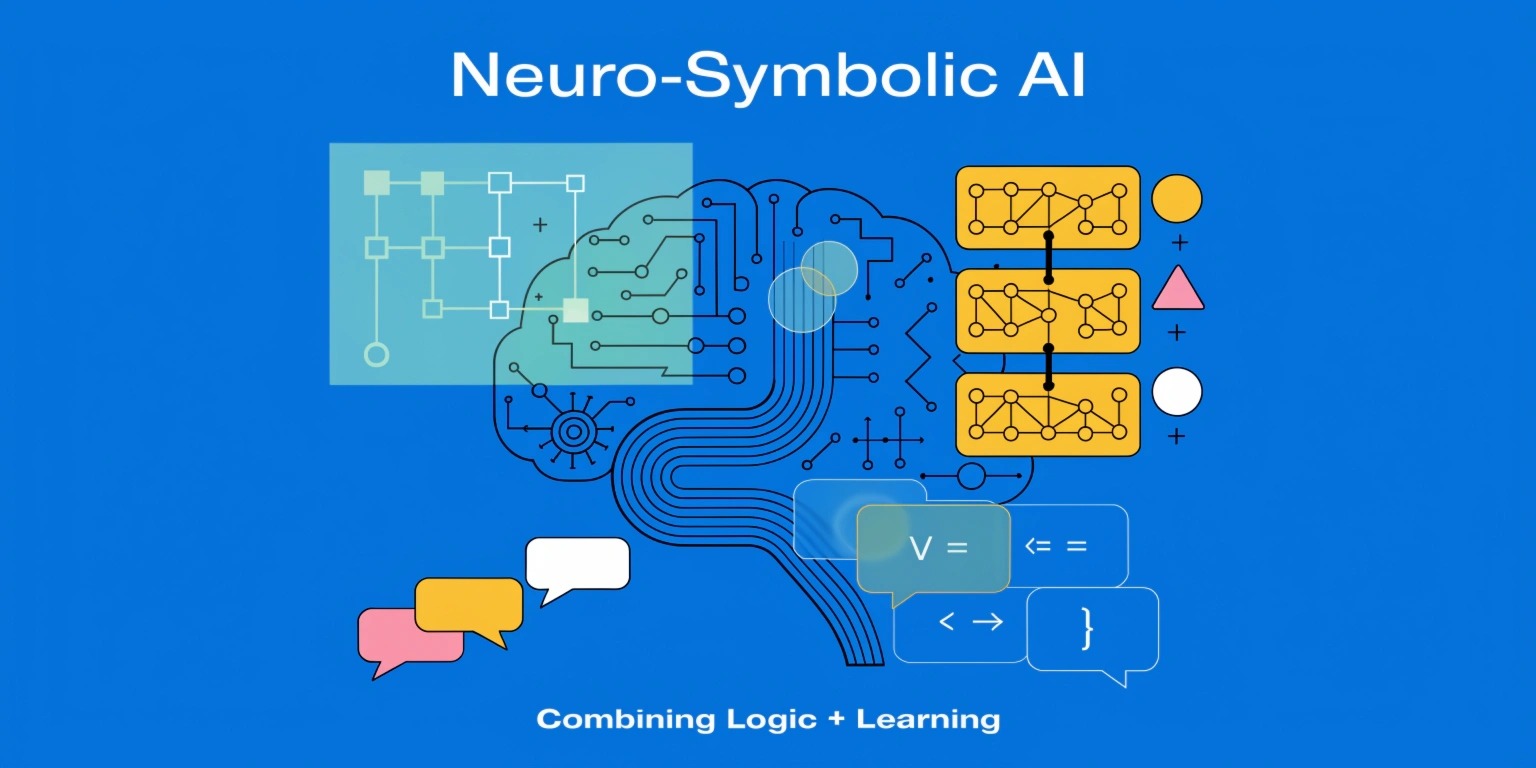
Artificial intelligence has made remarkable progress through deep learning. Neural networks can recognize images, understand language, generate content, detect patterns, and make predictions from enormous amounts of data.
However, modern neural networks also face important limitations.
They can struggle with explicit reasoning, logical constraints, knowledge representation, compositional reasoning, and explaining why a particular decision was made.
This has renewed interest in combining two different approaches to artificial intelligence:
Learning from data + reasoning with knowledge.
This is the foundation of Neuro-Symbolic AI.
Neuro-Symbolic AI combines neural networks with symbolic methods to create hybrid systems that can learn patterns while also applying rules, relationships, constraints, and logical reasoning.
What Is Neuro-Symbolic AI?
Neuro-Symbolic AI combines two major AI paradigms.
Neural AI
Neural networks are highly effective at learning patterns from unstructured data.
They can process:
- Images
- Audio
- Video
- Text
- Sensor data
- User behavior
For example, a neural network can analyze an image and recognize that it contains a car.
Symbolic AI
Symbolic AI represents knowledge using explicit structures such as:
- Rules
- Logic
- Facts
- Ontologies
- Knowledge graphs
- Relationships
A symbolic system could reason:
All electric vehicles require electrical energy.
Vehicle X is electric.
Therefore, Vehicle X requires electrical energy.
The symbolic system is not simply recognizing a statistical pattern. It is applying an explicit logical relationship.
Why Combine Logic and Learning?
Neural networks are excellent at perception and statistical learning.
Symbolic systems are powerful at structured reasoning.
Each approach has limitations when used independently.
A purely neural system may recognize patterns but struggle with precise logical constraints.
A purely symbolic system can reason over explicit rules but usually requires humans to define much of its knowledge and has difficulty learning directly from raw data.
Neuro-Symbolic AI attempts to combine their strengths.
The simplified architecture is:
Raw Data
↓
Neural Network
↓
Learned Representation
↓
Symbolic Reasoning
↓
Inference
↓
Decision
This creates a system capable of both learning and reasoning.
Neural Networks for Perception
Neural models can transform complex real-world information into structured representations.
For example, consider an autonomous system observing a road.
The neural component may identify:
- Vehicles
- Pedestrians
- Traffic signals
- Road markings
- Obstacles
The symbolic component can then reason over these detected entities.
For example:
Pedestrian detected
+
Pedestrian is crossing
+
Vehicle is approaching
=
Reduce vehicle speed
The neural network handles perception while symbolic reasoning applies structured rules.
Symbolic Reasoning and Knowledge Representation
A major advantage of symbolic AI is explicit knowledge representation.
Knowledge can be represented using:
Entity → Relationship → Entity
For example:
Paris → located_in → France
France → located_in → Europe
A knowledge graph can store millions of such relationships.
A reasoning engine can then derive additional information from them.
This makes symbolic components particularly useful when relationships and rules are important.
Knowledge Graphs in Neuro-Symbolic AI
Knowledge graphs can serve as a bridge between learned representations and structured reasoning.
For example, an enterprise AI system could connect:
- Customers
- Products
- Employees
- Documents
- Transactions
- Policies
A neural language model might extract information from documents.
The extracted information can then be represented in a knowledge graph.
A reasoning engine can use that structured knowledge to answer questions or validate decisions.
This combination can be more powerful than relying exclusively on text generation.
Neuro-Symbolic AI for Explainability
Explainability is an important challenge in AI.
A traditional neural network may produce a prediction without providing an intuitive explanation.
A hybrid system can potentially provide a reasoning path.
For example:
Input
↓
Detected Conditions
↓
Applied Rule
↓
Derived Conclusion
↓
Final Decision
This structure can make decisions easier to inspect.
Explainability is especially valuable in domains where decisions require human review and accountability.
Applications in Healthcare
Neuro-Symbolic AI can potentially support healthcare applications by combining medical data analysis with explicit clinical knowledge.
A neural model could identify patterns in medical images or patient information.
A symbolic reasoning layer could apply:
- Medical rules
- Treatment constraints
- Drug interactions
- Clinical guidelines
- Patient-specific conditions
The resulting system can provide both predictions and structured reasoning.
Such systems should complement qualified professionals rather than independently making high-stakes decisions.
Applications in Finance
Financial applications involve large amounts of structured and unstructured information.
Neuro-Symbolic systems can combine machine learning with rules for:
- Fraud detection
- Risk analysis
- Compliance
- Transaction monitoring
- Financial classification
For example, a neural model could identify suspicious transaction patterns while a symbolic layer applies predefined compliance rules.
This hybrid approach can improve the relationship between statistical detection and explicit policy requirements.
Applications in Robotics
Robots need both perception and reasoning.
A robot may use neural networks to recognize objects and symbolic reasoning to determine how those objects relate to its goals.
For example:
Neural Vision
↓
Object Recognition
↓
Symbolic World Model
↓
Planning
↓
Robot Action
This can help robots operate in environments where perception alone is insufficient.
Applications in Natural Language Processing
Large language models are powerful at understanding and generating natural language, but they can still produce logically inconsistent outputs.
Neuro-Symbolic approaches can introduce structured reasoning mechanisms.
For example, an AI assistant could combine:
- Language understanding
- Knowledge retrieval
- Logical constraints
- Rule evaluation
- Structured inference
This can help applications distinguish between generating plausible language and producing conclusions that satisfy explicit constraints.
AI Planning
Planning is another area where symbolic reasoning can be highly valuable.
Suppose an AI system needs to organize a sequence of tasks.
A neural network may learn patterns about user preferences.
A symbolic planner can then ensure that the final plan follows constraints.
For example:
Task A must happen before Task B.
Task C requires Resource X.
Resource X is unavailable until Task A completes.
The reasoning engine can enforce these relationships.
Training Neuro-Symbolic Systems
There are multiple approaches to building Neuro-Symbolic AI.
Neural-to-Symbolic
A neural network converts raw information into symbolic representations.
Symbolic-to-Neural
Symbolic rules or knowledge are incorporated into neural learning.
Joint Learning
Neural and symbolic components are optimized together.
Neural Guidance with Symbolic Verification
A neural model generates a candidate solution while symbolic reasoning verifies whether it satisfies required constraints.
Each architecture has different advantages depending on the application.
Benefits of Neuro-Symbolic AI
A well-designed Neuro-Symbolic system can provide:
- Better reasoning
- Improved interpretability
- Greater data efficiency in some tasks
- Explicit constraint handling
- Knowledge integration
- Better generalization in certain reasoning problems
- More controllable AI behavior
The combination can be particularly valuable when both pattern recognition and structured decision-making are required.
Challenges
Neuro-Symbolic AI is not without difficulties.
Important challenges include:
- Designing interfaces between neural and symbolic components
- Representing uncertain information
- Scaling symbolic reasoning
- Maintaining knowledge bases
- Integrating learned representations with formal logic
- Managing computational complexity
- Training hybrid architectures
- Handling contradictory knowledge
Building these systems often requires expertise in both machine learning and formal reasoning.
Neuro-Symbolic AI vs Traditional AI
Traditional deep-learning systems primarily learn relationships from data.
Traditional symbolic systems rely heavily on explicitly encoded knowledge.
Neuro-Symbolic AI combines these approaches.
Traditional Neural AI
Data → Learning → Prediction
Traditional Symbolic AI
Rules + Knowledge → Reasoning → Conclusion
Neuro-Symbolic AI
Data + Knowledge → Learning + Reasoning → Decision
This does not mean that every AI system should become Neuro-Symbolic.
The architecture should be selected according to the problem.
Improving AI Reliability
One promising role for symbolic components is constraint enforcement.
For example, a generative AI system may generate several possible outputs.
A symbolic layer can verify whether each output satisfies predefined requirements.
AI Generation
↓
Candidate Output
↓
Rule Validation
↓
Valid / Invalid
This creates an additional control layer around generative systems.
Future of Neuro-Symbolic AI
As AI systems become increasingly integrated into business-critical applications, the demand for reliable reasoning and controllability is likely to increase.
Future architectures may combine:
- Large language models
- Knowledge graphs
- Neural perception
- Formal logic
- Retrieval systems
- Planning engines
- Constraint solvers
- Agentic workflows
Instead of relying on a single model to perform every task, AI systems may increasingly operate as coordinated architectures where different components handle different types of intelligence.
Building a Neuro-Symbolic AI System
Organizations interested in adopting this approach can start with a focused problem.
Step 1: Identify the Learning Component
Determine what information must be learned from data.
Step 2: Identify Explicit Rules
Define constraints and relationships that should be represented symbolically.
Step 3: Build a Knowledge Layer
Use structured databases, ontologies, or knowledge graphs where appropriate.
Step 4: Connect Neural and Symbolic Components
Create a reliable interface for transferring representations and decisions.
Step 5: Add Verification
Use symbolic reasoning to validate important outputs.
Step 6: Measure Results
Evaluate accuracy, reasoning quality, explainability, latency, and maintenance requirements.
This gradual approach can help organizations determine whether Neuro-Symbolic architecture provides meaningful value.
Conclusion
Neuro-Symbolic AI represents an important direction in artificial intelligence because it combines two complementary capabilities: learning from data and reasoning with structured knowledge.
Neural networks provide powerful perception and pattern recognition, while symbolic systems contribute explicit rules, relationships, constraints, and logical inference.
This combination can be valuable in areas such as healthcare, finance, robotics, enterprise knowledge systems, natural language processing, planning, and AI agents.
The future of AI may not depend on choosing between neural and symbolic intelligence. Instead, increasingly sophisticated systems may combine both.
As AI applications become more complex and more deeply integrated into real-world workflows, the ability to learn, reason, verify, and explain decisions will become increasingly important. Neuro-Symbolic AI offers a promising architectural approach for achieving that combination.