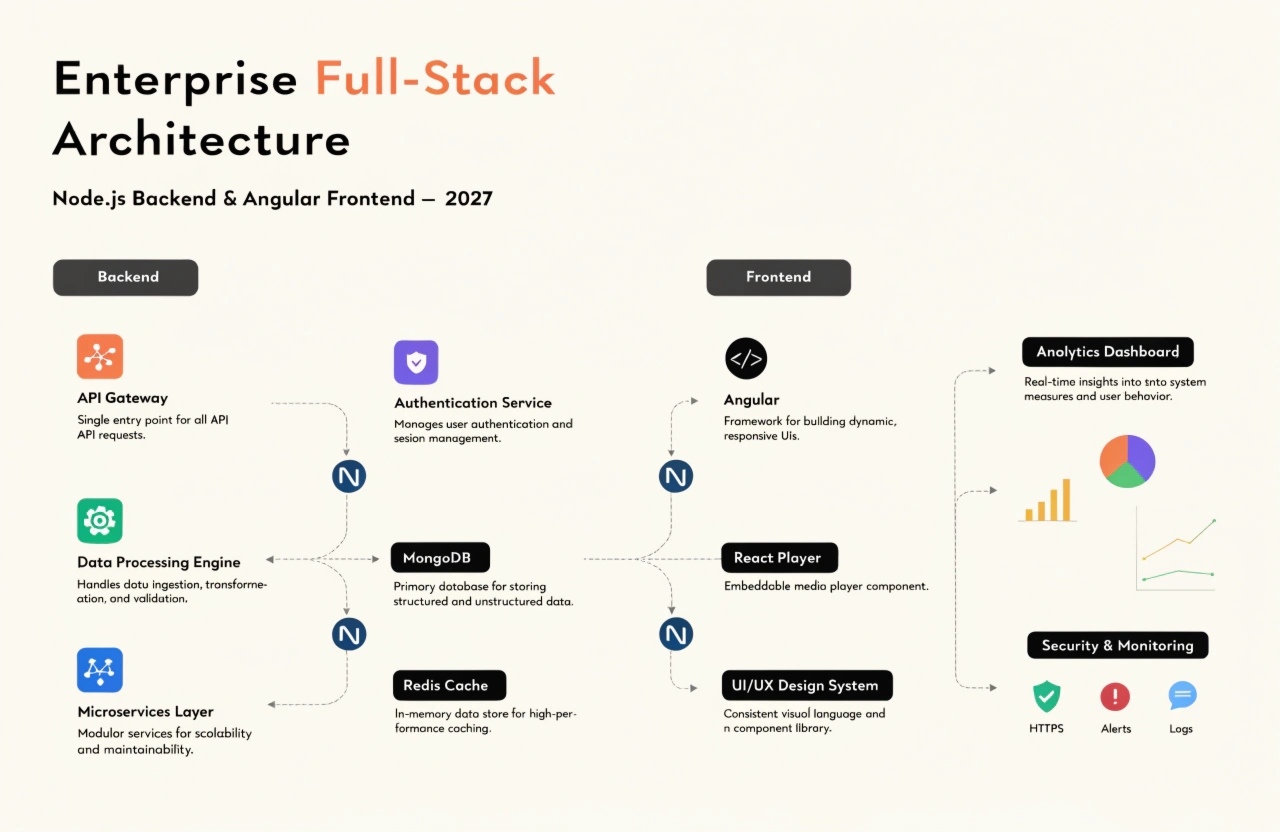
Node.js Backend + Angular Frontend: The Enterprise Full-Stack Architecture for 2027
Enterprise applications are becoming more complex, connected, and demanding. Businesses need software that can support thousands of users, integrate with multiple systems, process data efficiently, and remain maintainable as requirements evolve. In 2027, choosing the right full-stack technology combination will be critical for organizations building long-term digital platforms.
One architecture that continues to stand out is Node.js for the backend combined with Angular for the frontend.
Both technologies are built around JavaScript and TypeScript, creating a consistent development environment across the application stack. Node.js provides a scalable runtime for APIs, business logic, integrations, and real-time services, while Angular provides a structured framework for developing sophisticated enterprise interfaces.
Why Node.js and Angular Work Well Together
One of the biggest advantages of combining Node.js and Angular is the use of TypeScript across the full stack.
Angular is built with TypeScript, while Node.js applications can also be developed using TypeScript. This allows development teams to share common programming concepts, types, interfaces, validation models, and development practices.
A typical enterprise architecture can look like:
Angular Frontend → API Gateway → Node.js Services → Database / External Services
The Angular application handles user interfaces and client-side interactions. The Node.js backend manages authentication, business logic, APIs, integrations, and data processing.
This separation creates a clean architecture where frontend and backend teams can work independently while communicating through well-defined APIs.
Node.js as the Enterprise Backend
Node.js is particularly effective for applications that handle many concurrent connections and I/O-intensive workloads.
It can power:
- REST APIs
- GraphQL APIs
- Authentication services
- Payment integrations
- Real-time notifications
- Chat applications
- Data processing services
- Microservices
- Third-party integrations
- Cloud-native applications
Node.js's asynchronous, event-driven model makes it suitable for applications where the server frequently communicates with databases, APIs, queues, or external services.
For enterprise environments, Node.js can also be organized into modular services rather than creating one large backend application.
Angular for Enterprise Frontend Development
Angular provides a structured approach to frontend development that is particularly useful for large applications.
Enterprise software often contains dashboards, administration panels, reporting systems, customer portals, workflows, and complex forms. Managing these features with an unstructured frontend can become difficult as the application grows.
Angular provides features such as:
- Component-based architecture
- Dependency injection
- Routing
- Forms
- HTTP services
- State-management integration
- TypeScript support
- Lazy loading
- Testing capabilities
- Enterprise application patterns
Angular's opinionated structure can help development teams maintain consistency across large projects.
Microservices and Modular Architecture
For large enterprise systems, a Node.js and Angular architecture can evolve into a microservices-based ecosystem.
Instead of having one backend responsible for everything, individual services can handle specific business capabilities.
For example:
Angular → API Gateway → Authentication Service → Customer Service → Order Service → Payment Service → Notification Service
Each service can have its own responsibilities and deployment lifecycle.
This approach can improve scalability and allow organizations to update individual services without redeploying the entire backend.
However, microservices should not automatically be chosen for every application. For smaller enterprise projects, a well-designed modular monolith may be easier to develop, test, deploy, and maintain.
Security Should Be Built Into the Architecture
Enterprise applications cannot treat security as an afterthought.
A Node.js and Angular application should implement security across multiple layers.
Important practices include:
- Secure authentication
- Role-based access control
- OAuth 2.0 or OpenID Connect where appropriate
- Input validation
- API authorization
- Secure HTTP headers
- Rate limiting
- Encryption
- Dependency management
- Audit logging
- Secure secret management
Angular can protect frontend routes and manage authentication states, but authorization must ultimately be enforced by the backend. Client-side restrictions should never be considered sufficient security.
Performance and Scalability in 2027
Enterprise applications need to remain responsive as traffic and data volumes increase.
Node.js performance can be improved through caching, asynchronous processing, database optimization, connection pooling, queues, and horizontal scaling.
On the Angular side, performance strategies can include lazy-loaded features, optimized rendering, efficient state management, code splitting, and reducing unnecessary network requests.
Cloud infrastructure also makes it possible to scale services according to demand.
Cloud-Native Deployment
The Node.js + Angular combination fits naturally into modern cloud environments.
A production architecture could use:
Angular → CDN → API Gateway → Node.js Services → Database + Cache + Message Queue
Applications can be packaged using containers and deployed through modern CI/CD pipelines. Monitoring, logging, automated testing, and infrastructure automation can further improve reliability.
Organizations can also separate frontend and backend deployments, allowing teams to release UI changes without necessarily redeploying backend services.
Why This Architecture Matters for 2027
The enterprise software landscape is moving toward scalable APIs, cloud-native infrastructure, AI integrations, real-time experiences, and modular systems.
Node.js and Angular provide a strong foundation for these requirements.
Node.js can connect enterprise applications with AI services, databases, cloud platforms, third-party APIs, and event-driven systems. Angular can provide sophisticated interfaces for dashboards, analytics, AI-powered workflows, and business applications.
The combination also makes it easier for organizations to build teams around a common TypeScript ecosystem.
Conclusion
Node.js backend + Angular frontend is a compelling full-stack architecture for enterprise applications in 2027.
Node.js offers scalable backend development, API capabilities, real-time communication, microservices support, and cloud compatibility. Angular provides a structured frontend framework designed to manage complex applications and large development teams.
The most important factor, however, is not simply choosing two popular technologies. Successful enterprise architecture depends on proper API design, security, testing, database architecture, observability, deployment automation, and scalability planning.
For organizations looking to build reliable, maintainable, and cloud-ready enterprise applications, Node.js and Angular can provide a strong foundation for the next generation of digital products.